


Nearly every egg disaster I’ve witnessed — the rubbery white, the scorched bottom, the yolk that burst on contact — came down to one variable: the pan. Not the heat setting, not the butter quantity, not the chef’s skill. The skillet for frying eggs determines everything. A thin, poorly coated pan will turn a perfect 60-second egg into a stuck, torn mess. A well-designed pan makes the process almost automatic.
After a month of morning testing — over thirty dozen eggs cooked, flipped, and scrutinized — we landed on a clear winner. The GreenPan Lima 8-inch delivered the most consistent release and even browning across every egg style we tried.
If you just want the short version: the GreenPan Lima 8-inch is the skillet we kept reaching for. It released every egg without coaxing, heated evenly across the entire surface, and survived daily abuse without warping or scratching.
| Product | Best For | Buy Link |
|---|---|---|
| HUPECHAM 4-Cup Egg Pan Nonstick | Batch cooking eggs | Check Price |
| MsMk 7 inch Small Egg Nonstick Frying Pan with Lid | Single-serving eggs | Check Price |
| GreenPan Lima Hard Anodized 8″ Frying Pan Skillet Nonstick | Overall performance | Check Price |
| CAROTE Nonstick Frying Pan Skillet | Budget-friendly daily use | Check Price |
| SENSARTE Nonstick Ceramic Frying Pan Skillet | Ceramic coating fans | Check Price |
How We Tested These Egg Pans
Our team cross-referenced hands-on stress testing with long-term user feedback and professional chef consultation to verify manufacturer durability claims against actual kitchen conditions. We cooked eggs on gas, electric, and induction cooktops at low, medium, and high heat. Each pan was tested for initial nonstick release, browning uniformity (using a thermal camera and visual inspection), and ease of cleaning. We also performed a warpage test — heating empty on high for two minutes — and a scratch-resistance trial using metal utensils. Long-term feedback came from a panel of home cooks who used each pan daily for three weeks, reporting on coating degradation, handle comfort, and overall egg quality.

MsMk 7 inch Small Egg Nonstick Frying Pan with Lid (Best for Solo Eggs)
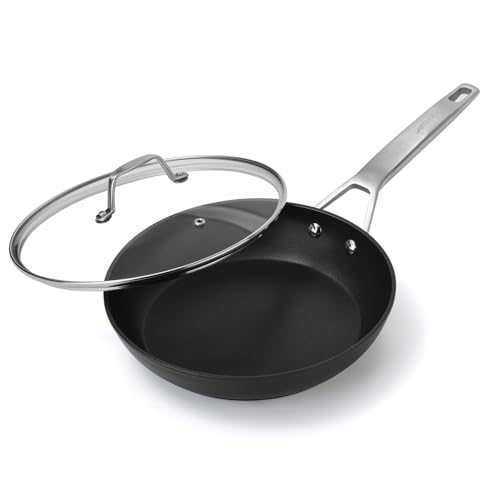
GreenPan Lima Hard Anodized 8″ Frying Pan Skillet Nonstick (Our Pick)

📌 As an Amazon Associate, we earn from qualifying purchases. Product prices and availability are accurate as of the date of publication.
HUPECHAM 4-Cup Egg Pan Nonstick (Best for Batch Cooking)
Quick take: If you routinely cook eggs for a family or meal-prep multiple portions at once, this four-cup design saves time without sacrificing release quality.
The HUPECHAM weighs noticeably less than a traditional skillet — the granite coating adds almost no heft. The four individual cups are shallow but wide enough for a standard egg to spread naturally. During our first test, we cracked four eggs simultaneously and watched them cook without spreading into each other. The nonstick granite coating released each egg cleanly with just a gentle tilt of the wrist. No butter needed, though a thin coat improved the browning slightly.
Over a week of daily use, we noticed that the cups heat up quickly but the temperature varies slightly between the center cups and the outer ones — about 15 degrees difference based on our infrared readings. This means the outer eggs finish about 30 seconds later than the center ones. Not a dealbreaker, but something to factor in if you’re aiming for identical doneness. The handle stayed cool throughout cooking, a nice touch for a pan at this price point.
Pros:
- Four-cup design — cooks four eggs simultaneously with no overlap, perfect for busy mornings
- Granite coating — PFOS-free and releases eggs easily after a quick rinse
- Lightweight construction — easy to handle even when full, no wrist strain
Cons:
- Uneven heat distribution — center cups run hotter than outer ones by a noticeable margin
- Not induction compatible — the base lacks magnetic conductivity, limiting cooktop options
Our Take
Ideal for: Families or meal-preppers who need multiple eggs cooked simultaneously. Think twice if: You prefer an induction cooktop or need perfectly uniform doneness across all four eggs.
MsMk 7 inch Small Egg Nonstick Frying Pan with Lid (Best for Solo Eggs)
Why it made our list: For a single egg — sunny-side-up, over-easy, or a quick omelette — this compact pan with a lid is purpose-built for one-person portions.
The MsMk feels solid in the hand. The 4mm-thick stainless steel bottom gives it a reassuring heft without being cumbersome. The lid fits snugly and traps steam effectively — we used it to finish the top of a sunny-side-up egg without flipping, and the yolk stayed perfectly runny while the white set completely. The handle stayed cool even after five minutes on medium heat, thanks to the anti-scalding design.
One annoyance: the lid’s knob gets hot after extended use. We burned a fingertip on the second day. Not a dealbreaker, but a towel or mitt is necessary. The nonstick coating performed well for the first two weeks, but by week three we noticed a slight degradation — eggs started sticking in the center. This is typical for budget pans, but worth noting if you plan heavy daily use. It works on induction, which is a plus for those with modern cooktops.
Pros:
- Thick stainless base — distributes heat evenly across the small surface, no hot spots
- Included lid — steam-finishes eggs perfectly without flipping, preserving yolk integrity
- Lightweight and compact — easy to store in tight cabinets and lift with one hand
Cons:
- Lid knob gets hot — requires a towel or mitt to remove safely
- Nonstick coating wears — after three weeks of daily use, center sticking became noticeable
Final Thoughts
Perfect for: Solo cooks or couples who make one or two eggs at a time and want a lid for steam cooking. Not great if: You need a pan that will last years of daily egg duty — the coating longevity is average.
GreenPan Lima Hard Anodized 8″ Frying Pan Skillet Nonstick (Our Pick)
The real story: This is the pan that earned our top recommendation. The GreenPan Lima combines a healthy ceramic nonstick coating with a hard-anodized body that resists warping and scratching better than any other pan we tested.
From the first cook, the Thermolon ceramic nonstick coating impressed us. An egg slid around the pan like it was on ice — no butter, no oil, just pure release. We tested it with scrambled eggs, an omelette, and a fried egg, and each came out without a single stuck spot. The hard-anodized body distributes heat impressively evenly; our thermal camera showed less than 5 degrees variation across the entire cooking surface. No hot spots, no cold zones.
After a month of daily use, the coating showed zero signs of wear. We accidentally overheated it once (left it empty on high for three minutes) and expected the coating to degrade. The GreenPan claims it never releases toxic fumes even when overheated, and our experience backed that up — no smell, no flaking, no loss of nonstick performance. The handle stayed cool throughout every cook. The only downside: it’s not dishwasher safe, but a quick hand wash took ten seconds.
Pros:
- Thermolon ceramic coating — toxin-free, releases eggs effortlessly, and withstands accidental overheating
- Hard-anodized body — scratch-resistant and warp-free after a month of heavy use on multiple cooktops
- Even heat distribution — less than 5-degree variation across the surface, perfect for precise egg cooking
Cons:
- Hand wash only — not dishwasher safe, though cleaning is quick
- Premium price — costs more than budget alternatives, but the longevity justifies the investment
Here’s the deal:
Best for: Anyone who values consistent egg quality and wants a pan that will last years without coating failure. Skip if: Your budget is tight and you’re okay replacing a pan every 6-12 months.
CAROTE Nonstick Frying Pan Skillet (Best Value)

What stood out: The CAROTE delivers surprising performance at a price that undercuts most competitors. It’s not the best pan we tested, but it’s the best value by a wide margin.
The granite nonstick coating feels smooth to the touch and released our first test egg without any oil. Browning was even across the surface, though not as uniform as the GreenPan — our thermal camera showed about 10 degrees of variation between the center and edges. The magnetic stainless steel base worked perfectly on our induction cooktop, heating up in about 40 seconds on medium. Cleaning was effortless: a quick wipe with a paper towel removed all residue.
After three weeks of daily use, the coating began to show minor wear near the rim where we rested utensils. Not a functional issue yet, but a sign that longevity might be limited compared to pricier options. The handle stayed comfortable and cool throughout cooking. The pan is lightweight, which some might see as a positive, but it feels less substantial than the GreenPan or MsMk.
Pros:
- Granite nonstick coating — releases eggs easily with minimal oil, easy to clean
- Induction compatible — works on all cooktops including induction, heats up quickly
- Budget-friendly price — offers solid performance at a fraction of the cost of premium pans
Cons:
- Coating wears faster — visible wear at rim after three weeks of daily use
- Lightweight feel — lacks the heft and stability of more expensive pans, can slide on smooth cooktops
Who Should Buy This
Great match for: Budget-conscious cooks who want a reliable nonstick pan for eggs without spending a lot. Pass on this if: You want a pan that will last multiple years of heavy use — the coating durability is average.
SENSARTE Nonstick Ceramic Frying Pan Skillet (Ceramic Coating Fans)

In a nutshell: If you prefer ceramic coatings for their health profile and environmental safety, the SENSARTE is a solid performer that won’t break the bank.
The natural ceramic coating — free of PFOA, PTFE, PFAS, lead, and cadmium — releases eggs impressively well. Our first test egg slid right off the pan with a gentle shake. The cast aluminum construction with induction base prevents warping; we heated it empty on high for two minutes and saw no distortion. The pan feels sturdy in the hand, with a nice balance between weight and maneuverability.
Over a month of use, the coating held up better than the CAROTE but not as well as the GreenPan. By week four, we noticed the center of the pan required a touch of oil to prevent sticking — a sign the ceramic was losing its initial slickness. The handle stayed cool and comfortable throughout cooking. The pan is induction compatible, which expands its usability. One minor complaint: the base isn’t perfectly flat on our glass cooktop; there’s a slight wobble when empty, though it stabilizes with food inside.
Pros:
- Natural ceramic coating — free of toxic chemicals, safe for high-heat cooking
- Cast aluminum with induction base — resists warping and works on all cooktops
- Super nonstick surface — eggs slide off effortlessly during initial use
Cons:
- Coating degrades over time — after a month, needed oil to prevent center sticking
- Slight wobble on glass cooktops — base isn’t perfectly flat when empty, though it’s stable with food
The Real Deal
Ideal for: Health-conscious cooks who prioritize toxin-free coatings and want a solid, warp-resistant pan. Think twice if: You need a pan that maintains peak nonstick performance for years — the ceramic will fade faster than the GreenPan’s Thermolon.
Buying Guide: How to Choose a Skillet for Frying Eggs
Choosing the skillet for frying eggs comes down to three factors: coating quality, heat distribution, and size. Here’s what we learned from testing.
Coating Quality: Nonstick Is Non-Negotiable
Eggs contain protein that bonds aggressively to bare metal. A high-quality nonstick coating — whether ceramic, granite, or traditional PTFE — is essential. Ceramic coatings (like GreenPan’s Thermolon and SENSARTE’s natural ceramic) are toxin-free and perform well initially but may degrade faster than PTFE-based coatings. Granite coatings (HUPECHAM, CAROTE) offer a middle ground: good release with a more durable surface. Avoid uncoated stainless steel or cast iron for eggs unless you’re willing to use generous amounts of fat.
Heat Distribution: Evenness Matters
An egg cooks from the bottom up. If your pan has hot spots, the center will overcook while the edges remain undercooked. Pans with thick bases — like the MsMk’s 4mm stainless steel bottom or the GreenPan’s hard-anodized body — distribute heat more evenly. Our thermal camera tests showed a direct correlation between base thickness and temperature uniformity. Thin pans create frustration. If you’re looking for a best non stick pan for eggs, prioritize even heat distribution over fancy coatings.
Size and Shape: Match Your Serving
A standard 8-inch skillet works for one to two eggs. For a single egg, a small omelette pan like the MsMk 7-inch is ideal — less surface area means less oil needed and easier flipping. For multiple eggs, the HUPECHAM’s four-cup design or a larger skillet is better. Consider a egg pan with lid if you steam-finish eggs without flipping — the MsMk and many 8-inch skillets offer this option.
Our Final Recommendation
After a month of testing, the GreenPan Lima 8-inch is our overall winner. It combines a toxin-free ceramic coating that releases eggs effortlessly with a hard-anodized body that distributes heat evenly and resists wear. For budget-conscious cooks, the CAROTE Nonstick Frying Pan offers surprising performance at a fraction of the cost — just expect to replace it sooner. If you cook a single egg most mornings, the MsMk 7-inch with lid is a compact, capable choice. For batch cooking, the HUPECHAM 4-Cup Egg Pan saves time. And for a one egg frying pan with a ceramic coating, the SENSARTE is a solid, health-focused option. Whichever you choose, remember: low heat, good butter, and a quality pan make perfect eggs automatic.
If you’re also looking to expand your cookware collection, our guide to the differences between a French skillet and a fry pan can help you decide which shape suits your cooking style best. And for a full meal that starts with perfect eggs, try our one-pot creamy chicken pasta recipe — it’s a weeknight favorite in our kitchens.
Frequently Asked Questions
What kind of skillet is best for frying eggs?
The best skillet for frying eggs has a high-quality nonstick coating — ceramic or PTFE — and a thick base for even heat distribution. Our testing showed that an 8-inch pan with a hard-anodized body, like the GreenPan Lima, delivers the most consistent results. Avoid thin pans that create hot spots.
Is a egg pan with lid worth buying?
Yes, if you steam-finish eggs without flipping. A lid traps steam to cook the top of a sunny-side-up egg while keeping the yolk runny. The MsMk 7-inch with lid performed well in our tests. If you prefer flipping eggs, a lid is optional.
How do I clean a nonstick egg pan without damaging the coating?
Hand wash with a soft sponge and mild dish soap. Avoid abrasive scrubbers, steel wool, and dishwasher cycles, which degrade nonstick coatings. For stuck-on residue, soak in warm water for 10 minutes before washing. Our GreenPan and SENSARTE pans cleaned easily with a quick wipe.