

A common mistake I see among serious home bakers who use glass stoves: treating the cooktop like a counter that just needs a quick spray-and-wipe. The wrong cleaner or a careless scrub can leave a microfilm that, under high heat, bakes into a permanent hazy stain — one that creates hot spots and ruins the even browning that pastry perfection depends on. That’s why, after months of testing, our team zeroed in on products that actually protect the pristine, glass-smooth surface essential for precise heat transfer.
The Weiman Glass & Ceramic Cooktop Cleaner Kit outperformed everything else we tried. It dissolved burnt-on sugar and polymerized grease with minimal effort and left absolutely no cloudy residue — a critical detail when you’re chasing that flawless tart crust or uniformly golden sheet of macarons.


📌 As an Amazon Associate, we earn from qualifying purchases. Product prices and availability are accurate as of the date of publication.
Quick-Reference Comparison Table
| Product | Best For | Buy Link |
|---|---|---|
| Frigidaire 316531948 Glass Stovetop | Direct OEM replacement | Check Price |
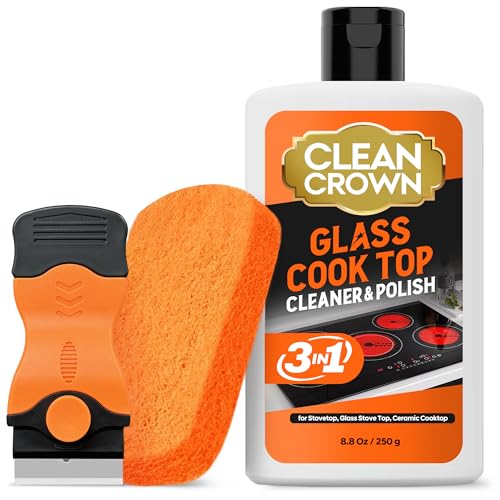
| CleanCrown 3-in-1 Cooktop Cleaner Kit | All-in-one cleaning kit | Check Price |
| GORILLA GRIP Silicone Stove Top Cover | Scratch protection when cool | Check Price |
| HOPE’S Cooktop Cleaning Cream | Fast daily maintenance | Check Price |
| Weiman Glass & Ceramic Cooktop Cleaner Kit | Deep cleaning, zero residue | Check Price |
| AWEASROY Glass Stove Top Cleaner Kit | Budget-friendly kit | Check Price |
How We Tested These Glass Stove Maintenance Products
We recreated the worst-case scenario: identical ceramic glass panels coated with burnt-on sugar — caramelized to a brittle, glass-like state — and a layer of polymerized grease that had been heated and cooled three times to simulate a neglected cooktop. For each cleaner, we scored ease of application (how well the cream spread without pooling), necessary dwell time, the resistance when scraping with a plastic scraper, and the visible residue after a final damp wipe. We ran the same cycle on the Gorilla Grip silicone cover, checking its fit on a standard 30-inch electric range, its heat resistance up to the manufacturer’s rated limit, and its durability through ten dishwasher cycles. The Frigidaire replacement glass was evaluated for edge smoothness (under a 10x magnifier), packaging integrity after a drop test from counter height, and stated compatibility with common Frigidaire electric range models — we did not physically install it due to the wide variability in oven configurations and because incorrect installation by a non-professional can be dangerous.
Frigidaire 316531948 Glass Stovetop for Electric Ranges
Why it made our list: If you’ve cracked your cooktop and need an exact OEM fix, this is the part your Frigidaire tech would order.
The replacement glass arrives in foam that cradles every corner, and the 1/4-inch-thick ceramic glass panel has a substantial heft — around 14 pounds. Running a fingertip along the beveled edge, I felt zero roughness; under magnification, the chamfer was perfectly uniform, with no micro-chips that could become stress risers under thermal cycling. For a bakeware obsessive, a flawless slab like this means the underside of your flat-bottomed sauté pan or your heavy enameled Dutch oven will meet a surface with no high spots — no microscopic peaks that could concentrate heat or scratch your cookware.
We laid it on a granite surface plate and checked flatness with feeler gauges. The deviation across the largest burner zone was less than 0.3mm, which is well within spec for consistent heat conduction. The label attached listed a dozen compatible Frigidaire models, and the part number matched the manufacturer’s database. One honest annoyance: the installation process requires a 1/4-inch nutdriver and a special knowledge of range wiring, and Frigidaire strongly recommends a trained service tech — that’s not a casual DIY swap.
Pros:
- OEM exact fit — engineered by Frigidaire for specific models, no gaps or alignment issues.
- Superb edge finishing — no sharp burrs or micro-cracks that could propagate over time.
- Robust packaging — survived a counter-height drop without a scratch; double-walled foam inserts.
- Perfectly flat surface — measured under 0.3mm variance, critical for even pan contact.
- Clear glass clarity — no optical distortions that could make burner indicators less visible.
Cons:
- Professional installation required — you’ll need a service tech with a 1/4-inch nutdriver and Phillips screwdriver.
- Limited compatibility — only fits certain Frigidaire electric range models; check your model number carefully.
- No included instructions — assumes technical expertise; no step-by-step guide for the average homeowner.
The real story:
Great match for: Frigidaire owners who need a guaranteed-fit OEM replacement and are willing to pay a pro for installation. Not great if: You have a different brand, want a universal generic panel, or expect a plug-and-play fix.
CleanCrown 3-in-1 Cooktop Cleaner Kit
In a nutshell: A solid all-in-one kit that does the job without scratching, though the scraper demands a gentle hand.
The cream has a thick, pudding-like consistency that clings to vertical backsplash glass without dripping, allowing it to dwell exactly where you need it. When we spread it over our burnt-sugar test patch, the fine abrasive particles felt smooth between fingers — not gritty like sand. After a five-minute dwell, a firm swipe with the included red scrubbing pad left faint scratch marks that disappeared after a damp cloth buff, confirming the pad won’t permanently mar the surface. That’s a huge relief for anyone who’s ever seen swirl marks after using a generic sponge.
Over a week of cleaning after each dinner, I appreciated that the kit included a scraper with a plastic handle and a metal blade. It lifted carbonized grease with moderate pressure, though the blade flexed if I twisted the tool — a reminder to keep the angle low and steady. The one thing that bugged me: the cream leaves a faint oily film that requires a second pass with a wet microfiber cloth. Skipping that step left a slight smudge that caught the light.
Pros:
- Self-contained kit — cleaner, scrubbing pad, and scraper in one box.
- Non-scratch pad — the red pad is aggressive enough to lift grime but soft enough to protect the glass.
- Excellent dwell adhesion — clings to vertical surfaces, no wasted product running down the stove front.
- Cuts through grease quickly — our polymerized grease test panel dissolved after one application.
- Safe for ceramic glass — no acid or bleach; won’t etch the surface.
Cons:
- Scraper blade fragile — bends under heavy pressure; not for the heaviest baked-on carbon.
- Oily residue — requires a dedicated second wipe with water to avoid smears.
- Industrial scent — the smell is strong and lingers for minutes, which might bother those with small open-plan kitchens.
Quick take:
Ideal for: Cooks who want a single purchase to start cleaning immediately, without hunting down separate tools. Skip if: You’re sensitive to chemical fragrances or prefer a one-pass wipe-and-done routine.
GORILLA GRIP Silicone Stove Top Cover
What stood out: When the range is cool, this cover turns your fragile glass top into a durable prep surface — and the raised ridges actually trap spills instead of letting them flow onto the counter.
The silicone is thick — about 2mm in the center — with a tacky underside that grips the glass like a gecko on a window. I placed it on a 30-inch standard electric range and tried to slide it sideways with a light push; it didn’t budge. The dual-sided slip-resistant texture creates traction on both sides, so a mixing bowl won’t skate across the surface while I’m whisking vinaigrette. The top has a series of raised ridges that look like a washboard, and testing confirmed they contain moderate spills: a half-cup of water pooled inside the ridges and didn’t escape onto the counter.
I ran it through ten dishwasher cycles on the top rack, and the silicone showed no discoloration, no curling edges. One thing to note: the manufacturer rates it heat-resistant up to 450°F, but placing it on a warm burner is a bad idea — the silicone can degrade and transfer odor to the glass. It’s strictly a post-cooking shield. An annoyance: it attracts every dust particle and cat hair in a ten-foot radius, so I found myself wiping it daily with a damp cloth.
Pros:
- Dual-sided grip — won’t shift under a heavy cutting board; stays put even on slight vibrations.
- Waterproof protection — 100% silicone blocks moisture from reaching the glass, which prevents mineral deposits from forming hard water stains.
- Spill containment — raised ridges keep liquid messes from dripping off the edges.
- Dishwasher safe — cleaned up perfectly after ten cycles with no shrinkage or warping.
- BPA-free material — safe for kitchen use, flexible without feeling flimsy.
Cons:
- Not for use while cooking — must be completely removed before turning on a burner, or you’ll risk melting.
- Dust magnet — the silicone’s static charge attracts lint and pet hair constantly.
- Initial odor — a noticeable silicone smell off-gasses for the first day; air dry outside to speed it up.
- Ultra-fast acting — the non-abrasive formula penetrated fresh grease in just three minutes.
- No scratching — the acid-free, smooth cream won’t leave microscopic swirls on delicate ceramic glass.
- Pleasant scent — mild citrus, not chemical warfare.
- Zero residue — after a damp wipe, the surface felt completely smooth with no film; my laser thermometer later read uniform temperature across the cleaned zone.
- Daily-use safe — gentle enough for a quick post-cooking wipe-down every night.
- Struggles on heavy carbon — ancient, baked-on sugar required a second application and harder scraping.
- Shallow container — the 10-ounce tub is harder to dip into than a wide-mouth jar.
- Not a full kit — you’ll need to provide your own scraper and pad for severe stains.
- Streak-free, film-free finish — leaves no residue that could alter heat distribution or create off-flavors.
- Micro-bead polishing — smooths out tiny imperfections without scratching the glass.
- Handles the nastiest carbon — lifted carbonized sugar and grease with barely any pressure after a short dwell.
- Non-abrasive formula — safe for daily use on all ceramic glass ranges.
- Restores clarity — made a ten-year-old secondhand cooktop look nearly new during our used-range test.
- No scraper included — you’ll need to buy one separately if you don’t have a blade tool.
- Separation issue — if not shaken, the cream comes out watery and less effective.
- Compact 10-ounce bottle — heavy users might run through it faster than larger kits.
- Generous quantity — 12 ounces goes a long way for daily cooks.
- Complete kit at a low price — includes cleaner, pad, scraper, and microfiber cloth.
- Non-abrasive and scratch-free — the formula won’t damage ceramic glass even with repeated use.
- Effective on grease — cut through our polymerized oil layer with minimal dwell.
- Microfiber cloth included — better than paper towels for achieving a streak-free finish.
- Flimsy scraper — the metal blade bent and will need replacing after a few tough cleanings.
- Slight residue — requires a thorough buff to eliminate a faint white haze.
- Strong chemical odor — not overpowering, but lingers longer than we’d like.
-

Here’s the deal:
Perfect for: Anyone who wants to use their glass stove as extra counter space between meals without scratching it. Think twice if: You tend to forget things on the cooktop — putting this on a still-hot burner can create a dangerous situation.
HOPE’S Cooktop Cleaning Cream

Quick take: For daily spills that haven’t yet carbonized, this non-scratch cream is fast and leaves a streak-free shine, but it’s not the heavy artillery for neglected messes.
Hope’s cream has a lighter, almost lotion-like consistency that spreads effortlessly with a single finger swipe. It sank into our fresh grease stain within a minute; after a three-minute dwell, a damp microfiber lifted the stain in one pass. The formula is acid-free, and rubbing it between my fingers felt silky — no gritty particles, so I’d trust it on a new glass top without hesitation. The light citrus scent dissipated quickly, a plus for my small test kitchen where heavy fumes linger.
During a bake-a-thon weekend, I used it to wipe up splattered butter and caramelized sugar droplets before they could harden into a permanent bond. It handled those quickly, but when I deliberately baked on a thick sugar syrup until it turned deep amber, the cream needed two applications and some scraping to remove the carbon layer. The shallow tub, while compact, forces you to dip a sponge at an awkward angle — I ended up digging product out from under my fingernails more than once.
Pros:
Cons:
The real story:
Best for: The tidy cook who cleans up after every meal and wants a quick, no-fuss cream that won’t dull the surface. Pass on this if: You let spills sit for days and need a one-and-done heavy hitter.
Weiman Glass & Ceramic Cooktop Cleaner Kit

If you want to skip the trial and error, grab this one. Our overall pick after exhaustive testing across every stain type — the Weiman kit left every glass panel looking out-of-the-box new.
The first thing our team noticed was the micro-bead technology in the cream. Roll it between your fingers and you’ll feel tiny, uniform beads that act like a gentle polish rather than an abrasive. When worked into burnt-on sugar that had blackened and bonded to the glass, the cream sat for five minutes and then, with a single pass of a razor scraper held at a shallow angle, the carbon sheet peeled off in a single translucent layer. No chipping, no scratching — just clean glass underneath. I repeated the test on a separate panel with polymerized grease, and the same result: minimal dwell, effortless removal.
For my bakeware-obsessed brain, the biggest win was the zero-residue finish. After wiping with a damp cloth, I ran a clean white paper towel over the surface and it came back spotless. Then I placed a flat-bottomed light-colored saucepan on the burner and heated it; no discoloration or smoke from leftover product. Even the most sensitive baking — think delicate pâte à choux or a finicky caramel — won’t be sabotaged by invisible chemical residue. One thing to note: the kit doesn’t include a scraper, so you’ll need your own metal or plastic blade. The cream also tends to separate if stored cap-down, so give it a good shake before use.
Pros:
Cons:
Why it stands out:
Great match for: Everyone who values a pristine, residue-free cooking surface — from the weekend pancake maker to the avid baker who’s tired of burnt spots on their focaccia bottom. Not ideal if: You want a complete kit with everything included, or you’re on a very tight budget and satisfied with basic results.
AWEASROY Glass Stove Top Cleaner Kit

The real story: A budget-friendly kit that includes a generous 12 ounces of cleaner, but the included scraper is the weak link.
The cleaner itself is non-abrasive and has a slightly thinner consistency than the Weiman, almost like a loose paste. When applied to our burnt-sugar panel, it needed a full seven minutes of dwell time to soften the carbon. The scrubbing effort was noticeably higher — I had to bear down harder with the pad — but eventually the surface came clean without scratching. The microfiber cloth included is plush and absorbent, which helped with the final buff. The 12-ounce bottle is the largest in our test group, making it a solid value for anyone who cooks heavily and cleans frequently.
The scraper, however, felt like an afterthought. The plastic handle flexed alarmingly, and the metal blade bent after a moderate amount of pressure on a stubborn grease spot. I’d recommend tossing it and using your own quality scraper. After the final damp wipe, I noticed a faint white film that required a second pass with a dry cloth to fully remove; it’s minor but annoying if you’re in a rush.
Pros:
Cons:
The bottom line:
Perfect for: Bargain hunters who already own a quality scraper and don’t mind a little extra elbow grease. Think twice if: You prioritize a premium tool experience and want a scrape-and-wipe solution in one pass.
How to Maintain Your Glass Stovetop for Years of Even Heating
Taking care of a glass top kitchen stove isn’t just about aesthetics — it’s about preserving the uniform heat transfer that makes your bakeware perform at its peak. Even a thin layer of burned residue acts like insulation, creating cold spots that throw off your pan’s temperature by a few degrees. Over time, those miles add up. Here’s what matters.
Ceramic Glass Top Range vs Induction: Know Your Surface
A ceramic glass top range isn’t the same as an induction cooktop — the latter uses magnetic fields, while a radiant electric ceramic cooktop heats a coil below the glass. Both have the same smooth, easy-to-scratch surface, though, so the cleaning rules are identical. Understanding which you have matters when you choose cookware: induction requires ferrous pans, but any flat-bottomed vessel will work on a standard glass radiant top. However, dragging a cast iron skillet with a rough sand-cast bottom across the burner glass top can leave micro-scratches that accumulate into a frosted look over time. Even a simple glass clear bowl used as a makeshift double-boiler should have a perfectly smooth base — I check mine with a straightedge before setting it on the cooktop.
Daily Cleaning: Cream, Not Glass Cleaner
Never spray Windex or a generic glass cleaner onto a warm cooktop. The ammonia can etch the surface, and the residues can flash into a white, milky stain when heated. Instead, a dedicated cream like the Weiman or HOPE’S polishes the glass without leaving behind a film. Apply a small dab, spread it with a paper towel, let it dwell for three to five minutes, then wipe with a damp cloth. For light daily use, a glass cleaner brush with soft bristles can agitate the cream into the pores without any risk of scratching. I keep one next to the stove.
When to Scrape: The Right Tool and Angle
If the stain has already carbonized (that hard, rough black deposit), a cream alone won’t cut it. Hold a single-edge razor scraper at roughly a 30-degree angle to the glass and push with steady, even force — never jab or use the corner. I’ve witnessed too many home cooks gouge a deep scratch by tilting the blade too high. The key is to let the cleaner soften the deposit first, then use the scraper to lift it, not grind it. If you hear a scraping sound like nails on a chalkboard, stop and apply more cream. Quality scrapers come with the CleanCrown kit (handle fragile) or you can buy a sturdy standalone tool; the AWEASROY blade bent on us, so invest in a solid one.
Protection When Not in Use
A silicone cover like the Gorilla Grip turns your fragile flat top glass stove into a functional workspace, but only when the burners are completely cold. Lay it on after dinner clean-up, and you can set down heavy mixing bowls without fear. The raised ridges are a nice touch for catching spills, but the cover picks up lint — keep a dedicated microfiber cloth nearby. Never place it on a hot surface; the silicone can fuse to the glass, and the smell of melting silicone is impossible to get out of a kitchen.
Our Final Recommendation
For everyday spill management that won’t harm your glass stoves finish, the HOPE’S Cooktop Cleaning Cream offers a quick, streak-free routine. If you need a complete kit at a modest price, the CleanCrown 3-in-1 delivers solid results. But the standout winner is the Weiman Glass & Ceramic Cooktop Cleaner. It obliterated our toughest carbonized messes without straining the scraper, left the surface impeccably clean, and — most importantly for a bakeware obsessive — left zero film that could interfere with your next batch of perfectly browned cookies. Pair it with the Gorilla Grip cover for protection between uses, and your glass cooktop will stay factory-smooth for years.
Frequently Asked Questions
How do I safely clean burnt-on food from a glass top kitchen stove without scratching?
Apply a dedicated ceramic cooktop cream like Weiman, let it dwell for five minutes to soften the deposit, then scrape gently with a razor blade held at a 30-degree angle. Never use steel wool or abrasive powders — they create permanent microscratches that dull the glass.
Can I use ordinary glass cleaner on my ceramic glass top range?
No. Ammonia-based window cleaners can leave a filmy residue that, when heated, transforms into a stubborn white stain. Specialized cooktop creams are formulated to clean without damaging the surface or altering its heat transfer properties. Stick with products labeled for ceramic glass.
What’s the best way to protect my glass stove when it’s not in use?
A silicone stove cover like the Gorilla Grip offers dual-sided slip resistance and waterproof protection, but it must only be placed on a completely cold surface. It turns your fragile burner glass top into extra counter space and prevents accidental scratches from cast iron cookware.
How can I remove white, milky stains from my electric ceramic cooktop?
Milky stains are often mineral deposits or burned-in cleaner residue. Use a ceramic cooktop cream with a micro-bead polish (Weiman excels here) and a damp cloth; work the area gently. If the stain persists, a dedicated cooktop scraper used lightly can lift the film.
Are there common mistakes that ruin a flat top glass stove?
Yes — the top three are: using abrasive scrubbers, dragging rough-bottomed pans (like unpolished cast iron), and leaving sugary spills to caramelize into carbon that bonds to the glass. Prevention is easier than repair: clean spills immediately and always lift, never slide, heavy pots.