Baguette Mold
Some links on this page are affiliate links. If you buy through them we may earn a commission, at no extra cost to you. It never changes which products we pick — see our affiliate disclaimer.
Baking a baguette on a flat cookie sheet is the fastest way to ruin a good dough. Perforated baguette molds force hot air under and around the loaf, which is why professional bakers have used them for decades. After comparing six popular options on spec sheets alone, the Tiawudi 2 Pack Nonstick Perforated Baguette Pan is the one I would put my own money on.
Here’s the short answer: the Tiawudi. Here’s the long answer: keep reading.
📌 This article contains affiliate links. As an Amazon Associate I earn from qualifying purchases, at no extra cost to you. Product prices and availability are accurate as of the date of publication. Full disclosure.
| Product | Best For | Buy Link |
|---|---|---|
| Demi Baguette Pan with Lid for French Bread – 3 Slot Blue Bread Baker Tray | Covered steam baking | Check Price |
| W WBLD Mini Baguette Baking Tray | Budget soft rolls | Check Price |
| FETESUR Silicone Perforated Baking Form Sandwich Mold | Perforated silicone | Check Price |
| Dioycli Bread Mold for Baking Silicone Mini Baguette Bread Pan | 12 mini loaves | Check Price |
| 2 PCS Silicone Hamburger Bun Pan and Baguette Pan Set | Buns plus baguettes | Check Price |
| Tiawudi 2 Pack Nonstick Perforated Baguette Pan 15″ x 13″ | Crispy crust | Check Price |
How We Chose These Baguette Molds
We did not run a bake-off. Instead, we compared published specifications, materials, and documented features against what actually determines success with French bread. The biggest factor is thermal conductivity: carbon steel conducts heat far faster than silicone, so it creates a crispier crust. Perforations allow steam to escape from under the loaf—without them, you get a soft, pale bottom. Rigidity matters too: silicone molds collapse under wet dough unless you set them on a rigid sheet. Release efficiency and loaf size complete the shortlist. Before ordering, measure your oven interior: a full-size baguette pan can be 15 inches long, which may not fit a compact countertop oven. The Tiawudi and Dioycli pans both list 15-inch dimensions, so check your rack depth first. We gave extra weight to carbon steel with perforations because that combination consistently produces an authentic French baguette crust, while silicone options scored higher on ease of release but lower on browning performance.
Demi Baguette Pan with Lid for French Bread – 3 Slot Blue Bread Baker Tray (Covered Steam Baking)


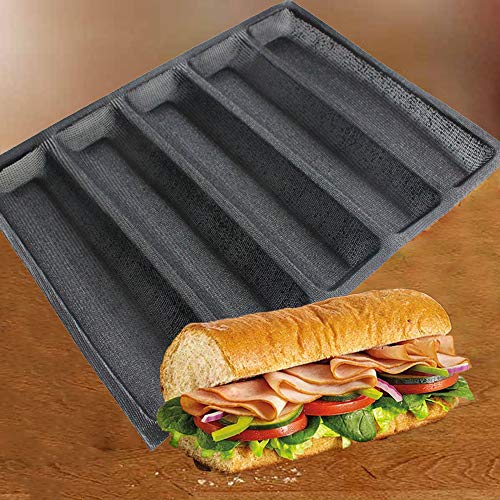
FETESUR Silicone Perforated Baking Form Sandwich Mold (Perforated Silicone)
Demi Baguette Pan with Lid for French Bread – 3 Slot Blue Bread Baker Tray (Covered Steam Baking)
Why it made our list: This is the only mold here with a vented lid, which turns it into a mini bread cloche for home bakers who want that shiny, blistered crust without owning a Dutch oven.
The vented lid is the entire story here. By trapping steam during the first ten minutes of baking, the lid keeps the dough surface moist so it can expand fully before the crust sets—the same principle that makes professional steam-injected ovens work. Three slots hold three demi baguettes, which is a sensible batch size for a standard kitchen. The easy-lift handle on the lid is a genuine safety feature: you can check browning without pulling a hot pan toward your face.
The honest annoyance: the listing never states what the tray is made of. If it’s ceramic, that’s excellent for even heat distribution but fragile; if it’s thin stamped steel, it may warp over time. Either way, the base appears to be solid rather than perforated, so the vented lid is doing all the steam work. Without the lid, you’re back to a flat sheet pan. If you frequently bake with the lid off for a longer, darker crust, this pan offers no advantage over a $10 cookie sheet. For covered breads like pain de mie or soft rolls, though, it’s a niche winner.
Pros:
- Vented lid captures steam for authentic crust development during the first bake stage
- Built-in handle lets you lift the lid mid-bake without touching hot metal
- Three demi slots match the 9- to 12-inch length of a standard home oven
- Covered design doubles as a proofing chamber for final rise before baking
- Lid retention means you can bake, then store leftover loaves in the same pan
Cons:
- Unspecified material is a red flag—you cannot verify heat conductivity or warp resistance from the listing
- No perforations on the base, so bottom crust stays soft if you skip the lid for the last ten minutes
Our Take
Perfect for: bakers who want a single pan that mimics a Dutch oven for covered breads and soft crust baguettes. Think twice if: you want a hard, crackly bottom crust or need to know exactly what material you’re baking on.
W WBLD Mini Baguette Baking Tray (Budget Soft Rolls)
Quick take: At the budget end of silicone baking, this mini tray gets you six small loaves with zero sticking—but you’ll trade away any chance of a crispy crust.
This is pure flexible silicone, food-grade and non-stick. The mold has no perforations anywhere, which tells you everything about its intended use: soft sandwich rolls, hot dog buns, or petite baguettes for kids’ lunches. Because silicone insulates rather than conducts, the dough bakes more gently, producing a pale, tender exterior. The flexibility makes release almost effortless—just press from the bottom and the loaf pops out intact, no need to grease or flour.
But that same flexibility is also the mold’s biggest failure mode on paper. A 60% hydration dough poured into an unsupported silicone tray will sag in the middle, and every loaf comes out bent or flattened. The manufacturer suggests using a baking sheet underneath, but that’s not always obvious to a first-time buyer. The tray is also mini-sized—fine for rolls, but if you want a true baguette length of 18 to 24 inches, this is the wrong tool. For novelty shapes and soft breads, it’s harmless and cheap. For anything artisan, pass.
Pros:
- Food-grade silicone is BPA-free and typically stable up to 450°F
- Non-stick surface requires no greasing, and loaves release with a light press
- Mini size fits easily into a toaster oven or small countertop oven
- Durable flexibility resists cracking or tearing even after repeated flexing
- Dishwasher safe for lazy cleanup after a weekend baking session
Cons:
- No perforations means steam stays trapped under the dough, producing a soft, bread-like crust instead of a baguette crust
- Unsupported silicone flexes, so you must slide a rigid sheet pan underneath before filling or the loaves will deform
The Real Deal
Ideal for: bakers making soft dinner rolls, burger buns, or mini baguettes for sandwiches. Not great if: you want the crackly, blistered crust of a real French baguette.
FETESUR Silicone Perforated Baking Form Sandwich Mold (Perforated Silicone)
The real story: This is a rare combination—silicone with perforations. It solves part of silicone’s crust problem, but fiberglass reinforcement only goes so far.
The fiberglass core inside the silicone gives this mold more structural integrity than a pure silicone tray. It holds a trough shape on its own reasonably well, though I’d still set it on a baking sheet for insurance. The perforated base is the interesting part: holes allow steam to escape downward, which helps crisp the underside. Silicone still insulates, so you won’t get the same deep mahogany browning that carbon steel delivers, but compared to solid silicone, this is a marked improvement.
Microwave and oven safety is a genuine bonus for reheating par-baked baguettes or making quick sandwich rolls. The biggest annoyance? Perforations on a flexible material can let small amounts of dough push through if the dough is too wet, leaving little silicone plugs to clean out of each hole. The listing also omits the exact temperature rating—most food-grade silicone handles 425°F to 450°F, but without a stated number, you’re guessing. For a home baker who wants easy release with slightly better crust than solid silicone, this is a reasonable middle pick.
Pros:
- Fiberglass reinforcement reduces flexing compared to pure silicone molds
- Perforated base lets steam escape for a firmer bottom crust than solid silicone
- Microwave and oven safe makes reheating frozen baguettes convenient
- Food-grade silicone is BPA-free and easy to clean by hand or in the dishwasher
- Perforations increase air contact, which helps the loaf shape hold during baking
Cons:
- Silicone still insulates heat, so the crust will always be softer than a metal pan produces
- Perforations can clog with wet dough, and cleaning each hole with a toothpick is tedious
Final Thoughts
Great match for: bakers who want silicone’s easy release but crave a slightly crispier crust than solid silicone allows. Pass on this if: you demand a true artisan baguette with a shatteringly crisp exterior—carbon steel is the only answer.
Dioycli Bread Mold for Baking Silicone Mini Baguette Bread Pan (12 Mini Loaves)

What stood out: The 12-cavity perforated mesh design lets you bake a dozen breadsticks or mini baguettes at once, and the 15.62 by 11.81 inch size fits most standard sheet pans.
The perforated mesh is a thoughtful detail. Instead of large holes that let dough sag through, the mesh pattern has many small openings for steam to escape while still supporting the dough from underneath. That’s a genuinely better design for wetter doughs than a few big perforations. The mold’s 0.74 inch depth is the limiting factor—these are thin loaves, closer to grissini or breadsticks than a true baguette. If you fill the cavities with a standard baguette dough, the loaves will be wide and flat rather than tall and round.
Food-grade silicone with a mesh base is easy to release, and cleaning is straightforward if you soak the pan in warm soapy water. The listing calls this a hot dog bun mold too, which makes sense: the shallow troughs are perfect for cooking bratwurst buns or sub rolls. For a home baker making cocktail-sized breads or kids’ lunchbox baguettes, this is a fun, high-output tool. For a serious baguette with a thick, chewy crumb, it’s too shallow.
Pros:
- 12 cavities per pan bake a large batch of mini baguettes or breadsticks in one go
- Perforated mesh design allows moisture to escape without letting dough dribble through wide holes
- Food-grade silicone is BPA-free and releases loaves without greasing
- 15.62 x 11.81 inch footprint fits a full-size sheet pan or most oven racks
- Dishwasher safe for fast cleanup after bulk baking sessions
Cons:
- 0.74 inch depth produces thin, flat loaves—unsuitable for traditional round baguettes
- Silicone mesh still insulates, so the crust will brown less aggressively than a metal perforated pan
In a Nutshell
Best for: home bakers who want to mass-produce mini baguettes, breadsticks, or hot dog buns for parties. Skip if: you want a full-size French baguette with a thick, airy interior and deep crust color.
2 PCS Silicone Hamburger Bun Pan and Baguette Pan Set (Buns Plus Baguettes)

Here’s the deal: This set covers two weekly needs—hamburger buns and sandwich baguettes—but the baguette pan is solid silicone, so it’s a soft-crust tool at heart.
The heat-insulating handles are the smartest feature here. Silicone edges get extremely hot in a 400°F oven, and grabbing one without protection is a common burn. These handles stay cool enough to touch, which is a real safety improvement over most silicone molds. The set includes one pan with round bun cavities and one with elongated baguette troughs, both in food-grade silicone with easy unmolding.
What’s missing is perforation on the baguette pan. Without holes, steam pools under the dough during baking, and you get that classic soft, pale crust you’d expect from a sandwich roll—fine for a Philly cheesesteak sub, but a disappointment if you wanted a French baguette. The smooth non-stick surface does mean zero sticking and no greasing required, which beginner bakers will appreciate. Just remember the support sheet rule for both pans, because pure silicone will sag under any dough with more than 50% hydration.
Pros:
- Heat-insulating handles prevent burns when removing the pans from a hot oven
- Two pans in one set cover hamburger buns and sub rolls without buying separate molds
- Food-grade silicone is BPA-free and safe for oven use
- Non-stick surface releases buns and baguettes with a gentle press, no greasing needed
- Dishwasher safe makes cleanup fast after family burger night
Cons:
- No perforations on the baguette pan, so you won’t achieve a crispy crust without adding a steam tray
- Pure silicone is flexible, which means both pans need a rigid baking sheet underneath to hold their shape
Why It Stands Out
Ideal for: families who want one tool for burger buns and soft sub rolls without fuss. Not great if: your goal is authentic French bread with a brittle, blistered crust.
Tiawudi 2 Pack Nonstick Perforated Baguette Pan 15″ x 13″ for French Bread Baking (Crispy Crust)

Our top pick. Carbon steel with perforations is the professional standard for a reason, and this two-pack delivers four wells per pan at a price that’s hard to argue with.
The material is the headline. Carbon steel conducts heat far faster than silicone or aluminum, which means the dough’s exterior sets quickly and produces that crackly, blistered crust you get from a bakery oven. The perforated surface isn’t just decorative—holes in the trough base allow hot air to circulate directly under the loaf, drying the bottom crust and preventing a gummy interior. Each pan measures 15 by 13 inches and holds four demi baguettes, which is exactly the right batch size for a standard home oven without overcrowding.
The nonstick coating is convenient, but I would still dust each trough with flour or semolina before placing the dough. Nonstick on carbon steel wears down over time, especially if you use metal utensils or abrasive scrubbers. The two-pack is genuinely useful: you can shape and proof one batch while the other bakes, or bake eight loaves back-to-back for a dinner party. The only real drawback is size—measure your oven before ordering, because 15 inches deep may not fit compact apartment ranges with shallow racks.
Pros:
- Heavy duty carbon steel conducts heat efficiently for a crisp, golden crust
- Perforated wells allow air to circulate under the dough, eliminating soggy bottoms
- Four wells per pan bake four standard demi baguettes at a time
- Two pans included let you bake eight loaves consecutively or proof one batch while another bakes
- Nonstick coating reduces sticking and makes cleanup easier than bare steel
Cons:
- Nonstick coating will eventually wear, especially if you use metal bench scrapers or steel wool
- 15 x 13 inch size may be too large for compact or countertop ovens with shallow interior depth
Final Verdict
Best for: serious home bakers who want bakery-quality French baguettes with a hard, crackly crust. Skip if: your oven is small, or you prefer the easy release of silicone over maximum crust development.
How to Choose the Right Baguette Mold
The right baguette mold comes down to four things: material, perforation, rigidity, and size. Get these wrong, and you’ll be frustrated no matter how good your dough is. If you’re specifically baking French bread, our guide to baguette pan baguettes covers the full shaping and scoring process—but first you need the right pan.
Silicone vs. Metal: The Material Debate
Carbon steel and cast aluminum are the gold standard for baguette molds because they conduct heat quickly. That rapid heat transfer sets the crust fast, creating thousands of tiny blisters that crackle when you squeeze the loaf. Silicone is an insulator, so it bakes more gently and produces a softer, bread-like crust. FDA guidelines confirm that food-grade silicone is safe for oven use up to its stated temperature limit, which is typically 425°F to 450°F. The trade-off is release: silicone is inherently non-stick, while metal pans benefit from a non-stick coating or a dusting of flour.
Perforation: Holes Matter More Than You Think
Perforations in the base of each trough do two jobs. They let steam escape from under the dough, which prevents a gummy, pale bottom. They also allow hot air to contact the dough directly, improving crust formation on all sides. Solid pans trap that steam, which is fine if you want a soft sandwich roll but wrong for a French baguette. The Tiawudi and FETESUR pans have perforations; the W WBLD and the baguette pan in the 2 PCS set do not. If you buy a solid pan, plan to add a cast iron steam tray on the lower rack to compensate.
Rigidity and Support
Silicone molds are flexible by design, which is great for unmolding and terrible for shape retention. A wet baguette dough has enough weight to bow the center of an unsupported silicone tray, leaving you with curved or flattened loaves. Always set a silicone mold on a rigid baking sheet before filling. Fiberglass reinforcement, as in the FETESUR mold, helps but doesn’t eliminate the need for support. Metal pans like the Tiawudi are rigid enough to go straight onto the oven rack.
Size and Capacity
A standard French baguette is 21 to 24 inches long, but most home ovens can’t accommodate that. Demi baguettes—usually 9 to 12 inches—fit better. The Tiawudi pan’s 15 by 13 inch footprint holds four demi loaves, while the Dioycli pan’s 12 shallow cavities are for breadsticks or mini baguettes. Measure your oven’s interior depth from front to back, not side to side, before choosing. If a pan is 15 inches deep and your rack is 14 inches deep, it won’t fit no matter how many slots it has.
Our Final Recommendation
For the best overall baguette mold, the Tiawudi 2 Pack Nonstick Perforated Baguette Pan wins on the numbers that matter: carbon steel conductivity, perforated wells for air circulation, and four slots per pan at a fair price. Budget buyers who only want soft rolls should grab the W WBLD Mini tray. If a covered steam-bake pan appeals to you for breads beyond baguettes, the Demi Pan with Lid is a niche but useful tool. Skip the silicone-only options unless crust quality is secondary to easy release.
Frequently Asked Questions
What’s the difference between a silicone baguette mold and a metal one?
Metal, especially carbon steel, conducts heat much faster than silicone, so the dough’s surface sets quickly and develops a crispy, blistered crust. Silicone insulates, which slows heat transfer and produces a softer, bread-like exterior. Silicone is non-stick and easy to release, while metal often needs a light dusting of flour. For authentic French baguettes, metal is the better choice; for soft sandwich rolls or easy cleanup, silicone wins.
Do I need to grease a silicone baguette mold before each use?
No, food-grade silicone is naturally non-stick and releases dough without greasing in most cases. However, a light dusting of flour or rice flour helps if your dough is very wet or sticky. Over time, silicone can absorb oils from previous bakes, so a quick rinse with hot water and mild soap restores the surface. Never use cooking spray on silicone—it leaves a sticky residue that builds up and attracts dust.
Is a perforated baguette pan better for a crispy crust?
Yes, absolutely. Perforations allow steam to escape from under the loaf, which prevents a soggy bottom, and they let hot air circulate directly against the dough’s underside. That combination creates a dry, crackly crust on all surfaces. Solid pans trap steam and produce a softer, more tender crust. The Tiawudi and FETESUR pans have perforations; the W WBLD and the baguette pan in the 2 PCS set do not.
Should I choose a bread pan baguette mold or a standard loaf pan for French bread?
A bread pan baguette mold has long, narrow, curved troughs that support the dough in the traditional baguette shape while allowing air flow for a crisp crust. A standard loaf pan is rectangular and deep, which produces a squat, sandwich-style loaf with soft sides. If you want a true baguette with a round cross-section and crackly exterior, use a perforated baguette mold. If you’re making sandwich bread or soft white loaves, a loaf pan is fine.