Culinary Knife Sets for Students: Top Picks for 2026
Some links on this page are affiliate links. If you buy through them we may earn a commission, at no extra cost to you. It never changes which products we pick — see our affiliate disclaimer.
Every fall, a fresh crop of culinary students buys a knife set based on piece count and price, only to discover their blades are dull by the time midterms roll around. The mistake is almost always the same: soft steel that can’t hold an edge through a week of prep on hard poly boards. Analyzing how cutting board materials interact with knife edges shows that the steel grade matters far more than the number of pieces in the roll when choosing culinary knife sets for students.
After comparing six sets on paper — steel type, forged versus stamped construction, handle grip, and roll security — the Mercer Culinary Genesis 7-Piece Forged Knife Roll Set is the one I’d recommend to a student who wants a blade that survives the semester.
📌 This article contains affiliate links. As an Amazon Associate I earn from qualifying purchases, at no extra cost to you. Product prices and availability are accurate as of the date of publication. Full disclosure.
| Product | Best For | Buy Link |
|---|---|---|
| Mercer Culinary Millennia 8-Piece Knife Roll Set | Budget starter kit | Check Price |
| Mercer Culinary Genesis 7-Piece Forged Knife Roll Set | Long-term durability | Check Price |
| Mercer Culinary Millennia 8-Piece Knife Roll Set (Long Bread Knife) | Broader blade lengths | Check Price |
| Mercer Culinary Millennia 7-Piece Knife Roll Set | Fewer pieces, longer slicer | Check Price |
| Astercook Knife Set (Color-Coded) | Cross-contamination awareness | Check Price |
| Astercook Knife Set (Blade Guards) | Safe storage on a budget | Check Price |
How We Chose These Student Knife Sets
These six sets were shortlisted by comparing published specifications, material lists, and documented features against the real demands of a culinary student’s routine. I weighted steel grade first: high-carbon stainless holds an edge far longer than basic stainless, and that’s what determines whether a knife is still slicing cleanly in week eight. Forged versus stamped construction came second, because forged blades have denser steel grain and resist chipping better under daily use. Handle slip resistance in wet conditions mattered, as did whether the storage roll actually secures each blade rather than letting them rattle together. I also flagged warranty length and the presence of any anti-corrosion coating. One thing every buyer should check before ordering: does the roll have individual blade slots or just a single open pouch? That single design detail predicts whether your edges arrive at class chipped or clean.
Mercer Culinary Millennia 8-Piece Knife Roll Set (The Entry-Level Workhorse)

Mercer Culinary Genesis 7-Piece Forged Knife Roll Set (The Top Pick)

Mercer Culinary Millennia 8-Piece Knife Roll Set (Long Bread Knife Variant)

Mercer Culinary Millennia 8-Piece Knife Roll Set (The Entry-Level Workhorse)

Quick take: This is the default starter set for students who need a full kit without spending forged-knife money.
The Millennia line uses one-piece high-carbon Japanese steel, which is stamped rather than forged. Stamping means the blade is cut from a sheet and ground down, so it’s thinner and more flexible than a forged blade. That’s not automatically bad — a thin blade sharpens quickly and is easy to maintain — but it will need honing more often on hard cutting boards. The handles are textured Santoprene, a rubber-like thermoplastic that gives a genuinely non-slip grip even with wet or greasy hands. The set includes a 3.5-inch paring knife, 6-inch boning knife, 7-inch Granton edge Santoku, and an 8-inch wavy edge offset bread knife, among others.
The roll is functional but thin. Blades sit in a single open compartment rather than individual sleeves, so the edges can knock against each other if the roll gets tossed in a backpack. I also flag the Santoprene issue: if these handles are left soaking in the quaternary sanitizer solutions used in commercial kitchens, they can discolor over time. That doesn’t hurt performance, but it looks rough. A one-piece steel construction means no bolster or full tang, so the knife is lighter and less balanced than a forged option. For a student who rotates through a shared kitchen, that’s acceptable but not ideal.
Pros:
- High-carbon Japanese steel — sharpens fast and holds a working edge longer than basic stainless.
- Textured Santoprene handles — grip stays put even when hands are wet or covered in oil.
- Eight pieces in a roll — covers paring, boning, bread, and Santoku tasks out of the box.
Cons:
- Stamped construction — thinner blade flexes more and needs frequent honing, especially on dense produce.
- Open roll design — no individual blade sleeves, so edges can chip when the roll shifts.
- Santoprene discoloration — sanitizer chemicals in school kitchens may stain the handles permanently.
Verdict
Best for: A student who wants a complete, affordable kit and doesn’t mind honing once a week. Skip if: You plan to keep the same set through culinary school and into a professional kitchen — forged steel will last longer.
Mercer Culinary Genesis 7-Piece Forged Knife Roll Set (The Top Pick)
Why it stands out: Forged high-carbon German steel puts this set in a completely different durability class than any stamped alternative.
The Genesis line is precision-forged with high-carbon German steel, then taper-ground along the edge. Forging compresses the steel’s grain structure, which generally produces a finer, longer-lasting edge — and that’s the single biggest upgrade a student can make. The handles are described as the finest in forged cutlery, built with an ergonomic shape and a non-slip grip. I read the taper-ground edge as a signal: the blade gets progressively thinner toward the tip, so it cuts with less resistance than a standard flat-ground stamped knife. The set includes a 3.5-inch paring knife, 5-inch utility knife, and 6-inch flexible boning knife, plus additional essentials.
One honest annoyance: this is a 7-piece set, not 8, so you get one fewer blade than the Millennia rolls. But the trade-off is worth it. A forged blade resists chipping far better when a student accidentally hits a bone or a frozen chunk. The roll it comes with is still a soft pouch, not a hard case, so blades can shift — but the forged edges are less likely to deform from that minor impact. I’d take forged German steel over an extra stamped knife every time, especially for someone who preps on a mix of poly and wood boards. If you’re also stocking a home kitchen, our guide to steak knife sets covers the serrated side of the drawer.
Pros:
- Forged high-carbon German steel — denser edge that holds sharpness through multiple prep sessions.
- Taper-ground blade — reduces drag through thick vegetables and meats.
- Ergonomic non-slip handle — comfortable for long mise en place sessions without fatigue.
Cons:
- Seven pieces, not eight — you miss out on one knife compared to the Millennia rolls.
- Soft storage roll — still lacks individual blade sleeves, so careful packing is required.
- Higher cost — forged construction demands a premium, though it pays back in longevity.
The Real Deal
Best for: A serious student who wants one set to survive culinary school and beyond. Skip if: You’re on a strict budget and plan to replace the set after graduation anyway.
Mercer Culinary Millennia 8-Piece Knife Roll Set (Long Bread Knife Variant)
In a nutshell: A slight variation on the first Millennia set, this one stretches the blade lengths to cover more bread and slicing tasks.
This set uses the same one-piece high-carbon Japanese steel and textured Santoprene handles as the other Millennia rolls. The difference is the blade lineup: a 3.5-inch slim paring knife, 6-inch boning knife, 7-inch Santoku, a 9-inch wavy edge offset bread knife, and a 10-inch blade (the listing doesn’t specify the style, but the length suggests a chef’s knife). A 9-inch bread knife is a meaningful upgrade over the 8-inch version in the first set — it gives more clearance under the handle when slicing through tall sourdough loaves or layered cakes.
The open roll design persists, so blade rattle remains a concern if you carry this set daily. The 10-inch blade also makes the roll slightly longer and less compact, which is worth knowing if you have a small locker. On the positive side, the longer bread knife and chef’s knife give you more versatility for weekend projects without buying anything extra. The Santoprene handles are just as grippy here, but they will discolor if left in sanitizer. I’d pick this over the first Millennia set only if you bake bread often or need a larger chef’s knife for big batches.
Pros:
- 9-inch offset bread knife — cuts through tall loaves without scraping your knuckles.
- 10-inch chef’s knife length — more leverage for dense produce or large cuts.
- Same comfortable Santoprene grip — non-slip even when wet.
Cons:
- Still stamped steel — edge retention falls short of the forged Genesis set.
- Longer roll — takes up more space in a backpack or locker.
- No individual blade sleeves — edges can chip during transport.
Our Take
Best for: A baking-focused student who needs a longer bread knife and chef’s knife. Skip if: You rarely slice bread and prefer a more compact kit.
Mercer Culinary Millennia 7-Piece Knife Roll Set (Fewer Pieces, Longer Slicer)
What stood out: This trimmed-down set skips the extras and includes an 11-inch Granton edge slicer, which most students won’t need in class but might want later.
The steel and handles match the other Millennia sets: one-piece high-carbon Japanese steel, stamped, with textured Santoprene grips. The piece count drops to seven, but the lineup is unusual: a 3.5-inch paring knife, 6-inch boning knife, 8-inch wavy edge offset bread knife, and an 11-inch Granton edge slicer. That slicer has oval hollows along the blade, which reduce friction and stop thin slices of roast or ham from sticking. For a culinary student, an 11-inch slicer is overkill — most school tasks are fine with a 10-inch chef’s knife — but it’s a nice extra if you plan to work carving stations or host holiday dinners.
The roll is the same soft pouch, and the longer slicer makes the roll even longer than the 8-piece variant. That’s a real drawback for a student who commutes by bike or bus. The Granton edge, by the way, requires a bit more care when sharpening because you don’t want to grind down the hollows. I’d say this set makes sense only if you specifically want a slicer. Otherwise, the first Millennia 8-piece gives you a more balanced kit for the same money. When you eventually have a full kitchen, prepping a one pot creamy chicken pasta will show you why a sharp chef’s knife matters more than a slicer.
Pros:
- 11-inch Granton edge slicer — thin, clean slices for roasts, hams, and large fruits.
- Fewer pieces to carry — lighter and less cluttered than the 8-piece versions.
- Textured Santoprene handles — same reliable wet grip.
Cons:
- Stamped steel dulls faster — slicers need frequent honing to maintain that thin edge.
- Very long roll — awkward for a small backpack or locker.
- No chef’s knife — the missing 8-inch chef’s knife is a bigger gap than the slicer is a bonus.
Final Thoughts
Best for: A student who already has a chef’s knife and wants a dedicated slicer for weekend projects. Skip if: You need a single kit that covers all standard culinary school tasks — this one has a glaring hole.
Astercook Knife Set (Color-Coded Convenience)

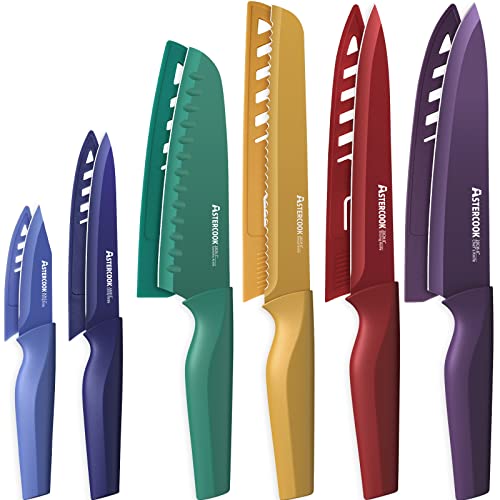
Here’s the deal: Astercook goes after the budget-conscious student with color-coded blades and a dishwasher-safe claim, but the anti-rust coating is a trade-off you need to understand.
This set includes an 8-inch chef knife, 8-inch slicing knife, 7-inch Santoku, and 8-inch serrated knife, among others. Each blade has a color-coded coating designed to reduce cross-contamination — red for raw meat, green for produce, that sort of thing. The coating is described as anti-rust and dishwasher safe, which sounds convenient. But from a materials standpoint, a colored coating on the blade surface is a wear layer. Over time, especially in a commercial kitchen with frequent washing and sanitizing, that coating can chip or peel. Once the coating is gone, the underlying steel is exposed, and the color-coding becomes useless. The handles are non-slip, which is good, but the listing doesn’t specify the steel grade — that’s a red flag for edge retention. Basic stainless that isn’t high-carbon will dull quickly on a poly board.
The dishwasher-safe claim is misleading. Even if the coating survives the heat and detergent, the high-pressure spray can knock blades against racks and dull edges. Hand washing is always better. For a student on a tight budget who wants a visual reminder to avoid cross-contamination, these color-coded knives have some appeal. But I wouldn’t trust them to hold an edge through a semester. Our guide to dishwasher safe steak knife sets covers the same trade-offs in more detail.
Pros:
- Color-coded blades — reduces the chance of using the same knife for raw chicken and vegetables.
- Anti-rust coating — protects the steel from oxidation if you’re not meticulous about drying.
- Dishwasher-safe claim — convenient for a dorm kitchen with no time for hand washing.
Cons:
- Unspecified steel grade — likely basic stainless that dulls after a few weeks of heavy prep.
- Coating can wear off — once it chips, the color-coding and rust protection disappear.
- No forged option — stamped and lightweight, which limits edge stability.
Who Should Buy This
Best for: A home cook, not a culinary student. The color-coded system works for casual cross-contamination awareness. Skip if: You need knives that survive daily use in a school kitchen — these won’t hold up professionally.
Astercook Knife Set (Blade Guards Included)
Why it made our list: Another Astercook set, this one bundles individual blade guards for safe storage, but the steel and coating concerns remain the same.
The line-up mirrors the previous Astercook set: 8-inch chef, 8-inch slicing, 7-inch Santoku, and 8-inch serrated knife, plus a few others. The key difference is that each knife comes with a blade guard, which is a plastic sheath that snaps over the edge. That’s genuinely useful for a student who tosses knives in a drawer or backpack — it prevents nicks and keeps the edge from chipping against other tools. The anti-rust coating is present here as well, which the manufacturer says protects against oxidation and allows dishwasher cleaning. The non-stick or non-slip handle detail is mentioned, but no specific steel grade is given.
The blade guards are a nice touch, but they don’t fix the core issue: if the steel is soft, the knife dulls quickly regardless of how well you store it. The coating may protect against superficial rust, but it also adds a layer that can interfere with sharpening — when you run the blade over a stone, the coating near the edge can clog the stone or peel. I’d treat this set as a temporary solution for a first semester, then upgrade to a forged Mercer once you know you’re serious. For at-home casual use, the blade guards make it safer than the color-coded version.
Pros:
- Individual blade guards — protect edges during transport and storage, something the Mercer rolls lack.
- Anti-rust coating — helps prevent surface rust if you forget to dry the blade immediately.
- Compact storage — no roll needed; the guards let you stack knives in a drawer safely.
Cons:
- Unspecified steel quality — edge retention is the big unknown, and that’s exactly what a student needs to know.
- Coating can peel — over time, the colored layer may flake into food or compromise the edge.
- Dishwasher-safe claim overstated — heat and detergent will still degrade both the coating and the handle bond.
Our Verdict
Best for: A casual home cook who wants a safe, cheap set with blade guards for drawer storage. Skip if: You’re entering culinary school — spend the same money on a stamped Mercer instead.
What Matters in a Student Knife Set (and What Doesn’t)
Choosing among culinary knife sets for students comes down to a few material and design factors that most beginners overlook. I’ll break down the decision points that actually affect your daily prep.
Forged vs. Stamped: The Steel Decision
Forged knives, like the Mercer Genesis, are heated and hammered into shape, which compresses the steel grain. The result is a denser, tougher blade that holds an edge longer and resists chipping. Stamped knives, like all the Millennia sets, are cut from a sheet and ground down, so they’re thinner and more flexible. Stamped knives sharpen easily but need more frequent honing. For a student who preps for hours each day, forged steel pays for itself in reduced sharpening time and better performance on dense ingredients.
Handle Grip and Sanitizer Resistance
Wet hands are the enemy. The textured Santoprene handles on Mercer Millennia and Genesis sets give a reliable non-slip grip, but Santoprene can discolor if submerged in the quaternary sanitizer solutions used in commercial kitchens. Astercook handles are also non-slip, but the material isn’t specified, so I’d be cautious. If your school requires sanitizer dips, rinse and dry your knives immediately after to extend handle life.
Knife Roll: Protection or Just a Bag?
Every Mercer set in this list includes a soft roll, and none of them have individual blade sleeves. That’s a problem because loose blades rattle and chip each other. A hard case or a roll with separate pockets is a better long-term investment. If you must use the included roll, wrap each blade in a paper towel or buy cheap blade guards separately. The Astercook sets with included guards actually do better here, but their steel quality is a bigger concern.
Color-Coded Coating: Hygiene Aid or Gimmick?
Astercook’s color-coded blades are a visual reminder against cross-contamination, which is genuinely useful in a busy kitchen. But the coating is a wear layer. Once it chips, the color-coding disappears and the underlying steel is exposed. If you adopt a strict cutting board color system instead, you get the same safety benefit without relying on a fragile coating.
Our Final Recommendation
For the student who wants one set to survive culinary school and beyond, the Mercer Culinary Genesis 7-Piece Forged Knife Roll Set is the clear winner. Forged high-carbon German steel, taper-ground edges, and a comfortable non-slip handle outclass every stamped option here. If budget is tight and you’re willing to hone weekly, the Mercer Culinary Millennia 8-Piece Knife Roll Set offers the best value with a complete starter kit. The Astercook sets are not suitable for professional training, but they work as casual home backups. Overall, spend the extra on forged steel now and avoid buying a replacement set six months later.
Frequently Asked Questions
What should I look for in a student chef knife set?
Prioritize steel grade first: high-carbon stainless holds an edge far longer than basic stainless. Then look for forged construction, which resists chipping better than stamped. A non-slip handle is essential for wet hands, and the storage roll should have individual blade sleeves to prevent edge damage. Avoid sets with unspecified steel grades or coatings that can wear off. The Mercer Genesis ticks all these boxes except the roll design, which you can upgrade with aftermarket blade guards.
Are dishwasher-safe knives actually safe for culinary school?
No. Even if a knife is labeled dishwasher safe, the high heat, harsh detergent, and water pressure will dull the edge and degrade the handle bond over time. The Astercook sets claim dishwasher safety, but hand washing is always recommended. A better approach is to wash, dry, and store your knives immediately after use. If you absolutely need a dishwasher-safe option for steak knives at home, our guide to dishwasher safe steak knife sets explains the trade-offs in detail.
How long will a typical student knife set last?
A stamped set like the Mercer Millennia will last through a school year with regular honing, but the edges will need sharpening more often by the second semester. A forged set like the Mercer Genesis can last five or more years with proper care, because the denser steel wears slower and doesn’t chip as easily. The Astercook sets, with unknown steel grades and coatings, are likely to show noticeable dulling within a few months of daily use. Hand washing and proper storage extend any knife’s life significantly.