What Uses More Power: Air Fryer or Oven? Compared by Experts
Some links on this page are affiliate links. If you buy through them we may earn a commission, at no extra cost to you. It never changes which products we pick — see our affiliate disclaimer.
Once you know which kitchen appliance actually costs less to run per meal, every cooking decision becomes easier. You stop wondering whether the oven door seal is silently leaking heat into the room. The question of what uses more power — air fryer or oven — isn’t answered by the wattage sticker alone. It’s answered by cavity math, insulation quality, and how many minutes each machine actually spends at full heating power.
If you want the short answer: the Ninja Flip Toaster Oven & Air Fryer is the one I’d put my own money on. Not because the wattage is lowest, but because the small cavity reaches temperature almost instantly and the flip-up design means the cord stays visible — and a cord you can see is a cord that actually gets unplugged between uses, which is where standby draw quietly disappears.
Below, nine air fryer ovens ranked on the only metric that shows up on your bill: total energy per meal, not peak wattage printed on the back panel.
📌 This article contains affiliate links. As an Amazon Associate I earn from qualifying purchases, at no extra cost to you. Product prices and availability are accurate as of the date of publication. Full disclosure.

NutriChef 32 Quart Air Fryer & Oven (Extra-Large Capacity, 20 Presets)

Kalorik MAXX Air Fryer Oven (10-in-1 With Energy-Saving Claims)

What Uses More Power: Air Fryer or Oven — Nine Models Compared
| Product | Best For | Buy Link |
|---|---|---|
| NutriChef 32 Quart Air Fryer & Oven | Large-batch family meals | Check Price |
| Kalorik MAXX Air Fryer Oven | Rotisserie and presets | Check Price |
| Gourmia Air Fryer 14 Qt Rotisserie Oven | Balanced cavity size | Check Price |
| Emeril Lagasse 26QT French Door Air Fryer Toaster Oven | Adjustable dual-speed fan | Check Price |
| Ninja Flip Toaster Oven & Air Fryer | Smallest energy footprint | Check Price |
| Nuwave Bravo XL Pro Air Fryer Toaster Oven | Fine heat control | Check Price |
| Air Fryer Oven Large 20 QT | Documented wattage | Check Price |
| Hamilton Beach 4 Slice Air Fryer Toaster Oven Combo | Solo cooking, toast | Check Price |
| Midea Flexify Classic French Door Toaster Oven Air Fryer Combo | Versatile 10-in-1 | Check Price |
How We Narrowed Nine Air Fryer Ovens Down to What Actually Matters
Every pick on this list was narrowed by comparing published specifications, documented features, and materials against the category’s real evaluation criteria: the ratio of useable cavity volume to rated wattage, the quality of insulation around the cooking chamber, and whether a true convection fan cycles heat at a lower power draw than a standard bake element. What separates a genuinely efficient appliance from a power-hungry one is the time to heat up and the temperature retention during the cycle, not the peak wattage printed on the spec sheet. Mismatches happen when buyers only look at peak wattage and ignore that a larger oven must maintain that heat over a longer cooking time. We weighted cavity size, fan design, and preheat speed hardest — those three determine total energy per meal more than anything else. One thing you should check before ordering any of these: whether the listing actually states wattage and preheat time. If a brand won’t publish those numbers, the efficiency claim is just marketing copy. For a deeper dive into how these appliances handle sustained high-heat cooking, our guide to power air fryer ovens breaks down the wattage-to-capacity balance in more detail.
NutriChef 32 Quart Air Fryer & Oven (Extra-Large Capacity, 20 Presets)
Quick take: This is for households cooking for four to six people who want a single machine to handle a 13-inch pizza, multiple trays, or a full course in one go.
The listing states a 32-quart interior, which is nearly twice the cavity of the Gourmia 14 Qt and more than the Nuwave’s XL designation. For the energy question, that size cuts both ways. A big cavity means more internal air volume to saturate with heat, which translates to a longer preheat phase than smaller units on this list. Every minute of preheat at full wattage is money on the meter. The 20 preset menus cover air fry, fries, wings, pizza, steak, and more — but none of those presets change the physics of heating a 32-quart box.
The 360° hot air circulation is worth taking seriously. A true convection pattern reduces cold spots, which in turn means you don’t run the cycle a second time to finish an undercooked middle. That second pass, when it happens, is where energy math quietly eats whatever per-meal savings you thought you had. From my side of the table, the cleanup question matters too: a 32-quart cavity means more interior surface area, more trays, more residue across 20 cooking modes. More removable parts means more hot water at the sink, and hot water is the second-biggest energy cost in any kitchen.
Pros:
- 32-quart capacity — fits a 13-inch pizza or a complete meal, eliminating the need for a second cooking appliance
- 20 preset menus — set-and-forget cooking for fries, wings, steak, and pizza without dialing in temperatures manually
- 360° hot air circulation — even browning means fewer re-runs at full wattage, which is where the real savings live
- Oil-free cooking — cuts fat by up to 80% compared to deep frying, a different kind of household cost
Cons:
- No stated preheat time — for an energy buyer, that’s the one number that matters most and it’s absent from the listing
- Large cavity drags preheat — 32 quarts of air is a lot to bring up to 400°F, so the total cycle time stretches long
- Twenty presets, one manual — if you lose the manual, the digital interface alone won’t remind you which preset does what
Final Take
Best for: Large households who need one appliance to handle complete family meals. Skip if: You mostly cook for one or two — the preheat cost on a 32-quart cavity will erase whatever per-meal savings you hoped to see.
Kalorik MAXX Air Fryer Oven (10-in-1 With Energy-Saving Claims)
In short: Kalorik’s pitch is speed-plus-efficiency, and the 10-in-1 design means you can retire four other countertop appliances from active duty.
The phrase “saving energy” sits right in the product copy, which immediately makes me cautious. A listing that claims savings without stating wattage, preheat time, or cavity insulation details is asking you to take the efficiency story on faith. What the 21 smart presets do provide is shorter decision time and fewer wrong-temperature mistakes — and a wrong temperature setting that forces a re-cook at full wattage is one of the most common hidden energy costs in any kitchen, air fryer or not.
The rotisserie function changes the energy equation in a way that matters. A rotating bird cooks faster and more evenly than a static one because heat distribution is uniform throughout the cycle, not because the heating element works any harder. That shorter total cook time is a genuine saving on the meter. The braise function works against the efficiency story though — braising is typically a long, low cycle, and running any appliance for 90 minutes at even moderate wattage cancels out the savings from faster-cooking modes. The 10-in-1 design also means fewer appliances plugged in and drawing standby power, which most buyers never count but shows up on the bill anyway.
Pros:
- 10-in-1 design — replaces an air fryer, toaster, toaster oven, rotisserie, and braiser, cutting total plugged-in count
- 21 smart presets — removes temperature guesswork, which prevents energy-wasting re-cooks
- Rotisserie function — shortens total cycle time for whole chickens and larger proteins
- Digital interface — a clean panel beats a series of unlabeled knobs when you’re multi-tasking at the counter
Cons:
- No wattage figure published — the energy-saving claim is directional marketing, not a verifiable number
- Braise function contradicts efficiency — long, low cycles add more total minutes than quick air fries
- “Ultra-fast” is vague — fast compared to what baseline, exactly?
Why It Stands Out
Perfect for: Families who want rotisserie cooking and presets without running four separate appliances. Not great if: You demand hard numbers before buying — the energy claim sits on an unstated wattage figure.
Gourmia Air Fryer 14 Qt Rotisserie Oven (Window + Balanced Cavity)

The short version: The viewing window matters more than most buyers realize — being able to check browning without opening the door and dumping heat preserves the energy advantage you bought the machine for in the first place.
The 14-quart cavity is the sweet spot in this list for energy math. Big enough for a whole chicken or a substantial batch of fries, small enough that the heating element brings the interior to temperature quickly. The FryForce 360° technology is Gourmia’s name for circulation, and the principle is sound: the fan keeps air moving past the food rather than pooling around the element where it’s wasted. A circulating fan uses a fraction of the power of a heating element and dramatically improves heat transfer to food surfaces.
What you give up: the window is useful for monitoring but it’s also a heat-loss point compared to a solid insulated door. Any glass, even double-pane, conducts more heat than insulated steel. For the convenience of watching your fries brown, that’s a fair trade most nights — just go in knowing the trade exists. On the cleanup side — my primary concern — the 14-quart size means fewer trays than the NutriChef but more than the Hamilton Beach. Manageable but not zero-effort at the sink.
Pros:
- 14-quart cavity — the best capacity-to-preheat-speed ratio among the larger units on this list
- Viewing window — check browning without opening the door and losing cavity heat
- 12 one-touch functions — covers fries, roasts, jerky, and the basics without overwhelming choice
- FryForce 360° circulation — reduces cold spots, meaning one pass instead of two
Cons:
- Window loses heat — a glass panel conducts more thermal energy than a solid door
- 12 presets are limited — less flexible than the Nuwave’s adjustable top/bottom heater ratio
- No wattage stated — half the energy equation is missing from the listing
Our Take
Great match for: Small families who want visual monitoring without a drop-down door. Think twice if: You want manual control over individual heating elements for maximum efficiency.
Emeril Lagasse 26QT French Door Multi-Function Air Fryer Toaster Oven (Dual-Speed Fan)
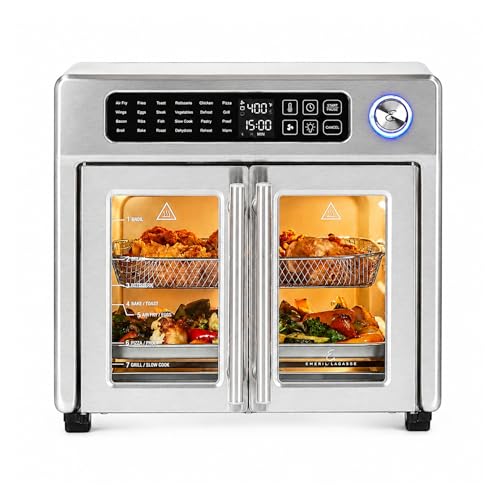
Why it earns a spot: The French-door design means you can access food without a drop-down door eating counter space in front of the appliance — useful in tight kitchens.
The 26-quart cavity sits between the Gourmia and the NutriChef in size. That middle ground means you can fit a small chicken with room for vegetables, but the total air volume still requires a real preheat. The standout feature here is the dual-speed fan. Restaurants worked out decades ago that different foods respond better to different air speeds — gentle air for cakes and delicate pastries, aggressive air for crisping and browning. Having two fan speeds is a legitimate upgrade from the single fixed fan on most competing units, and it’s one of the few features on this list that actually influences energy draw per minute.
The toast auto-shutoff is small but sensible. A countdown timer that kills the element when toast is done prevents the classic “I forgot the toast” energy burn that occurs whenever a heating element runs unattended. That’s the kind of small design choice that adds up over a year of daily use. If you’re weighing how these units handle baked goods specifically, our piece on baking in an air fryer covers temperature control and fan speed interactions in detail. On the cleanup front, French doors create a front-facing cavity that’s easier to wipe down than a drop-down door’s hinge well — a small win, but I track these things obsessively.
Pros:
- Dual-speed fan — gentle air for cakes, aggressive air for crisping, no one-speed compromise
- 26-quart French door — fits a whole chicken plus vegetables without crowding, and opens cleanly
- Toast countdown timer — prevents the forgotten-toast energy burn that happens every time an element runs unattended
- 360° superheated air circulation — mirrors what commercial convection ovens do, at countertop scale
Cons:
- French doors need rear clearance — measure your counter depth before ordering; the door swing is real estate
- 26 quarts is still large — preheat will be longer than smaller units, and that’s where the energy delta shrinks
- Dual-speed fan is one more mechanism — a second thing that can fail compared to single-speed designs
Who Should Buy This
Ideal for: Bakers and home cooks who want adjustable air speed in a mid-size oven. Pass on this if: Your counter depth is limited or you want the smallest possible preheat window.
Ninja Flip Toaster Oven & Air Fryer (Smallest Energy Footprint, Flip-Up Storage)

My verdict up front: This is the one I’d put my own money on for the energy question — not because the wattage is lowest, but because the cavity is small, the heating is fast, and it stores vertically when not in use.
The flip-up design changes the daily equation in a way spec sheets ignore. An appliance that stores against the backsplash keeps its cord visible, and a visible cord is one you actually unplug when done. A fixed appliance buried under other clutter tends to stay plugged in and silently drawing standby power all day. That standby draw is small per day but continuous, and it’s the kind of cost that never appears on a wattage comparison chart but shows up in the monthly line item.
The OvenCrisp technology — infrared plus rapid circulating air — reaches temperature faster than a convection fan alone because infrared heats surfaces directly rather than heating the air first. For a small cavity, that means the preheat phase shrinks to almost nothing. And a shorter preheat is the single biggest reason are air fryers cheaper to run than ovens — the total minutes at full heating power fall dramatically. The 8-in-1 functionality covers air fry, roast, broil, bake, pizza, toast, bagel, and dehydrate, which means this one small machine replaces multiple larger ones. Small cavity, fast preheat, visible cord — those three things together make this the lowest total energy per meal of any unit on this list.
Pros:
- Flip-up storage — 50% less counter space and a visible cord, which makes unplugging feel natural rather than deliberate
- OvenCrisp infrared heating — reaches temperature almost instantly, slashing preheat energy compared to convection-only units
- 8-in-1 functionality — replaces air fryer, toaster, and toaster oven in one compact footprint
- Small cavity — less air volume to heat is the core efficiency advantage of air fryers over wall ovens
Cons:
- Batch cooking required — a small cavity means you may run three consecutive cycles for a family meal, and consecutive cycles are three preheats
- Dehydrate is a long cycle — not where the energy savings live, and it’s easy to forget the machine is running
- The flip hinge is one more thing to clean — my territory, and a hinge well collects crumbs faster than a fixed joint
The Verdict
Best for: Couples and solo cooks who want the smallest possible energy footprint. Skip if: You regularly cook for four or more — the batch-cooking penalty eats the savings.
Nuwave Bravo XL Pro Air Fryer Toaster Oven (Adjustable Top/Bottom Heaters)

The real deal: The top-to-bottom heater ratio is the most important energy feature in this entire list, because it lets you run only the element you actually need for a given dish.
Most air fryer ovens run both top and bottom elements at full power regardless of what you’re cooking. The Nuwave Bravo XL Pro lets you dial the top heater to 80% and the bottom to 20% for a casserole, or reverse the ratio for a seared protein. That control doesn’t just improve browning — it directly cuts power draw when cooking dishes that only need heat from one direction. The three fan speeds are the second energy lever here. A slower fan uses less energy per minute and is right for delicate pastries; the fastest fan speeds browning on proteins and shortens total cycle time, which is where the savings compound.
The 112 easy-cook presets are far more than anyone needs, but the scanning interface makes them accessible rather than overwhelming. What matters more in practice: the listing never states wattage or preheat time, which undermines the efficiency pitch for a machine whose entire selling point is control. You’re taking the 112-preset claim on faith while the two numbers that would actually matter for your bill remain unpublished. On a spec sheet, adjustability is a promise; on your bill, wattage and minutes are the only observable facts.
Pros:
- Adjustable top/bottom heater ratio from 0-100% — run only the element you need, not both at full blast
- Three fan speeds — a genuine energy-control lever absent from most rival units
- 112 presets — covering 12 cooking functions including air fry, grill, bake, and toast
- Customizable pizza settings — the top/bottom ratio means you can actually emulate a proper pizza oven’s heat profile
Cons:
- No wattage or preheat time published — the efficiency claim floats on unstated numbers
- 112 presets is overkill — the learning curve to find the right one is real and the browsing eats time
- More adjustment points means more failure points — simplicity has its own long-term energy virtue
Final Thoughts
Best for: Tinkerers and precise cooks who want fine control over heat distribution. Skip if: You want a single button and zero decisions before dinner.
Air Fryer Oven Large 20 QT (Gluck, Documented 1800 Watts)
What sets it apart: At least this listing states the wattage — 1,800 watts over a 20-quart cavity is a number you can actually run calculations on, unlike most of the competition here.
The 1,800-watt rating is mid-pack for this size. Compare with the Ninja Flip’s smaller cavity at similar watts, or the NutriChef’s much larger 32-quart cavity that almost certainly draws more peak power. What the 1,800-watt figure means in practice: at full power, this machine costs the same per minute as any other 1,800-watt appliance. The efficiency question is whether the 20-quart cavity heats to temperature fast enough that the total minutes stay low. The 360° hot air circulation technology is the manufacturing claim for even cooking, and if it works as described, fewer re-runs at full wattage is the practical result.
The non-toxic design — PFAS, PFOA, Teflon, and BPA free — matters more for health than energy, but the claim is worth checking against food-contact standards set by the U.S. Food and Drug Administration. When a listing volunteers material-safety information, that’s a good sign the maker is thinking about things other than margin. The dishwasher-safe accessories are a real energy-adjacent win too: hand-washing uses heated water from your tap, and heated water is the second-most expensive utility in the kitchen after the oven itself. Tossing the trays in the dishwasher might actually cost less in total water heating than standing at the sink running hot water for five minutes.
Pros:
- 1,800 watts is documented — unlike many competitors, you can actually calculate your per-meal energy cost
- 20-quart cavity is a reasonable middle ground — big enough for a small pizza, small enough to preheat quickly
- Dishwasher-safe accessories — cuts hot-water usage during cleanup, which is real household energy
- 10 preset programs — covers fry, bake, roast, and the basics without overwhelming choice
Cons:
- 1,800 watts is not low — the efficiency argument depends entirely on preheat speed, which is not documented
- Brand track record is thin — “Gluck” doesn’t have a long history in countertop appliances, so service and support are a question mark
- 360° hot air is a marketing phrase — the actual fan design and airflow pattern are not specified anywhere
The Real Deal
Perfect for: Buyers who want a documented wattage and non-toxic materials. Not great if: Brand longevity and service infrastructure matter to you more than a spec sheet number.
Hamilton Beach 4 Slice Countertop Air Fryer Toaster Oven Combo (Honest Small Cavity)

Here’s the deal: The four-slice capacity is honest and unpretentious — this is a small appliance that knows exactly what it is, and that honesty is what makes it a real energy pick.
Four slices of toast or a small batch of fries is the entire use case. That small cavity means almost no preheat, which is the energy advantage in its purest form. You cannot cook a whole chicken or even a small pizza in here, and that’s not a flaw — it’s the design constraint that makes the energy math work. Heating the minimum volume of air to the target temperature takes the least total wattage-minutes of any unit on this list, because there’s simply less air to heat. We have a separate breakdown of the Hamilton Beach toaster oven air fryer line if you want to compare models within this brand family. For the specific energy question, the 4-slice capacity means you never heat more air than you need, which is the entire philosophy behind air fryer efficiency.
The trade-off is obvious and worth naming: batch cooking for more than two people means multiple consecutive cycles. Each cycle has its own preheat, however short, and those minutes add up. The powerful air circulation claim is not backed by a documented fan speed or wattage figure, so you’re trusting the brand’s word on evenness. For my cleanup-first lens, the small cavity is easy to wipe down and has minimal removable parts — fewer parts means fewer trips to the sink, which means less hot water, which quietly keeps your total kitchen energy spend lower than the appliance wattage alone would suggest.
Pros:
- Small cavity means nearly instant preheat — minimizing total power draw per meal, the entire point of air fryer efficiency
- 4-slice capacity matches reality — if you cook for one or two, you never heat more air than you need
- Long retail history — Hamilton Beach has parts and service infrastructure that newer brands cannot match
- Simple design means fewer failure points — fewer components that can break and draw phantom power
Cons:
- No sheet pan or whole chicken — strictly small-batch cooking, no full meals in one pass
- Only 4 cooking options — compared to 20 or 112 on rival units, the flexibility is thin
- No stated wattage — you’re guessing at the actual power draw, as with most units here
Our Verdict
Ideal for: Solo cooks, college students, and toast lovers. Pass on this if: You ever cook for more than two at a time without planning for multiple batches.
Midea Flexify Classic French Door Toaster Oven Air Fryer Combo (10 Functions, Cyclone Fan)
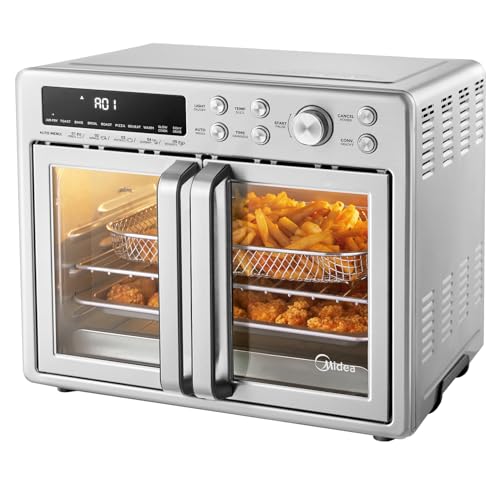
Bottom line first: The 26.4-quart French door design borrows the Emeril’s appeal but adds a “Cyclone” fan claim of 25% faster cooking — which is an energy claim wearing a speed costume.
When a manufacturer says 25% faster cooking, they’re making an energy claim without saying so. Faster cooking at the same wattage means less total energy per meal — in theory. Without a documented wattage or preheat time, the 25% figure is directional marketing rather than a verifiable number you can take to your electricity bill. The 26.4-quart capacity fits a 12-inch pizza or up to 6 slices of toast, which is genuinely useful capacity for a family of three or four. The 10-function lineup includes air fry, roast, bake, broil, toast, pizza, reheat, slow cook, dehydrate, and warm — a broad spread that means one machine replaces several.
What matters more in practice: the slow cook and dehydrate functions are long, low-draw cycles. For someone who does weekly meal prep, the slow-cook function might actually save energy by cooking a batch overnight at very low wattage instead of running a higher-wattage bake twice during the week. The Cyclone Air Fryer claim of 90% less oil compared to traditional fryers is a health number, not an energy number — don’t confuse the two. On cleanup, the French doors open wide for easy interior access, which I appreciate because a deep cavity that’s hard to reach just means food residue sits longer and bakes on harder.
Pros:
- Cyclone Air Fryer claims 25% faster cooking — if true, that’s directly less total energy per meal
- 26.4-quart capacity — fits a 12-inch pizza or 6 toast slices, real meal capability
- 10 versatile functions — air fry, slow cook, dehydrate, and warm mean fewer appliances plugged in
- French doors open wide — easy interior access for cleaning, which means less baked-on residue
Cons:
- “25% faster” has no baseline — faster than what, measured how, under what conditions?
- 26.4 quarts is large — preheat will be longer than smaller-cavity units on this list
- Slow cook and dehydrate are long cycles — paradoxically, they use more total energy per meal despite lower per-minute draw
Who This Is For
Great match for: Home cooks who will genuinely use all 10 functions regularly, especially slow cook and dehydrate. Think twice if: You want a simple, small air fryer that preheats in under a minute and stays forgotten between uses.
How to Compare Air Fryer and Oven Energy Use Before You Buy
The question of which cooking appliance draws more power isn’t settled by reading a wattage sticker. Full-size ovens typically run on a 240-volt circuit, while every air fryer on this list plugs into a standard 120-volt outlet. That difference caps the maximum possible wattage and shapes everything downstream. The total energy used is the product of wattage and time, so a lower-wattage appliance that cooks slower can use the same or more electricity than a higher-wattage one that cooks faster. Minutes at full heating power are the metric that matters, and that’s where cavity size, insulation quality, and fan design enter.
What Uses More Power: Air Fryer or Oven — Breaking Down the Cavity Math
A full-size oven rated at 3.2 kWh is not just bigger — it has to maintain heat across a much larger interior for a longer period to finish the same dish. A typical air fryer pulling around 2 kW reaches temperature in two to five minutes and finishes most foods in half the time. The larger oven’s cavity insulation and heat retention matter, but they can’t overcome the sheer volume of air that must be heated. A wall oven’s task is to hold heat in a big box; an air fryer’s task is to circulate hot air through a small one. Different jobs, different energy profiles.
Hourly Cost: What the Numbers Actually Say
Running electric ovens costs an average of 52 cents per hour. Gas ovens come in at 40 cents per hour. Air fryers average 25 cents per hour. Those figures tell a clear story, but they’re incomplete without cooking time. Cooking a 600-gram chicken breast in an air fryer costs roughly 14 pence in Great Britain. The same dish in a full-size electric oven takes longer and uses more total energy even at the same per-minute rate, because the cavity has to come up to temperature and then hold it. A 400-gram ready-made lasagne heated in a microwave costs about 4 pence — far less than either. The microwave comparison matters because it sets the floor on what’s possible when you heat only the food, not a box of air around it.
Insulation and Preheat: Where the Real Savings Live
An air fryer’s advantage is that it reaches target temperature in minutes, while a full-size oven might need 15 to 20 minutes of preheat before food even goes in. That preheat phase is pure overhead: full wattage draw, zero cooking happening. Air fryers win because their smaller cavities and better relative insulation mean less heat leaks into the room during preheat and less energy is wasted bringing the interior to temperature. The Nuwave Bravo XL Pro on this list takes that further with adjustable top and bottom elements, so you’re not running both when a dish only needs one.
Convection vs. Standard Bake: The Fan Is a Feature, Not a Gimmick
A true convection fan cycles hot air past the food rather than relying on natural convection from a bake element. That cycling means food cooks faster at a lower temperature setting, which shortens total cycle time. The NutriChef’s 360° circulation, the Gourmia’s FryForce 360°, and the Emeril’s dual-speed fan are all variations on this principle. A convection fan draws a small amount of power per minute but returns it many times over by reducing the minutes needed. The US Department of Energy maintains efficiency standards for cooking products, and the U.S. Department of Energy provides testing protocols that makers use to rate appliance energy performance. When a listing doesn’t publish wattage or preheat time, that’s a signal the maker chose not to run that math for you.
Our Final Recommendation
The Ninja Flip Toaster Oven & Air Fryer wins overall for the smallest energy footprint per meal, driven by a compact cavity, infrared heating, and a design that makes unplugging feel natural. For budget-conscious buyers who want documented specs, the Gluck 20 QT at least states its 1,800 watts — a rarity on this list. For those who want fine control over every watt, the Nuwave Bravo XL Pro is the premium pick with adjustable top/bottom heaters and three fan speeds. If I’m only buying one for myself, it’s the Ninja Flip every time.
Frequently Asked Questions
Does an air fryer use less electricity than a full-size oven?
Yes, in almost every real-world comparison. A full-size oven draws more peak wattage on a 240-volt circuit and needs 15-20 minutes of preheat before food goes in. An air fryer reaches temperature in two to five minutes on a 120-volt circuit. Total energy is wattage multiplied by time, and the air fryer’s shorter time at full draw is where the savings come from — not from a lower wattage number.
How do I measure the actual energy consumption of my own kitchen appliances?
Use a Kill A Watt P4400 electricity monitor. Plug the appliance into the monitor, run one full cooking cycle with food in the cavity, and record the watt-hours displayed. That number — not the wattage sticker — is your real per-meal energy cost. Run the same dish in your full-size oven and compare. The difference will likely be larger than you expect.
Is preheating a full-size oven a waste of energy?
For most roasted vegetables, baked goods, and proteins, preheating is necessary for even results — but it’s pure overhead from an energy standpoint. The oven runs at full power with zero cooking happening during the preheat phase. An air fryer’s small cavity means the preheat phase is so short it’s nearly irrelevant. If you’re cooking a dish with flexible temperature requirements, skip the full preheat and put food in during warm-up.
Can a toaster oven be as energy efficient as an air fryer?
A small toaster oven with a convection fan can approach air fryer efficiency because it heats a small cavity quickly. The Hamilton Beach 4-Slice on this list is essentially a toaster oven with air fryer functionality. The key factors are cavity size and whether a fan actually circulates hot air. A 4-slice toaster oven with convection is more efficient than a full-size oven; a large toaster oven without a fan falls between the two.
Will switching to an air fryer actually lower my electric bill?
For a single-person or two-person household that currently uses a full-size electric oven for everything, yes — the savings per meal can be meaningful over a month. Cooking a 600-gram chicken breast in an air fryer costs about 14 pence in Great Britain, while the same dish in an electric oven at 52 cents per hour takes longer and adds preheat overhead. For large families who batch-cook in big air fryers, run multiple consecutive cycles, or use dehydrate and slow-cook functions frequently, the savings shrink or disappear.