14 Inch Frying Pan
Some links on this page are affiliate links. If you buy through them we may earn a commission, at no extra cost to you. It never changes which products we pick — see our affiliate disclaimer.
A 14-inch stainless pan that scorches pancake batter in the center while the edges stay gummy is telling you about its base, not your burner. Check the spec sheet on pans that behave that way and you usually find stamped aluminum barely 2mm thick—nowhere near enough mass to carry heat across that much cooking surface. That failure mode is why this roundup exists, because a 14 inch frying pan is a serious piece of iron, and the wrong one turns into a one-burner frustration machine.
Skip the guesswork: the All-Clad D5 Stainless Steel Core 14 Inch Frying Pan Covered is the one I’d put my own money on. Its five-ply bonded construction and steel core address the exact heat-distribution problem that cheap oversized pans ignore.
📌 This article contains affiliate links. As an Amazon Associate I earn from qualifying purchases, at no extra cost to you. Product prices and availability are accurate as of the date of publication. Full disclosure.
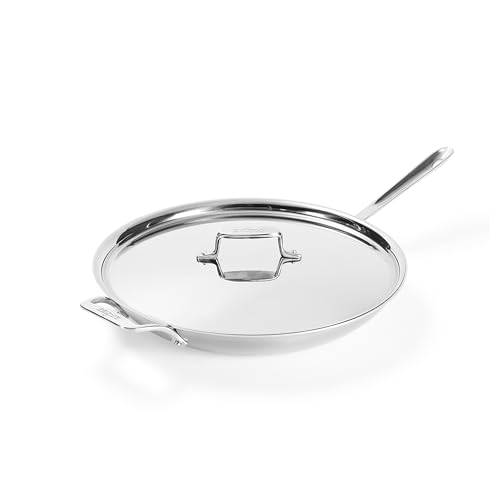
All-Clad D5 Stainless Steel Core 14 Inch Frying Pan Covered (Best Overall)
Tramontina Professional 14-Inch Non Stick Extra Large Frying Pan (Best Value)

GOTHAM STEEL Hammered 14 Inch Large Nonstick Frying Pan with Lid (Recommended for Families)

Comparison Table
| Product | Best For | Buy Link |
|---|---|---|
| All-Clad D5 Stainless Steel Core 14 Inch Frying Pan Covered | Serious home cooks | Check Price |
| Tramontina Professional 14-Inch Non Stick Extra Large Frying Pan | Everyday nonstick | Check Price |
| GOTHAM STEEL Hammered 14 Inch Large Nonstick Frying Pan with Lid | Family batch cooking | Check Price |
| Circulon Radiance Hard Anodized Nonstick Frying Pan | Durable hard anodized | Check Price |
| Bzayeat 14 Inch Nonstick Ceramic Nonstick Hybrid Frying Pan with Lid | Budget ceramic | Check Price |
How We Chose These Oversized Skillets
No staged lab here. These five picks come from comparing published specifications, materials, and documented features against what actually matters in a 14-inch pan. I weighted base thickness and material above everything else, because a large-diameter pan with a thin aluminum core warps on induction, scorches the center, and kills nonstick coatings within months. Next I looked at handle design: a long heat-safety handle and balanced weight distribution matter when the empty pan alone can push five to seven pounds. For nonstick models, I checked whether the coating is PTFE or ceramic and the recommended max temperature—that determines whether the pan stays food-release after a year or turns sticky and peels. For stainless, the layering (D5’s five-ply vs. single-ply) and core material govern evenness. After that, I noted which pans included a lid, because a covered 14-inch pan does double duty for braises and one-pan dinners. Before ordering, check your largest burner diameter: a 14-inch base on a 9-inch electric coil heats unevenly no matter how good the pan is.
All-Clad D5 Stainless Steel Core 14 Inch Frying Pan Covered (Best Overall)
If you want a pan that will outlive your current stove, this is the one. The five-ply bonded design and steel core are what serious cooks pay for when they’re tired of replacing warped cookware.
A 5-ply stack of stainless steel and aluminum has a heft that tells your wrist this is not a toy. The listing calls out five-ply bonded technology invented by All-Clad, with a steel core providing superior heat retention and even heating. That steel core matters more on a 14-inch pan than on smaller sizes because the distance from the center to the rim is long enough for heat to drop off dramatically if the core is thin. The covered version includes a tight-fitting lid, which turns this skillet into a shallow braiser for large batches.
The real annoyance is the handle. All-Clad lists riveted handles, and they stay put over years, but the stainless handle on a pan this heavy gets hot enough that I’d keep a towel nearby. The listing doesn’t state the oven max temperature, but All-Clad’s D5 line is typically rated to 600°F with a metal lid—confirm before broiling. If you’re torn between this and a rectangular cooking surface, our guide to rectangular frying pans explains the trade-off.
Pros:
- Five-ply bonded construction — the steel core resists warping on any cooktop, including induction
- Made in the USA — with global components, which usually means tighter quality control than fully imported pans
- Riveted stainless handle — no screws or welds to loosen, and it’s oven-safe
- Includes a lid — rare on skillets this size and useful for covered cooking
Cons:
- Premium price — you pay for the name and the five-ply build, and it’s not cheap
- Heavy — the empty pan is likely over five pounds, so flipping food one-handed is out
- No nonstick surface — eggs and delicate fish need proper preheating and oil or they’ll stick
Quick Take
Best for: Serious home cooks who want one large pan for searing, braising, and oven finishing. Skip if: You want a lightweight nonstick pan for daily scrambles—this is overkill and heavy.
Tramontina Professional 14-Inch Non Stick Extra Large Frying Pan (Best Value)
The budget pick that doesn’t act like one. Tramontina’s heavy-gauge aluminum and reinforced nonstick coating deliver even heating for big breakfasts and batch dinners without the All-Clad price.
Aluminum as a base material heats fast, and the listing specifies heavy-gauge aluminum for even heating, which means the base has enough density to avoid the center hot spot that plagues thin aluminum pans. The reinforced nonstick coating promises superior food release with less oil, and that’s exactly what you want when cooking eight eggs or a pile of hash browns at once. This is a big non stick frying pan built for high-volume cooking, not delicate searing.
My frustration is the lack of a lid in the listing. Tramontina sells lids separately for some lines, but you’ll need to check compatibility. Also, like all PTFE-based nonstick coatings, this pan should never be heated empty above medium—overheating releases fumes and ruins the coating. That’s the hidden cost of a budget nonstick pan. For a quick weeknight meal that uses this pan’s full surface, our one pot creamy chicken pasta recipe fits right in.
Pros:
- Heavy-gauge aluminum — more base thickness than typical cheap nonstick pans, so fewer hot spots
- Reinforced nonstick coating — holds up to daily scraping with silicone or wood utensils
- Extra-large capacity — a 14-inch surface cooks for six without crowding
- Budget-friendly — the value pick for a nonstick pan this size
Cons:
- No included lid — you’ll need to buy one separately or cover with foil
- PTFE coating — cannot go in the oven above 350°F and should never be heated empty
- No helper handle — the long handle alone bears all the weight when you lift a full pan
The Real Deal
Great match for: Families who cook big breakfasts or large batches and want hassle-free cleanup. Not great if: You plan to finish steaks in a 500°F oven—this pan’s coating won’t survive that.
GOTHAM STEEL Hammered 14 Inch Large Nonstick Frying Pan with Lid (Recommended for Families)
If you want a 14-inch nonstick with a lid included and a ceramic coating, this Gotham Steel model is the one to grab. The triple-coated Ti-Cerma surface is PTFE-free, which matters to anyone avoiding fluoropolymers.
The listing emphasizes a triple-coated ceramic-and-titanium coating with a hammered texture. That hammered pattern isn’t just cosmetic—raised peaks reduce the flat contact area where food sticks, and the valleys hold a micro-layer of oil, which improves release. A wide, flat 14-inch cooking base with gently sloped sides means you can fit more food before overcrowding, and the included lid is a genuine bonus for steaming or simmering.
The weakness is ceramic’s longevity. Ceramic nonstick starts out slicker than PTFE but degrades faster, especially if you use cooking sprays or high heat. The listing doesn’t state the maximum safe temperature, but ceramic coatings usually top out around 500°F and degrade quickly above that. Treat this as a medium-heat pan and it’ll last; blast it on high and you’ll be reseasoning or replacing within a year.
Pros:
- Triple-coated ceramic nonstick — PTFE-free and PFOA-free, so no fluoropolymer concerns
- XL family-sized capacity — 14-inch base holds enough for a big lasagna or stir-fry
- Lid included — turns the skillet into a covered braiser or steamer
- Hammered texture — reduces sticking and hides minor scratches better than smooth ceramic
Cons:
- Ceramic coating lifespan — slickness fades faster than PTFE, especially with frequent high heat
- No induction compatibility listed — the base may not be magnetic, so check before using on induction
- Unknown handle material — if it’s plastic or silicone over metal, oven use may be limited
Final Thoughts
Perfect for: Families who want a large PTFE-free nonstick with a lid and don’t mind replacing it sooner than a PTFE pan. Think twice if: You sear at high temperatures often—ceramic will break down quickly.
Circulon Radiance Hard Anodized Nonstick Frying Pan (Recommended for Durability)

Hard anodized aluminum is the quiet workhorse of oversized nonstick cookware. This Circulon Radiance model combines that rugged base with a raised-circle nonstick system designed to stand up to metal utensils.
The hard anodized construction is denser and harder than raw aluminum, so it resists warping better under a 14-inch span. The listing’s TOTAL Nonstick System of raised circles creates a surface where food sits on the peaks, not the coating itself, which reduces scratches and extends nonstick life. A helper handle is included, and that’s not a luxury on a pan this wide—lifting a full 14-inch skillet with one handle puts serious torque on your wrist.
My annoyance is the lack of a lid. Circulon sells separate universal lids, but at this size you’ll pay extra. The listing also says dishwasher safe, which is convenient, but any nonstick pan lasts longer if hand-washed—dishwasher detergent is abrasive over time. For a smaller option that might suit your needs better, check our guide to 12-inch frying pans for a more manageable daily size.
Pros:
- Hard anodized aluminum — denser base resists warping and distributes heat more evenly than stamped aluminum
- Raised circle nonstick — food slides off easily and the coating resists utensil marks
- Helper handle — offsets the weight of a full pan and makes two-handed lifting safer
- Dishwasher safe — convenient cleanup for those who don’t hand-wash
Cons:
- No lid included — an extra purchase if you want covered cooking
- Nonstick limits high heat — hard anodized can handle higher temps, but the coating still shouldn’t exceed 400°F
- Weight — with the helper handle, this pan is bulkier to store and maneuver
Our Take
Ideal for: Cooks who want a durable nonstick pan for daily use without PTFE worries and value the helper handle. Pass on this if: You need a lid and refuse to buy one separately.
Bzayeat 14 Inch Nonstick Ceramic Nonstick Hybrid Frying Pan with Lid (Budget Ceramic)

If you want a 14-inch ceramic pan for the lowest price and don’t mind some trade-offs, the Bzayeat hybrid is worth a look. Its five-layer structure and SGS certification address the two biggest concerns with cheap ceramic pans: coating safety and flimsy bases.
The listing describes a 5-layer structure with a precision digital etching surface, ceramic coating, food grade stainless steel, and a magnetic base for induction. That layered approach suggests the maker tried to solve even-heating and durability, though the exact base thickness isn’t stated. SGS-certified and free of PFOA/PFOS is a real credential—SGS is an independent testing body that verifies chemical safety, so the absence of PFAS is credible, not just marketing.
The frustration is the unknown. No maximum oven temperature is listed, and the exact ceramic blend isn’t specified beyond ‘hybrid.’ That means you can’t confidently finish this pan in a 450°F oven or know how the coating will hold up after a year of daily frying. The lid is a nice inclusion, and dishwasher-safe convenience is there if you want it, but hand-washing extends any ceramic surface.
Pros:
- SGS-certified no PFOA/PFOS — independent verification that the coating is free of fluorinated chemicals
- Five-layer structure — more layers than typical budget ceramic pans, suggesting better heat distribution
- Includes a lid — saves you an extra purchase and makes the pan more versatile
- Dishwasher safe — easy maintenance for everyday cleanup
Cons:
- No stated oven or heat limit — you’re guessing how much heat the ceramic hybrid can take
- Base thickness unknown — the biggest determinant of warping isn’t disclosed, a red flag for a 14-inch pan
- Ceramic coating durability — budget ceramic pans tend to lose nonstick properties within a year with regular use
Here’s the Deal
Great match for: Someone on a tight budget who wants a ceramic 14-inch pan with a lid and won’t push it past medium heat. Not great if: You expect long-term nonstick performance or need a pan that can handle high-heat searing.
Buying Guide: What to Look for in a Large-Format Skillet
A 14-inch cooking surface is about 154 square inches, nearly double a 10-inch pan. That extra real estate changes everything about heat management, weight, and storage. Here’s how to pick without regrets.
Base Thickness and Material Matter More Than Brand
The single most important spec is the base thickness relative to the 14-inch diameter. A stamped aluminum pan with a 2mm base will warp on induction and scorch the center because heat can’t spread fast enough. Look for wording like heavy-gauge aluminum (Tramontina), hard anodized aluminum (Circulon), or five-ply bonded construction (All-Clad D5). These indicate enough mass to resist warping. A true aluminum frying pan with a thick base heats quickly and evenly, but a thin one is a hot-spot machine.
Handle Design: The Wrist Test
An empty 14-inch pan weighs between 4 and 7 pounds depending on material. Fill it with six servings of food and you’re lifting 10 pounds with one hand. That’s why a long, heat-safety handle matters, and why a helper handle (like Circulon’s) is not a gimmick. Check whether the handle is riveted versus welded—rivets can loosen over decades, but screws are worse. Also confirm the handle material: stainless steel handles can go in the oven, while plastic or silicone-coated handles cap you around 350°F.
Nonstick Type: PTFE vs. Ceramic
PTFE-based nonstick pans (Tramontina, Circulon, Gotham Steel if PTFE) stay slick longer but must never be heated empty above 400°F—overheating releases toxic fumes. Ceramic-coated pans (Bzayeat, Gotham Steel’s Ti-Cerma) are PTFE-free and can handle slightly higher heat, but their slickness fades faster. If you want a big non stick frying pan for daily eggs, PTFE is the safer long-term bet if you respect the heat limit. For a 14 inch pan that doubles as an oven braiser, stainless steel (All-Clad) is the only choice—it just requires proper preheating and oil.
Why You Might Want an Extra Large Frying Pan with Lid
A lid turns a skillet into a shallow Dutch oven. For one-pan pasta, braised chicken, or vegetables that need steam, an extra large frying pan with lid is genuinely more versatile than one without. Among these picks, All-Clad and Bzayeat and Gotham Steel include lids. Tramontina and Circulon do not, so factor that into the cost.
Our Final Recommendation
For premium, the All-Clad D5 Stainless Steel Core 14-inch covered pan is the clear winner: five-ply construction, steel core, and a lid included make it the only pan here that will still be flat and beautiful in 20 years. For budget, the Tramontina Professional 14-inch nonstick is the best value—heavy-gauge aluminum and a reinforced coating for a fraction of the All-Clad price. If you want ceramic with a lid, Gotham Steel is the family pick; if durability over slickness is your priority, Circulon’s hard anodized pan earns its keep. Skip the Bzayeat unless your budget is the sole deciding factor—the missing specs are a warning sign. In short, a 14 frying pan is a big commitment; buy the best base you can afford.
Frequently Asked Questions
Is a 14-inch skillet too big for a normal stove?
Yes and no. The base of a 14-inch pan is often around 11–12 inches of actual flat cooking surface, because the flared sides add diameter. That still overhangs many standard electric coils by an inch or two on each side. On gas or induction with a large burner, it works well. Check your largest burner diameter before buying—if it’s under 10 inches, you’ll see uneven browning at the rim.
Can I put a big nonstick frying pan in the oven?
Depends on the coating and handle. PTFE nonstick pans (Tramontina, Circulon) should never exceed 350–400°F in the oven, and only if the handle is metal. Ceramic pans can usually go to 450–500°F, but check the maker’s limit. All-Clad D5 with its steel handle can go to 600°F. Never put a pan with a plastic or silicone-wrapped handle in the oven at any temperature—it will melt and release fumes.
Do I really need an extra large frying pan with a lid?
If you cook for four or more, the lid is the difference between a skillet and a braiser. You can simmer sauces, steam vegetables, or make one-pan pasta without transferring to another pot. Among our picks, only All-Clad, Gotham Steel, and Bzayeat include lids. Tramontina and Circulon require a separate purchase, so add that to your cost comparison.