

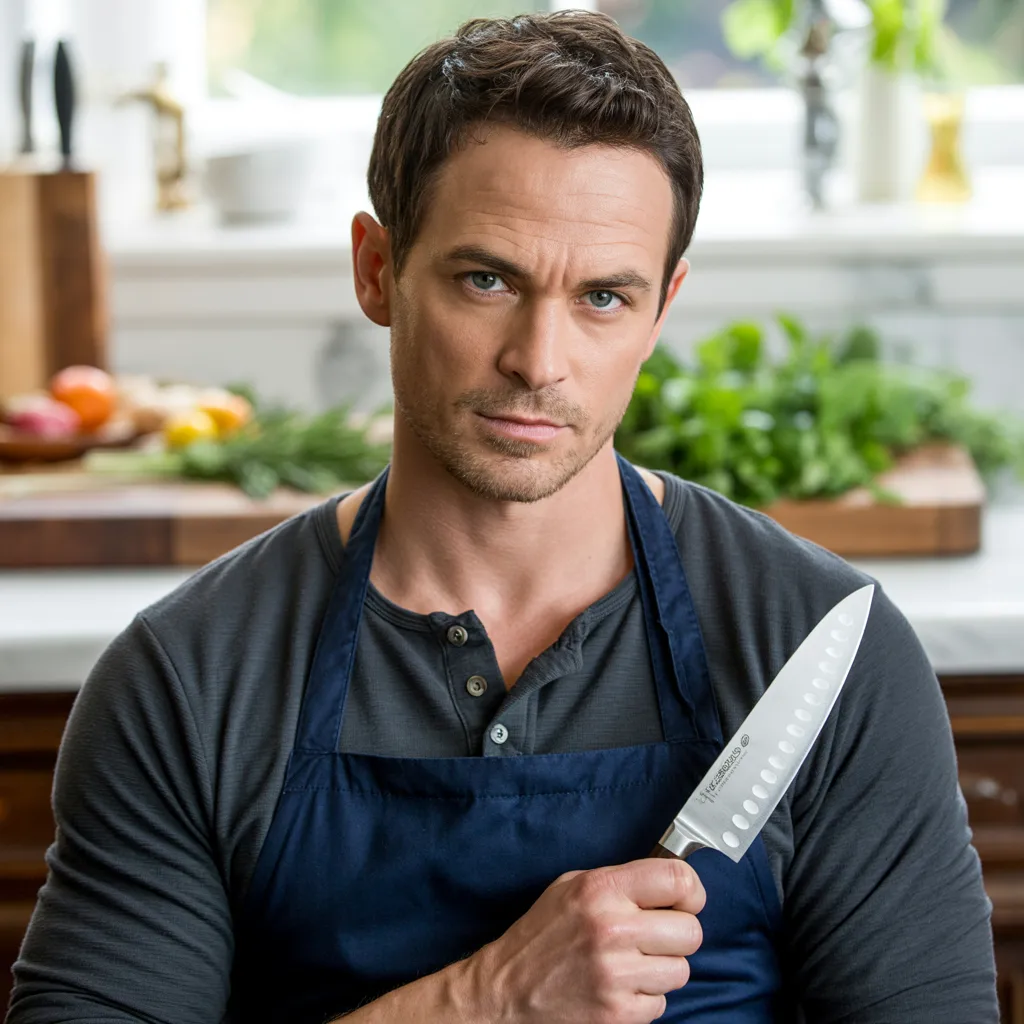
Through years of daily cooking and product testing, I have learned that most kitchen failures trace back to rushing setup. The extra 30 seconds to check your tools before you start saves hours of cleanup or genuine regret afterward. That lesson hit home the first time I tried breaking down a whole chicken with a dull, soft-steel chef knife. That experience pushed me to understand what separates a real butcher knife from a blade that will just frustrate you.
Key Takeaways
- A proper butcher knife is defined by its blade geometry and steel composition, not just its size.
- Steel hardness (Rockwell C scale) directly impacts edge retention and sharpening difficulty.
- Factory grind angle determines how the knife performs on meat, bone, and cartilage.
- Sharpening a dull butcher knife back to razor condition requires specific grit sequences and technique.
Butcher Knife Anatomy: The Steel Matters First
When I evaluate any butcher knife, the first thing I check is the steel hardness rating. Most home cooks never think about this, but it is the single most important factor in how a blade performs and how long it stays sharp. A knife’s hardness is measured on the Rockwell C scale (HRC). For a butcher knife, you want a minimum of 56 HRC. Anything softer will roll or dull within a few cuts on dense meat or light bone. I have tested blades at 54 HRC that needed a full sharpening session after breaking down just one pork shoulder.
Steel Hardness and Edge Retention
Steel in the 56-58 HRC range offers a good balance of edge retention and ease of sharpening. Steels like German X50CrMoV15 (common in many Wüsthof and Henckels knives) fall here. They are tough and resistant to chipping, but they will not hold a razor edge as long as harder steels. At 58-60 HRC, you get significantly better edge retention. This is where you find Japanese VG-10 and many high-carbon stainless steels. A butcher knife in this range can go through a full packer brisket before needing a touch-up. Above 60 HRC, you get exceptional edge retention but increased brittleness. I have seen blades at 62 HRC chip when twisted against a bone. For most home butchery, 58-60 HRC is the sweet spot.
The steel composition also matters. High-carbon steels like AEB-L or 14C28N are popular in custom butcher knives because they combine fine grain structure with good hardness. They take a very sharp edge and are easier to sharpen than some exotic powdered steels. Stainless options like Sandvik 14C28N are corrosion-resistant and still hit 58-60 HRC. When you are working with raw meat for extended periods, corrosion resistance is not just convenience—it prevents rust pitting that ruins an edge.
Grind Angle: The Geometry of Performance
The factory grind angle on a butcher knife determines how it separates muscle fibers, cuts through cartilage, and handles bone contact. Most Western-style butcher knives come with a 20-degree edge angle per side. This is durable and forgiving, but it does not slice as efficiently as a thinner edge. Japanese-style butcher knives, like the honesuki or garasuki, often come with a 15-degree edge angle. This thinner angle slices through meat with less resistance, but it is more prone to chipping if you hit bone.
For a general-purpose butcher knife, I recommend a 17-18 degree edge angle per side. This gives you a good compromise between slicing efficiency and edge toughness. If you are primarily breaking down poultry or boneless cuts, go with 15 degrees. If you are cutting through bone or frozen meat regularly, stick with 20 degrees. The angle matters because it dictates how the knife interacts with the food. A too-steep angle on a soft steel will roll the edge. A too-shallow angle on hard steel will chip.
Out-of-the-Box Sharpness
Most factory edges are not truly sharp. They are sharp enough to cut paper, but not sharp enough to shave arm hair. A truly sharp butcher knife should be able to slice through a hanging piece of printer paper without tearing. I test every knife I get by trying to slice a tomato with the weight of the blade alone. If it does not bite into the skin instantly, the edge needs work. Factory edges are often ground with coarse belts that leave a burr. That burr makes the knife feel sharp initially, but it folds over after a few cuts. The first thing I do with any new butcher knife is deburr it on a fine stone or strop.
When you buy a butcher knife, do not assume the factory edge is ready to go. Even premium brands sometimes leave a rough edge. Spend five minutes on a 1000-grit stone, then strop on leather. That will transform the performance. I have seen a $40 knife outperform a $200 knife after a proper sharpening because the cheaper knife had better geometry and steel.
Sharpening a Dull Butcher Knife
Bringing a dull butcher knife back to razor condition is a skill every home cook should learn. The number of strokes on a whetstone depends on how dull the knife is. A knife that still cuts paper but drags might need 10-15 strokes per side on a 1000-grit stone. A knife that cannot slice a tomato at all might need 30-40 strokes per side. A knife with a rolled edge or small chips might need 50-60 strokes per side on a coarse 400-grit stone first.
Here is the process I use for restoring a dull butcher knife:
- Step 1: Soak your whetstone in water for 10 minutes. Use a 400-grit stone if the edge is damaged or very dull. Use 1000-grit if it just needs sharpening.
- Step 2: Hold the knife at the correct angle (17-18 degrees for most butcher knives). Use a angle guide if you are not confident.
- Step 3: Make even, consistent strokes from heel to tip. Apply light pressure—let the stone do the work.
- Step 4: After 20 strokes per side, check for a burr on the opposite side. Run your thumb perpendicular to the edge—if you feel a small wire edge, you have apexed the edge.
- Step 5: Switch to a 3000-6000 grit stone. Do 10-15 strokes per side to refine the edge.
- Step 6: Strop on leather with a fine compound. 10 strokes per side.
The total time for a full sharpening is about 15-20 minutes. That is a small investment for a knife that will perform like new. I have sharpened hundreds of knives, and the most common mistake is using too much pressure. Let the stone abrade the steel. Pushing hard only creates uneven edges and makes the burr harder to remove.
Common Mistakes with Butcher Knives
One mistake I see constantly is using a butcher knife on a glass or granite cutting board. These surfaces destroy edges instantly. A knife that touches granite will be dull after one cut. Always use a wood or soft plastic board. Even bamboo boards are too hard for some steels. End-grain wood cutting boards are the best for edge retention because the fibers close up behind the blade.
Another mistake is storing the knife loose in a drawer. The edge bangs against other utensils and rolls or chips. A magnetic strip, knife block, or edge guard is essential. I have seen a high-end butcher knife lose its edge in a week of drawer storage. Proper storage keeps the edge ready to use.
Frequently Asked Questions
What is the best steel for a butcher knife?
For most home cooks, a high-carbon stainless steel like VG-10, AEB-L, or Sandvik 14C28N at 58-60 HRC offers the best combination of edge retention, toughness, and ease of sharpening. These steels take a very sharp edge and resist corrosion well. Avoid ultra-hard steels above 62 HRC for general butchery, as they are brittle and prone to chipping on bone.
How often should I sharpen my butcher knife?
That depends on how much you use it. If you break down meat weekly, a ceramic rod every 2-3 uses and a full sharpening every 3-4 months should keep the edge sharp. If you use it daily, you might need a full sharpening every 6-8 weeks. The test is simple: if the knife no longer slices a tomato skin without pressure, it needs sharpening.
Can I use a butcher knife for vegetables?
Yes, a butcher knife can handle vegetables, but it is not ideal. The blade is usually thicker and less nimble than a chef knife. For chopping herbs or dicing onions, a chef knife or santoku is better. The butcher knife excels at slicing large cuts of meat, breaking down poultry, and trimming fat. If you are looking for a versatile set, consider a good chef knife for vegetables and a dedicated butcher knife for meat.
What length butcher knife should I get?
A 6-8 inch blade is the most versatile for home use. A 6-inch blade is nimble for poultry and small roasts. An 8-inch blade handles larger cuts like beef top round or whole pork loins. Anything longer than 10 inches is for professional butchers breaking down sides of beef. For most home cooks, an 8-inch butcher knife is the best choice. It balances control with cutting surface area.
