Sharp Japanese Knife Top Picks for 2026
Some links on this page are affiliate links. If you buy through them we may earn a commission, at no extra cost to you. It never changes which products we pick — see our affiliate disclaimer.
There is a moment when a knife’s edge sinks through a ripe tomato without crushing the skin—clean, effortless, almost silent. That is the feeling you chase, and it starts with finding a blade that holds its sharpness past the first week. A truly japanese knife sharp enough for daily kitchen work demands more than a pretty handle or a Damascus pattern; it comes down to steel composition, heat treatment, and the grind geometry that decides whether the edge stays thin or folds over on the first carrot.
Out of all six, the Sunnecko 8 Inch Japanese Damascus Chef Knife is the one I would put my own money on—the 67-layer VG-10 core with a 10–12° edge angle and full tang is the best blend of hardness, thinness, and factory edge consistency on this list.
If you are pairing this with a storage solution, our guide to Japanese knife sets with magnetic blocks covers the full package of blade plus block.
📌 This article contains affiliate links. As an Amazon Associate I earn from qualifying purchases, at no extra cost to you. Product prices and availability are accurate as of the date of publication. Full disclosure.
| Product | Best For | Buy Link |
|---|---|---|
| imarku Japanese Chef Knife-Sharp Kitchen Knife 8 Inch | Budget gyutou starter | Check Price |
| FAMCÜTE 8″ Japanese Knife | High-hardness value | Check Price |
| HOSHANHO 7 Inch Nakiri Knife | Vegetable specialist | Check Price |
| Kitchen Chef Knife 8 inch Japanese High Carbon Staniless Steel Sharp Knife | Corrosion-resistant daily driver | Check Price |
| Sunnecko 8 Inch Japanese Damascus Chef Knife – Ultra Sharp VG10 Steel | Overall sharpness pick | Check Price |
| KnifeSaga 14 Pcs Knife Block Set | Full kitchen set | Check Price |
How These Picks Were Chosen
These six knives came from comparing published specifications, materials, and documented features against what actually matters for edge retention and everyday use. The deciding factors are steel composition and heat treatment (measured by HRC), grind geometry (whether the blade has a thin edge and proper angle), and factory edge quality. Buyers hit two problems: getting a knife that is so hard it chips on ordinary use, or a knife that loses its edge within weeks because the steel is too soft. The sweet spot is a high-hardness steel (HRC 58–62) with a grind that is thin without being fragile, and an edge that is consistent along the entire length. We weighted HRC and edge angle most heavily because those numbers predict real-world performance far better than marketing words like “ultra” or “forged.” Before ordering any of these, check the manufacturer’s listed HRC and edge angle—if those are missing (as they are on a couple of these picks), treat that as a red flag and expect to do your own touch-up sharpening sooner.


imarku Japanese Chef Knife-Sharp Kitchen Knife 8 Inch
The real story: This is a budget-friendly gyutou that covers the basics but leaves you guessing on the heat treatment.
The high-carbon stainless steel blade is the standard claim for imarku, and the ergonomic pakka handle gives a solid, warm grip that resists slipping even when your hands are wet. The 8-inch length is the classic gyutou profile—long enough for slicing roasts, short enough for precise tip work on onions. What you do not get anywhere in the listing is the HRC number, and that is the single most important spec for predicting whether this knife will hold an edge or roll over after a week of vegetable prep.
The multifunctional design means this is meant to be the only knife you reach for, from breaking down chicken (you can see how it handles a one-pot creamy chicken pasta prep here) to fine mincing. The annoyance is that the manufacturer never discloses the heat treatment, so you are buying blind on brittleness. If they have overheated the steel to a high HRC, the edge will chip on a stray bone; if they have annealed it too soft, you will sharpen it monthly. The pakka handle is comfortable, but without a stated tang construction, long-term durability is an open question.
Pros:
- High-carbon stainless steel — resists rust better than plain carbon while keeping some edge retention.
- Pakka handle — contoured and moisture-resistant, reducing fatigue in long prep sessions.
- 8-inch gyutou profile — true all-rounder shape for slicing, dicing, and light butchering.
- Lightweight build — easier on the wrist than heavier full-tang competitors.
Cons:
- No HRC listed — the biggest red flag; without it you cannot know if the edge will last or chip.
- No edge angle specified — you are left guessing whether it is 15° or 20° per side.
- Unknown tang construction — handle may loosen over years if it is a partial or rat-tail tang.
In a Nutshell
Best for: A beginner who wants a cheap Japanese-style knife and is willing to learn sharpening on a whetstone early. Skip if: You want out-of-the-box edge retention without a project—this one will likely need frequent touch-ups.
FAMCÜTE 8″ Japanese Knife (High-Hardness 9CR18MOV)
Why it made our list: The 9CR18MOV five-layer steel with HRC 62 is a serious edge-retention number at this price.
Five layers of steel around a core of 9CR18MOV gives you corrosion resistance on the outside and a hard, wear-resistant core on the inside. An HRC of 62 is at the upper end of the 58–62 sweet spot, which means this blade will hold a fine edge longer than softer knives, but it also becomes more brittle. The hand-forged construction claim is marketing fluff—9CR18MOV is a Chinese stainless, not a traditional Japanese carbon steel—but that does not mean it is bad. In fact, the high chromium content gives excellent stain resistance, which is why many Chinese OEMs use it for budget Japanese-style knives.
The ergonomic handle is designed for a comfortable grip, and the 8-inch length matches the standard chef knife role. The annoyance here is that FAMCÜTE never states the edge angle. With HRC 62, you could theoretically run a 12° edge and get razor performance, but if the factory grinds at 20°, you are leaving sharpness on the table. Without that number, the “outstanding performance” claim is unverified. Also, at HRC 62, you absolutely cannot cut frozen food, bones, or twist the blade—that is a chipping invitation.
Pros:
- HRC 62 hardness — long edge retention for stainless steel in this class.
- 9CR18MOV core — high chromium content prevents rust spots even if left wet briefly.
- Five-layer construction — adds a slight toughness buffer against the brittle core.
- Ergonomic handle — rounded profile reduces hot spots during long prep.
Cons:
- No edge angle disclosed — you cannot know if the factory edge is 10° or 20°.
- 9CR18MOV is not Japanese steel — the “hand-forged” label is traditional marketing, not origin.
- High hardness means high brittleness — drop it on a hard floor and the tip may snap.
Our Take
Best for: Someone who wants high hardness and corrosion resistance without paying for VG-10. Skip if: You tend to twist or pry with your knife—this steel will punish you with chips.
HOSHANHO 7 Inch Nakiri Knife (Vegetable Specialist)
What stood out: The 15-degree hand-polished edge and 10Cr15CoMoV are purpose-built for vegetable prep, though the shorter blade won’t replace a chef’s knife.
The Nakiri shape is a rectangle with a flat belly, which makes full contact with the cutting board on every stroke—ideal for push-cutting cabbage, onions, and herbs. The listing states the blade is hand-polished to a 15° edge angle, which is on the sharper side of the Japanese range. The steel is 10Cr15CoMoV, a high-carbon stainless with added cobalt and molybdenum for toughness. That cobalt addition is interesting because it helps the steel resist chipping at higher hardness, which is exactly what you want when you are rocking through dense root vegetables.
The ergonomic handle adapts to the natural holding posture, and the 7-inch length is short enough to feel nimble but long enough for a full head of lettuce. The annoyance is that cobalt steels often take a slightly less acute edge than pure VG-10—they trade a tiny bit of peak sharpness for durability. If you already own a chef’s knife, a Nakiri is a luxury, not a necessity, but if you do a lot of vegetable prep, this one will become your go-to. Just do not expect it to handle meat slicing as well as a curved gyutou.
Pros:
- 15° hand-polished edge — thinner than most Western knives, glides through vegetables.
- 10Cr15CoMoV steel — cobalt and molybdenum boost toughness against chipping.
- Flat Nakiri profile — full board contact for clean, complete cuts without accordion slices.
- 7-inch length — maneuverable in tight spaces and lighter on the wrist.
Cons:
- Only 7 inches — too short for large roasts or watermelon.
- Cobalt steel may not reach VG-10 peak sharpness — a trade-off for extra durability.
- Not a general-purpose knife — if you only own one blade, a gyutou is more versatile.
The Real Deal
Best for: Vegetable-centric cooks who want a dedicated push-cutter and already own a chef’s knife. Skip if: You need one knife for every task—this Nakiri will frustrate you on meat and fish.
Kitchen Chef Knife 8 inch Japanese High Carbon Staniless Steel Sharp Knife (EANINNO)
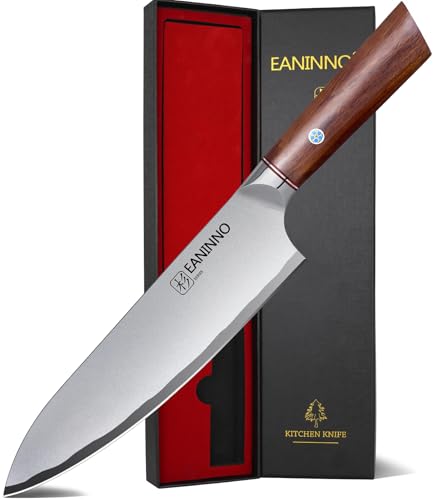
Short version: The 10Cr15MoV steel and matte finish deliver good corrosion resistance, but the listing is thin on grind and hardness details.
10Cr15MoV is a Chinese equivalent of AUS-10, which is a respectable mid-range stainless steel. It contains around 1% carbon and 15% chromium, giving it a decent balance of edge retention and stain resistance. The unique matte blade design is more than looks—a matte finish reduces drag when slicing through dense ingredients, because the surface is slightly textured and creates less suction. That is a small but real benefit.
The manufacturer claims “effortless slicing” and “long-lasting sharpness,” but neither the HRC nor the edge angle appears anywhere in the spec sheet. Without an HRC number, you cannot compare this knife to the FAMCÜTE’s 62 or the Sunnecko’s VG-10. The missing information is the annoyance, because the steel itself is capable. Also note the product name spells “Stainless” as “Staniless,” which suggests a hasty listing and raises questions about the brand’s attention to detail. The rust resistance claim is credible given the chromium content, but I would not trust the knife to hold an edge like the harder options here.
Pros:
- 10Cr15MoV steel — proven mid-range stainless with good corrosion resistance.
- Matte blade finish — reduces food sticking and looks less fingerprint-prone than polished steel.
- 8-inch chef profile — familiar shape for Western cooks transitioning to Japanese-style blades.
- Rust resistance — high chromium means it survives a forgotten rinse better than carbon steel.
Cons:
- No HRC listed — you are buying edge retention on faith.
- No edge angle specified — the “sharp” in the name is unverified.
- Misspelled product name — “Staniless” on the packaging is a quality-control red flag.
The Bottom Line
Best for: Someone who wants a rust-resistant daily driver and does not demand peak sharpness. Skip if: You care about long-term edge retention—without a stated HRC, this knife will likely need more frequent sharpening.
Sunnecko 8 Inch Japanese Damascus Chef Knife – Ultra Sharp VG10 Steel (67-Layer)

Our top pick’s story: The 67-layer Damascus wrapped around a VG-10 core with a 10–12° inclusive edge is the sharpest out-of-the-box candidate here.
VG-10 is a Japanese stainless steel originally developed for kitchen knives, and it holds a finer edge than most stainless alternatives. The 67-layer Damascus pattern is forge-welded around the VG-10 core, which means the core steel does all the cutting while the outer layers provide looks and a slight increase in toughness. The listed edge angle is 10–12° per side, which is extremely thin—this is why the knife will feel dramatically sharper on the first tomato than any Western 20° blade. However, that thinness also means the edge is fragile: cutting into a squash that is too hard, or scraping the board to move food, can roll or micro-chip the edge.
The full tang design gives seamless weight distribution from blade to handle, and that balance matters when you are doing fine tip work or rocking through herbs. The annoyance is that the Damascus claims often lead buyers to believe the pattern itself increases sharpness—it does not. The sharpness comes entirely from the VG-10 core and the thin grind. Also, because the edge is so acute, you will need to touch it up more often on a fine whetstone than a thicker knife. If you are willing to maintain it, this is the sharpest Japanese knife experience on the list.
Pros:
- VG-10 core steel — the benchmark for Japanese stainless kitchen knives, excellent edge retention.
- 10–12° edge angle — dramatically sharper out of the box than standard chef knives.
- 67-layer Damascus — beautiful ripple pattern and the outer layers add slight impact resistance.
- Full tang construction — stable, balanced, and unlikely to loosen over time.
Cons:
- Extremely thin edge — chips easily on bones, frozen food, or even hard squash skin.
- Requires frequent maintenance — the acute angle needs touch-ups on a fine stone more often.
- Damascus pattern is aesthetic — do not pay extra expecting better cutting performance from the layers.
Final Thoughts
Best for: Cooks who want peak sharpness and are disciplined about hand washing, proper cutting technique, and regular honing. Skip if: You tend to cut through chicken bones or toss knives into a drawer—this blade will chip.
KnifeSaga 14 Pcs Knife Block Set (Complete Kitchen Collection)
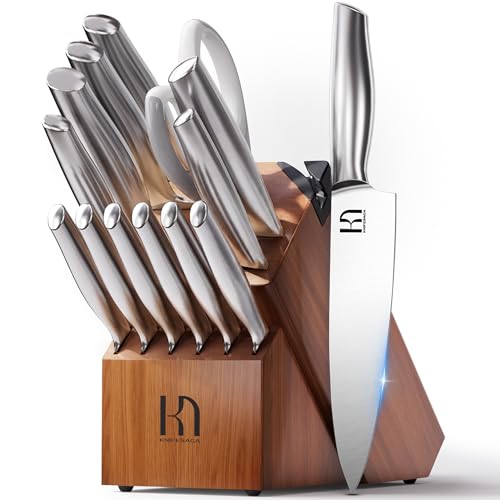
Here’s the deal: If you need a full block, the KnifeSaga set gives you numbers, but the individual knives won’t match a single focused Japanese blade.
The KnifeSaga set includes 14 pieces in a block, which means you get a chef knife, bread knife, pairing knife, utility knife, steak knives, and kitchen shears. The manufacturer uses the term “Mystic Forged Steel,” which is marketing speak with no technical meaning—there is no steel composition, no HRC, no edge angle given for any knife in the set. The claim of “long-lasting sharpness” is impossible to verify from the listing because they give you zero metallurgical data. That is a major red flag when you are shopping for sharpness.
What the set does offer is convenience and a consistent handle design. The weight and grip are described as perfect, but without handling them, we cannot confirm. The annoyance is that the “revolutionary steel formula” is never explained—revolutionary usually means a proprietary blend that the company does not want tested. For a block set, the individual blade quality is often lower than a single-purpose knife at the same price. You are buying variety, not peak performance. If you have a family and need a safe knife for everyone, this could work; if you want a razor-sharp Japanese edge, look elsewhere.
Pros:
- 14-piece complete set — covers every kitchen task from paring to bread slicing.
- Included block storage — protects edges and keeps knives organized on the counter.
- Ergonomic handle emphasis — the listing focuses on grip comfort, which matters for long prep.
- Kitchen shears included — a useful addition many single-knife buyers forget.
Cons:
- No steel type or HRC disclosed — “Mystic Forged Steel” is meaningless without a spec.
- No edge angle information — you cannot compare sharpness to the single knives here.
- “Revolutionary steel formula” is a red flag — vague claims usually hide mediocre steel.
Quick Take
Best for: A household that needs a full set and does not prioritize razor sharpness. Skip if: You are shopping for the sharpest Japanese knife possible—none of these 14 will match the Sunnecko or FAMCÜTE.
What Actually Matters for Japanese Knife Sharpness
The word “sharp” appears on almost every knife box, but real sharpness comes from three measurable things: steel hardness, edge angle, and grind geometry. Here is how to judge a Japanese knife before you buy.
Steel Composition and HRC: The Foundation of Sharpness
Japanese knives are famous because their makers have historically used high-carbon steels hardened above HRC 60, which allows a finer edge to resist deformation. The Rockwell hardness scale (HRC) measures how well a steel resists indentation—in knife terms, how long the edge stays crisp. For a home cook, you want HRC 58–62. Below 58, the edge rolls over quickly; above 62, the steel becomes brittle and chips. The FAMCÜTE at HRC 62 sits at the top of that range, while the imarku and KnifeSaga give you no number at all—which is why we could not verify their edge retention claims. VG-10 (as in the Sunnecko) typically lands around HRC 60–61, and that is a proven sweet spot for kitchen knives.
Edge Angle: The Real Reason Japanese Knives Feel Sharper
Most Western chef knives are sharpened at 20° per side, giving a durable but blunt edge. Japanese knives typically run 10–15° per side. The Sunnecko’s 10–12° edge is extremely acute, which is why it cuts with so little effort, but also why it chips more easily. The HOSHANHO’s 15° is a more forgiving compromise. If a listing does not state the edge angle—like the imarku, FAMCÜTE, and KnifeSaga—you have no idea whether the factory edge will perform like a scalpel or a hatchet. That missing spec is the difference between a knife that falls through an onion and one that crushes it.
Grind Geometry and the Factory Edge
Even with good steel and a thin angle, a poorly ground blade will wedge in food. The grind should taper evenly from spine to edge without thick shoulders near the cutting bevel. Hand-polished edges, like the HOSHANHO, tend to be more consistent because a human adjusts for deviations. The factory edge on the Sunnecko is described as razor-sharp, which suggests a careful finishing pass. But any factory edge will degrade, so check whether the maker recommends a specific sharpening angle for maintenance. A knife that arrives sharp but cannot be re-sharpened to the same angle is a temporary pleasure.
Storage and Cutting Board: The Sharpness Killers
Even the best Japanese knife dulls fast if stored loose in a drawer or used on a glass cutting board. Glass is essentially a sharpening stone in reverse—it will roll the edge in a single session. Use an end-grain wood board or a soft polymer board, and store the knife in a block, on a magnetic strip, or with an edge guard. The KnifeSaga set includes a block, which is good, but all single knives need a solution. Our guide to Japanese knife sets with magnetic blocks covers storage options that protect the edge.
Our Final Recommendation
For budget shoppers, the FAMCÜTE 8″ Japanese Knife with HRC 62 steel is the best value—you get high hardness and corrosion resistance without the Damascus price tag. For pure sharpness out of the box, the Sunnecko 8 Inch Japanese Damascus Chef Knife is the overall winner: its VG-10 core and 10–12° edge deliver the thinnest, most effortless cutting of the group, provided you treat it gently. If you want a dedicated vegetable knife, the HOSHANHO Nakiri is a solid addition, but it is not a replacement for a chef’s knife. The other three—imarku, EANINNO, and KnifeSaga—all omit the HRC and edge angle that would make them recommendable, and in a category defined by sharpness, that omission is the deciding factor. Buy the Sunnecko if you can afford it; buy the FAMCÜTE if you need to save a few dollars. Both will keep you sharp.
Frequently Asked Questions
What does “japanese sharp” really mean compared to Western knives?
Japanese sharp refers to the combination of higher steel hardness (typically HRC 58–62) and thinner edge angles (10–15° per side) that Japanese knife makers have traditionally used, versus the softer HRC 54–57 and 20° edges common in Western knives. That difference means a Japanese knife cuts with noticeably less force but is more prone to chipping if abused. The sharpness is not magic—it is metallurgy and geometry.
How do I tell if a Japanese knife is really sharp when it first arrives?
Try the paper test: hold a sheet of printer paper by one edge and slice downward with the knife. A truly sharp Japanese blade will cut through with almost no pressure, leaving a clean straight line. If the paper tears or the blade catches, the factory edge needs work. You can also gently rest the edge on your thumbnail—if it bites instead of sliding, the edge is thin and crisp. But do not test on your finger.
How often should I sharpen a Japanese knife to keep its edge?
With daily home use, a high-quality Japanese knife like the Sunnecko or FAMCÜTE will hold its edge for 2–4 months with regular honing on a fine ceramic or leather strop. After that, you need a whetstone touch-up at the original angle (10–15°). If you are using the knife on bamboo or glass, expect to sharpen monthly. The softer imarku or KnifeSaga blades will need sharpening more often, possibly every few weeks, because their HRC is unknown but likely lower.
Can I use a Japanese knife on a glass cutting board without ruining the edge?
No—glass cutting boards are the fastest way to destroy a Japanese edge. Glass is harder than any steel, so every cut rolls or micro-chips the edge, turning a 10° razor into a dull wedge within a single prep session. Stick to end-grain wood, soft polypropylene, or even a high-quality bamboo board (though bamboo is less ideal than maple). If you must use glass, buy a cheap Western knife and reserve your Japanese blade for real cutting boards.