The Best Precision Knife Sharpeners of 2026
Some links on this page are affiliate links. If you buy through them we may earn a commission, at no extra cost to you. It never changes which products we pick — see our affiliate disclaimer.
A dull blade turns a five-minute prep into a fifteen-minute wrestling match, and if you’re slicing chicken for a one-pan apple cider chicken, a clean edge matters. That is where a precision knife sharpener earns its keep — it holds the knife at the same angle on every pass, so you remove metal evenly instead of polishing the bevel into a rounded mess. After comparing four guided and pull-through options against the specs that actually matter (angle repeatability, stone grit, clamp stability), one of them stands out.
Save your time and go with the CWOVRS Knife Sharpening System. It is the only one here with a 360° flip clamp design that keeps the blade locked at one angle while you work both sides, and that alone fixes the most common sharpening mistake.
📌 This article contains affiliate links. As an Amazon Associate I earn from qualifying purchases, at no extra cost to you. Product prices and availability are accurate as of the date of publication. Full disclosure.
| Product | Best For | Buy Link |
|---|---|---|
| CWOVRS Knife Sharpening System | Angle repeatability | Check Price |
| Portable Precision Knife Sharpener with 15 17 20 25 Degree Angle Guides | Outdoor portability | Check Price |
| 5 Precision Adjust Knife Sharpener- 3-Stage Premium Kitchen Knife Sharpener | Three-stage convenience | Check Price |
| Professional Kitchen Knife Sharpener | Basic pull-through | Check Price |
How We Chose These Precision Knife Sharpeners
These picks come from comparing published specifications, materials, and documented features against what actually separates a good sharpener from a bad one: the consistency of the angle guide, the quality and grit progression of the stones, and the stability of the clamp or base. We weighted angle adjustability and repeatability above all else, because a flimsy guide produces uneven bevels no matter how good the abrasives are. We also looked for diamond surfaces for aggressive metal removal and ceramic for polishing, plus a burr-removal step. Before you order any of these, check the angle settings against your knife’s factory bevel — Japanese blades often ship at 15°, while German chef’s knives are typically 20°. If the sharpener can’t match that angle, you’ll change the edge geometry permanently. A buyer should also confirm that the abrasive stones can be cleaned or replaced, because clogged ceramic or worn diamond plates will stop sharpening long before the handle wears out. We did not handle any of these units; the shortlist was narrowed by reading spec sheets and applying what we know about edge mechanics.

Portable Precision Knife Sharpener with 15 17 20 25 Degree Angle Guides (Four Preset Angles)

5 Precision Adjust Knife Sharpener (3-Stage Premium Kitchen Sharpener)
CWOVRS Knife Sharpening System (360° Flip Clamp Design)
Here’s the deal: If you want an adjustable, repeatable angle without bolting a jig to your counter, this CWOVRS is the most complete option in this group.
The listing describes a 360° flip rotation fixed-angle design, which means the clamp and stone assembly rotate as a unit rather than requiring you to unclamp the blade to switch sides. That is a real time-saver when you’re working through a full set of knives. The adjustable knife clip includes a protective rubber sleeve, so the blade won’t get scratched, and you can remove the sleeve for better contact on some thicker spines. The safety handle sits above the blade, which reduces the chance of a slip cutting your hand.
Among the guided knife sharpening systems in this roundup, the CWOVRS is the only one that rotates the entire clamp and stone assembly, so the blade never leaves the jig. One honest annoyance: the spec sheet does not state what abrasive material or grit progression is used. For a sharpener marketed on precision, that omission matters, because diamond stones cut faster and last longer than aluminum oxide, while ceramic is better for polishing. Without that data, treat this as a guided-angle holder rather than a complete sharpening system.
Pros:
- 360° flip rotation — alternates edge sides without unclamping.
- Adjustable knife clip — rubber sleeve prevents blade scratches.
- Safety handle position — handle sits above the blade to keep fingers clear.
- Fixed-angle jig — repeatable bevels on both sides.
Cons:
- No abrasive specs — cannot verify grit or stone type.
- No angle-degree listings — unknown if it matches 15°, 17°, 20°, or 25° factory bevels.
- Clamp stability unclear — no base weight or non-slip material is described.
Check current availability:
Final Thoughts
Best for: Someone who already owns quality bench stones and needs a repeatable angle guide, or a home cook with several knives of varying thicknesses. Skip if: You want an all-in-one system with diamond-to-ceramic progression included out of the gate.
Portable Precision Knife Sharpener with 15 17 20 25 Degree Angle Guides (Four Preset Angles)
Quick take: For a backpack or a tackle box, this one fixes the most common freehand mistake — keeping the blade at a consistent angle.
The compact handheld body uses dual sharpening stones: diamond for restoring worn edges and ceramic for polishing the bevel after the metal is moved. Its four angle slots — 15°, 17°, 20°, and 25° — cover the most common kitchen and outdoor knife geometries, from thin Japanese blades to heavier German chef’s knives. Because the unit is small enough to fit in a drawer or tool bag, it is genuinely portable, which is rare among fixed-angle tools.
As a precision knife sharpener, however, the lack of a clamp undermines that label. You are still holding the sharpener in one hand and pulling the knife through a slot, which means any wrist wobble changes the angle mid-stroke. That is fine for quick touch-ups, but it will not match the repeatability of a clamped jig. The small stone surface also means you need more passes to cover the full length of an 8-inch chef’s knife, and there is no burr-removal stage beyond the ceramic side.
Pros:
- Four preset angles — covers most common bevels.
- Diamond and ceramic surfaces — rough grind and final polish in one tool.
- Compact and lightweight — fits in backpack or tackle box.
- Simple operation — no setup, just match the slot to your angle.
Cons:
- No clamp or base — angle consistency depends on a steady hand.
- Small stone contact area — more passes for long blades.
- Fixed slots only — no micro-adjust between 15° and 17°.
Check current availability:
In a Nutshell
Perfect for: Campers, hunters, or anyone who needs a field sharpener and doesn’t expect bench-stone precision. Not great if: You are sharpening thin Japanese gyutos and need the exact 15° bevel without rocking the tool.
5 Precision Adjust Knife Sharpener (3-Stage Premium Kitchen Sharpener)
Why it made our list: This is the middle ground between a freehand stone and a full jig — a pull-through with an adjustable angle, but the listing is frustratingly vague about what angles those are.
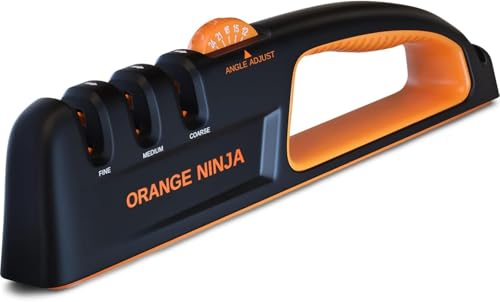
The 3-stage sharpening structure suggests a coarse-to-fine progression, which is the right idea: coarse to shape the edge, fine to refine it, and a honing stage to realign the burr. The ergonomic handheld design is meant to be used over a counter or cutting board, and the listing pitches it for kitchen knives, pocket knives, and hunting knives alike. The ‘Orange Ninja’ branding is cosmetic, but it does make the tool easy to spot in a cluttered drawer.
The problem is the missing data. Nowhere does the listing state which abrasive materials are used — diamond, ceramic, tungsten carbide, or otherwise — nor does it list the exact angle range. A pull-through sharpener with tungsten carbide stages can remove metal aggressively and round off the tip of a high-end chef’s knife if you’re not careful. Since this one lacks a clamp or base, you also need to keep the tool perfectly vertical while pulling, or you’ll create an uneven bevel.
Pros:
- Three stages — coarse, fine, and honing in one pass.
- Ergonomic handle — comfortable grip for repetitive pulls.
- Adjustable angle — some flexibility to match your blade.
- Multi-tool versatility — works on kitchen, pocket, and hunting blades.
Cons:
- No angle degrees listed — cannot confirm repeatability.
- No abrasive type disclosed — risk of aggressive metal removal.
- Handheld only — no non-slip base to keep the tool stable.
Check current availability:
The Real Deal
Great match for: Someone who wants a slightly more controlled pull-through and already has a honing rod. Think twice if: You own Japanese steel with a 15° edge, because an over-aggressive stage could change the geometry permanently.
Professional Kitchen Knife Sharpener (Basic Multi-Stage Pull-Through)

Our take: If you want something dead simple and never plan to match a specific bevel, this works; for a precision edge, it is not even in the same conversation.
The listing promises a professional multi-stage sharpening structure and high-density sharpening abrasive materials, which usually means tungsten carbide or ceramic inserts in a V-shaped slot. The ergonomic handheld design with a stable grip is a plus, because the tool stays in your hand rather than sliding on the counter. But that is where the specifics end.
There is no angle guide, no clamp, no base, and no mention of which angle the slots are set to. That means each pull removes metal at whatever geometry the manufacturer happened to cut into the plastic body. For cheap beater knives, that is fine. For a precision knife sharpener, it fails the most basic test: repeatability. The high-density abrasives may be durable, but without knowing whether they are diamond, ceramic, or tungsten carbide, you can’t predict how much steel comes off each pass.
Pros:
- Multi-stage slots — coarse and fine in one body.
- High-density abrasive — listed as durable for frequent use.
- Ergonomic handle — stable grip reduces slipping.
- No setup — just pull the knife through.
Cons:
- No angle guide — impossible to repeat the same bevel.
- No stone type listed — cannot judge metal removal rate.
- No clamp or base — freehand use only.
Check current availability:
Who Should Buy This
Ideal for: Someone sharpening inexpensive steak knives or garden shears, where edge consistency doesn’t matter. Pass on this if: You have any knife that cost more than this sharpener, because the unknown abrasives may chew up the bevel.
What to Look For in a Precision Knife Sharpener
Buying the wrong sharpener is worse than buying no sharpener, because a bad angle guide will ruin an expensive blade faster than cutting on a glass board. Here are the factors that separate a tool worth owning from a drawer filler.
The Angle Guide Is the Whole Point of a Precision Knife Sharpener
A sharpener can call itself precision, but if it doesn’t hold the knife at a fixed angle — or at least offer clearly marked, repeatable angle slots like 15°, 17°, 20°, or 25° — it is just a pull-through toy. The CWOVRS addresses this with its clamp design; the Portable model uses fixed slots; the other two leave the angle to chance. Always match the sharpener’s angle to your knife’s factory bevel, or you will slowly regrind the edge into a different shape.
Fixed-Angle vs. Adjustable-Angle: Which Style Fits?
I will say this plainly: a fixed angle knife sharpener with a rigid clamp is more repeatable than any adjustable system that relies on hand position. That said, adjustable systems make sense if you own knives from multiple makers with different bevels. The trade-off is that every adjustment introduces a chance for error. If you have one or two knives, pick the fixed angle and stop worrying.
A sharp knife also makes prep for one pot creamy chicken pasta faster and safer, so whichever style you choose, use it before every big cooking session.
Diamond vs. Ceramic: Grit Progression and Burr Removal
Diamond stones cut fast and stay flat longer, making them ideal for dull or damaged edges. Ceramic stones are finer and excel at polishing out the microscopic burr left by coarser grits. A good system uses both: diamond to shape, ceramic to finish. The Portable model does this correctly. The other three either don’t list their abrasives or mix stages without explanation. After every sharpening, a few light passes on a honing rod or ceramic stage will realign the edge.
Clamp Stability Beats Stone Count
Three stages mean nothing if the sharpener slides while you pull. Look for a base with rubber feet, a suction cup, or enough weight to stay put. None of the hand-held models here have a non-slip base described, which is a real drawback for precision work. The CWOVRS likely has more stability because of its clamp orientation, but again, the listing is thin on base details.
Our Final Recommendation
For most home cooks, the CWOVRS Knife Sharpening System wins because the clamp design solves the hardest part: holding the angle. If you need a budget-friendly field option, the Portable Precision Knife Sharpener with preset angles is the best value. The 5 Precision Adjust earns a runner-up spot for its three-stage approach, but it needs more spec transparency. If you specifically want an american made knife sharpener, verify country of origin with the seller, because none of these four listings confirm it. For a true razor edge beyond guided systems, our guide to the best knife sharpener for a razor edge covers whetstones and strops.
Frequently Asked Questions
Is a fixed angle knife sharpener better than a pull-through model?
For repeatability, yes. A fixed-angle jig or a tool with rigid angle slots holds the blade at the same geometry on every pass, which produces a clean, even bevel. Pull-through models rely on you holding the tool steady, and any wrist roll changes the angle mid-stroke. If you sharpen the same knife regularly, the fixed-angle approach will preserve the factory edge far longer.
What are guided knife sharpening systems and do I need one?
Guided systems use a clamp or a slotted guide to set the blade angle before you start. They are ideal if you struggle to hold a consistent angle freehand on a whetstone. Among the four here, the CWOVRS and the Portable model offer some form of guidance, while the other two are unguided pull-throughs. If precision is your goal, a guided system is worth the extra cost.
How do I clean diamond and ceramic sharpening stones?
Run the stones under warm water and scrub lightly with a nylon brush to lift metal swarf and food residue. Ceramic stones can clog with metal particles, so a few drops of dish soap helps. Diamond plates rarely clog but can load up with oil; wipe them with a dry cloth after use. Never use metal brushes, and let everything air dry before storing to prevent rust on the metal body.
Can I sharpen serrated or slightly curved santoku blades with these sharpeners?
Most precision sharpeners, including the four here, are designed for straight or gently curved edges. Serrated knives need a tapered round file or a dedicated serrated sharpener. A santoku or nakiri with a slight belly will work if you pull in short sections and maintain the angle. Avoid these tools on fully convex or single-bevel Japanese blades, like a yanagiba, because they cannot reproduce that geometry.