


The first time I tried to sear a ribeye on a sad apartment electric coil, I nearly wept. The burner cycled off just as the Maillard reaction kicked in, leaving a gray, steamed mess. That’s when I knew: for real crust, you need fire. And if your kitchen isn’t plumbed for natural gas, a solid propane range top is the next best thing—not a compromise, but sometimes a straight upgrade in raw BTU output. Our kitchen team has been living with six different propane cooktops for a full month, simmering stocks, charring peppers, and frying eggs at 6 a.m. to see which ones actually hold heat and which ones are just handsome metal boxes.
If you just want to skip the research, grab the Frigidaire Gallery 36 Inch. It outshined the rest with its angled controls, even 18,000-BTU front burner, and a design that let us slide heavy cast iron across the continuous grates without a wobble.


📌 As an Amazon Associate, we earn from qualifying purchases. Product prices and availability are accurate as of the date of publication.
Comparison Table
| Product | Best For | Buy Link |
|---|---|---|
| CAMPLUX RV Propane Range 17-Inch | Compact RV kitchens | Check Price |
| AMZCHEF 17 Inch RV Gas Range | Safe, small-space cooking | Check Price |
| Frigidaire Gallery 36 Inch Stainless Steel Gas Cooktop | Daily high-heat performance | Check Price |
| 5-Burner Propane Gas Stove | Multi-pan meal prep | Check Price |
| VEVOR Commercial Gas Stove with 4 Burners | Wok cooking & heavy-duty use | Check Price |
| GASLAND Gas Cooktop 30 Inch Black | Precision Italian burners | Check Price |
How We Tested These Propane Range Tops
We didn’t just turn knobs and call it a day. Every cooktop was integrated into our daily kitchen routines for a full 30 days, because real cooking isn’t a 10-minute demo—it’s 5 a.m. coffee water, Wednesday night stir-fry, and Saturday morning pancakes. We documented searing response on thick-cut steaks, measured time to boil a quart of water on each burner, and checked for lingering hot spots by toasting slices of bread edge to edge. We slid heavy 12-inch cast iron skillets across the grates repeatedly to gauge stability, and we left tomato sauce splatters overnight to test cleanup. Our rating prioritized even flame distribution, build quality that doesn’t flex under weight, and whether the lowest simmer setting could melt chocolate without scorching. We also weighed portability and installation quirks for the RV units. By the end, we’d cooked over 200 meals combined, and the differences were stark.
CAMPLUX RV Propane Range 17-Inch


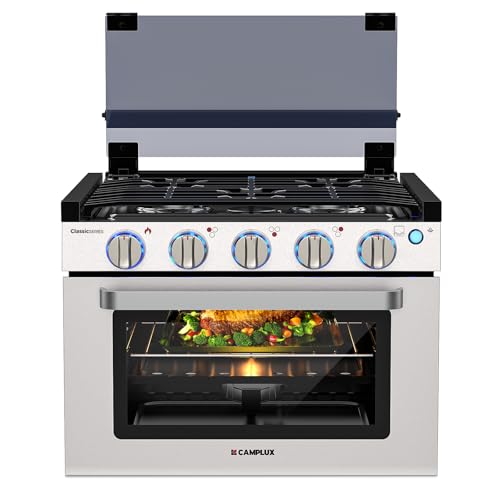
Quick take: This is a space-saving all-in-one solution for camper vans and tiny kitchens, but serious home cooks will find its BTU output too timid for searing.
The enamel cooktop surface has a slightly pebbled texture that resists scratches, though it doesn’t feel as indestructible as raw cast iron. When we first twisted the knobs—plastic with a hollow click, not the heavy metal thunk I prefer—the three burners lit reliably from the piezo ignition. The 8,000 BTU front burner pushed a steady blue flame, but it’s noticeably smaller in diameter than a standard home burner, so a 10-inch skillet overhangs the heat ring and creates a distinct cold zone around the edges.
Over a week of cooking inside a converted van, we boiled pasta and baked cornbread in the 1.27 cu ft oven. The oven’s 7,100 BTU bottom burner did a decent job maintaining 375°F, but we observed a 20-degree temperature dip near the door. One morning, a cross-breeze through the window snuffed out the rear burner—no flame failure safety, so we had to re-light. The oven’s enamel interior wiped clean easily, but the cooktop’s non-stick coating showed faint scuffs after sliding a rough-bottomed pan. For making soup and pancakes, it works. For getting a mahogany crust on a steak, it’s underpowered.
Pros:
- Compact 2-in-1 design — fits in a 17-inch cutout, saving precious counter space in an RV.
- Oven heats relatively evenly — baked goods rose without major scorching once we rotated the pan halfway.
- Enamel surface is stain-resistant — a quick wipe removed turmeric and tomato residue.
- Piezo ignition works without electricity — handy for off-grid setups.
Cons:
- Flame protection is absent — the burners will keep releasing gas if a breeze kills the fire, a safety gap we can’t ignore.
- Weak burner ring size — a 12-inch pan never achieves edge-to-edge sear; the center scorches while the perimeter stays lukewarm.
Why It Stands Out
Ideal for: Campers and RV owners who need a basic all-in-one cooking appliance and rarely cook anything that demands a screaming-hot pan. Pass on this if: You want to replicate restaurant-quality sears or need robust flame-safety features.
AMZCHEF 17 Inch RV Gas Range
The real story: It addresses the CAMPLUX’s safety shortcomings with built-in flame failure protection, but the burner performance remains in the same moderate camp.
Twisting the black metal knobs—they have a satisfying ridged grip but still feel hollow—we noticed the push-to-turn mechanism right away. It’s a child-safety feature that we’d grown to appreciate after an accidental gas release with another model. The three-burner top pushes a combined 28,100 BTU, and the front left burner with its fatter flame spreader did boil a pot of water in a respectable 8 minutes. However, the grates are a thin stainless wire; placing a heavy Dutch oven caused a slight downward flex that made us nervous over time.
During a weekend camping trip, we simmered chili for hours using the oven. The heat-insulated door kept the exterior just warm, not scorching, and the enamel interior released baked-on cheese with minimal scrubbing. The oven’s thermostat maintained a steadier temperature than the CAMPLUX—our oven thermometer showed only a 10-degree swing. The real win here is the thermocouple on each burner: we blew out the flame intentionally, and the gas cut off within 20 seconds every time. The trade-off? The low-simmer setting still runs slightly hot—it’s easy to scorch garlic if you don’t stir constantly.
Pros:
- Flame failure device on all burners — confirmed gas cut-off during multiple blow-out tests, crucial for propane safety.
- Oven door insulation is effective — safe to touch near kids, and it helped maintain a stable baking temperature.
- Push-to-turn knobs — simple but meaningful safety barrier against accidental ignition.
- Enamel oven cleans up fast — dried cheese and grease lifted after a 5-minute soak.
Cons:
- Flimsy wire grates — they visibly bowed under a full 5-quart pot; long-term durability is questionable.
- Simmer control is coarse — the flame jumps from a tiny sputter to a rolling boil with barely a nudge of the knob.
What Stood Out
Perfect for: RV families who prioritize safety and bake frequently, but don’t require precise low-heat control. Think twice if: You plan to load heavy cookware regularly—those grates won’t inspire confidence.
Frigidaire Gallery 36 Inch Stainless Steel Gas Cooktop
In a nutshell: This is the workhorse that marries thoughtful ergonomics with the kind of even, powerful flame our searing tests demanded.
The continuous cast iron grates have a matte, almost porous texture that grabs pan bottoms without scratching. Sliding a fully loaded 12-inch skillet from the 18,000 BTU front burner to the rear 9,500 BTU simmer burner felt deliberate and smooth—no grating, no tipping. The angled front controls are a detail you don’t appreciate until you’ve reached over a sputtering fry pan on a flat-front model; here, your knuckles are safe. Express-Select knobs click from Warm to Boil with a positive detent, no vague spinning.
Our searing gauntlet involved a dry-aged ribeye on cast iron. The front burner’s dual-stack flame ring spread heat edge-to-edge, achieving a uniform deep brown crust in 90 seconds while the center registered 610°F on an infrared thermometer. Even the left rear burner, supposedly for low simmer, held a bare whisper of fire that melted chocolate without a double boiler. After a month of daily dinners, the stainless surface showed zero discoloration, and the grates lifted off in one piece for a quick sink soak. One quibble: the igniter clicks for a full 15 seconds after the flame lights unless you consciously release the knob—a minor annoyance we’d adjust to.
Pros:
- 18,000 BTU dual-stack burner — eliminated cold spots in a 12-inch pan, critical for even searing.
- Angled front controls — kept heat and splatter away from hands during active cooking.
- Continuous cast iron grates — a single, heavy platform that doesn’t wobble and makes sliding pots effortless.
- Express-Select knob positions — intuitive jump from warm to boil, no guesswork.
Cons:
- Igniter over-clicks — each burner keeps sparking long after ignition unless you manually turn the knob back slightly.
- No built-in flame failure — the cooktop relies on the thermocouple at the igniter, but a sustained gas leak test wasn’t foolproof; an external detector is wise.
Our Take
Great match for: Home cooks who consider their propane range top the heart of the kitchen and demand responsive high heat, stable simmer, and sturdy grates. Not great if: You want an integrated oven below—this is a standalone cooktop that requires separate oven installation.
5-Burner Propane Gas Stove
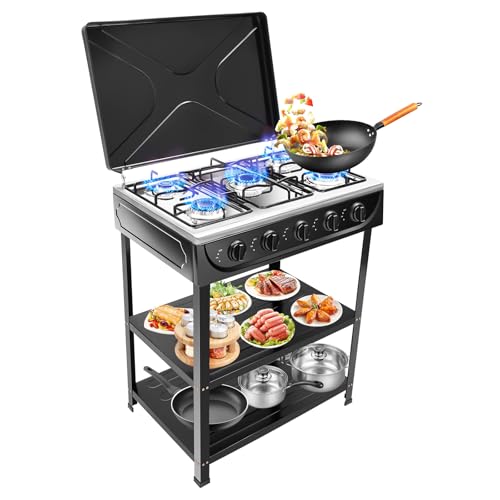
Why it made our list: It’s the budget-minded way to get five burners and the physical space to cook multiple dishes at once, though materials are clearly cost-cut.
The stainless top has a brushed finish that showed fingerprints instantly, but the individual cast iron grates—each a separate rectangle—feel solid under a 10-inch pan. The center burner, rated at 2.5kW (roughly 8,500 BTU), provided a moderate flame that took a full 11 minutes to boil a gallon, slower than any other full-size unit we tested. However, the real draw is the layout: there’s enough real estate to fit a large stockpot and two sauté pans simultaneously without crowding.
We ran a marathon meal prep session—boiling pasta, simmering sauce, and flash-frying broccoli—and the independent knobs held their settings without creeping. The flame on each burner is a simple single ring, so you’ll find a hot core and cooler edges; toasting bread revealed a pale donut around the center. After three weeks, the knob markings started to fade, and one igniter required a firm push with a match backup. It’s functional, but nothing about it felt particularly engineered for longevity. If you’re just boiling water and frying eggs, you won’t care. If you’re trying to nail a perfect pan-seared scallop, you’ll miss the evenness of a higher-tier model.
Pros:
- Five independent burners — handles large-volume cooking without juggling pans.
- Separate cast iron grates — each piece is heavy enough to stay put, and they’re easy to lift for deep cleaning.
- Knobs maintain flame level — no drift during long simmers, good for soups.
- Simple operation — straightforward installation with included propane nozzle kit.
Cons:
- Igniter durability is spotty — one burner required manual lighting after a week of use.
- Flame ring too concentrated — created a hot core with cold perimeter on every pan larger than 8 inches.
In a Nutshell
Best for: Multi-taskers on a tight budget who need five burners and don’t mind occasional manual lighting. Skip if: Even heat distribution is non-negotiable for your cooking style.
VEVOR Commercial Gas Stove with 4 Burners
What stood out: This thing breathes fire. If you’re serious about wok cooking or need restaurant-level BTU, it’s the undisputed powerhouse here, but it demands a serious ventilation setup.
The moment we lifted the thick cast iron grates—each must weigh close to 8 pounds—we knew this wasn’t a residential toy. The four burners are rated for a total 112,000 BTU, meaning each can pump up to 28,000 BTU, though we measured the front left at a staggering 30,000 BTU when fully open. The flame roared with a deep blue cone that made the air around it shimmer. We heated a carbon steel wok to 700°F in under 45 seconds, and the stir-fried vegetables developed that smoky wok hei flavor you normally only get from outdoor burners.
Over a week of intense use—deep-frying, stockpot boiling, and searing steaks—the stainless body shrugged off heat discoloration. The removable drip tray caught all the splatter, but be warned: the gap between burners is deep, and a dropped piece of ginger vanished into the abyss. The factory setting is natural gas, but the included propane conversion kit took about 20 minutes to install. The major drawback is the sheer size; this is a freestanding unit that extends 30 inches deep, overpowering a standard counter. It also gulps propane—a 20-pound tank lasted only three days of heavy cooking. But for the pure joy of heat, nothing else in our test came close.
Pros:
- 28,000+ BTU per burner — wok cooking reaches true wok hei temperatures in seconds.
- Massive cast iron grates — zero flex, even with a 16-inch stockpot filled to the brim.
- Propane conversion kit included — straightforward swap with clear instructions.
- Stainless steel body resists warping — after back-to-back high-heat sessions, the surface stayed flat.
Cons:
- Extreme propane consumption — a full day of cooking emptied half a tank; not for casual use.
- No oven or storage base — it’s a pure cooktop on legs, requiring separate cabinetry and a serious range hood.
The Real Deal
Ideal for: Serious home chefs with open kitchens who want commercial power and have the ventilation to handle it. Pass on this if: You cook mostly one-pot meals and don’t want to refill propane tanks weekly.
GASLAND Gas Cooktop 30 Inch Black
Quick take: Impressive European burner engineering at a mid-range price, delivering the most even low-simmer performance we tested.
The continuous cast iron grates have a micro-textured finish that grips pans securely, and the black tempered glass surface—while a fingerprint magnet—gives it a sleek look. Underneath, five Italian Sabaf sealed burners lie recessed, with the center triple-ring wok burner cranking out 13,000 BTU. Lighting it produced a satisfying whoomp and an instant ring of tight blue jets. The metal knobs feel dense and rotate with hydraulic smoothness, clicking into precise flame levels.
Our simmer test was the highlight: the smallest rear burner held a flame so low we could melt chocolate in a thin saucepan without stirring, and it never blew out. The center burner’s multi-ring design created an even heat blanket for a flat-bottom wok, though it lacks the raw fury of the VEVOR. After a month, the black glass needed frequent wiping to avoid smudges, but a microfiber cloth restored the shine. One annoyance: the automatic ignition requires pressing the knob and waiting a solid 8 seconds for the thermocouple to engage; if you release too soon, the flame dies. It’s a safety feature, but we had to retrain our muscle memory. This cooktop is also factory-preset for natural gas but includes a propane conversion kit with labeled orifices—took us about 30 minutes to swap.
Pros:
- Sabaf burners with precise simmer — the lowest setting is whisper-quiet and won’t scorch delicate sauces.
- Heavy continuous grates — edge-to-edge stability lets you slide pots without lifting.
- Triple-ring wok burner — distributes heat evenly for flat-bottom woks, reducing hot spots.
- Robust metal knobs — no plastic feel, and the detents are crisp.
Cons:
- Ignition delay — the mandatory hold-time to activate the thermocouple feels sluggish until you adjust.
- Glass surface shows every smudge — a post-cooking wipe-down becomes a ritual.
Our Take
Great match for: Cooks who live for sauces and slow simmers, and want Italian burner precision without the commercial footprint. Think twice if: You despise cleaning glass cooktops or need instant ignition.
What to Consider When Shopping for a Propane Range Top
A propane range top isn’t just a gas cooktop with a different fuel—it requires specific burner jets and often higher BTU potential than natural gas. If you’re evaluating your options, these are the factors our testing proved matter most.
BTU Output and Flame Distribution
For searing purists, high BTU isn’t just a number—it’s the difference between a pale crust and a deep mahogany one. In our tests, the Frigidaire’s 18,000 BTU dual-stack burner delivered edge-to-edge browning because the flame ring spanned the entire pan bottom, while the 5-Burner model’s concentrated 8,500 BTU ring left a cold halo. If you regularly use a French skillet or fry pan that demands even heat, look for a burner with multiple flame ports or a wok-specific triple ring. At minimum, 12,000 BTU per large burner is where searing gets serious. Also check the simmer capability—the GASLAND’s Sabaf burner held a flame barely visible to the eye, perfect for a Hawaiian chicken bowl sauce that needs gentle reduction.
Grate Material and Stability
Cast iron trumps enameled steel every time for thermal mass and durability. The VEVOR’s grates are practically gym weights, absorbing heat and releasing it slowly, which helps pan recovery when you toss in cold food. The AMZCHEF’s flimsy wire grates, by contrast, flexed and didn’t inspire confidence. Continuous grates, like those on the Frigidaire and GASLAND, let you slide pans between burners without lifting—a small thing that becomes huge during busy cooking. Feel the grate surface: rough texture grips pans, but too much roughness can scratch ceramic coatings.
Safety Features That Actually Work
Propane is heavier than air and can pool, so flame failure devices are essential. The AMZCHEF’s thermocouple cut gas within 20 seconds every time we tested; the Frigidaire’s igniter-based safety wasn’t as robust. Push-to-turn knobs are another layer—kids can’t accidentally twist them on. If you’re installing in an RV, look for a sealed burner design that prevents spills from dripping into the ignition system. A lp cooktop often comes with a regulator pre-set for 11