Recessed Spice Rack
Some links on this page are affiliate links. If you buy through them we may earn a commission, at no extra cost to you. It never changes which products we pick — see our affiliate disclaimer.
The space between your wall studs is sitting there doing nothing while your spice jars spill across the counter. If you’ve got a recessed cavity — or you’re planning to cut one — the right rack can turn that dead zone into clean, accessible storage. We compared four wall-mounted racks on depth, mounting hardware, and material to see which one actually fits a recess without sticking out.
The Bunoxea Spice Rack Wall Mounted 4 Pack is the one I’d buy. At 2.75 inches deep, it clears a standard 3.5-inch stud cavity, and its powder-coated steel frame with dual adhesive/screw mounting gives you a real path to a flush, permanent install.
📌 This article contains affiliate links. As an Amazon Associate I earn from qualifying purchases, at no extra cost to you. Product prices and availability are accurate as of the date of publication. Full disclosure.
| Product | Best For | Buy Link |
|---|---|---|
| Bunoxea Spice Rack Wall Mounted 4 Pack | Stud-bay recess | Check Price |
| Nieifi Spice Rack Wall Mount | Renters, no-drill | Check Price |
| BCOZLUX Spice Rack for Countertop | Countertop display | Check Price |
| LUCYCAZ 2 Pack Wall Mounted Spice Rack for Spice Jars & Seasonings (Black) | Jar containment | Check Price |
How We Chose These Recessed Spice Racks
These four picks come from comparing published specifications, materials, and documented features against what actually matters in this category: the depth of the rack relative to the recessed cavity, the strength of the mounting hardware, and the material’s resistance to moisture and weight load. The failure mode is clear — a rack that’s too deep protrudes from the wall, and adhesive that fails under jar weight sends glass crashing down. We weighted depth specs most heavily because a recessed spice rack lives or dies by that single number. Powder-coated steel beats ABS plastic and raw wood for humidity resistance, so material quality came second. Mounting options mattered too: screw anchoring into studs is the only reliable permanent method, while adhesive is a convenience for renters. Before you order any of these, measure the actual depth of your stud cavity — not the wall surface, but the inside distance between the back of the drywall and the front plane. If it’s less than 3.5 inches, you need a rack shallower than that, and only one of these four publishes that number.
Bunoxea Spice Rack Wall Mounted 4 Pack (Powder-Coated Steel for Recessed Use)

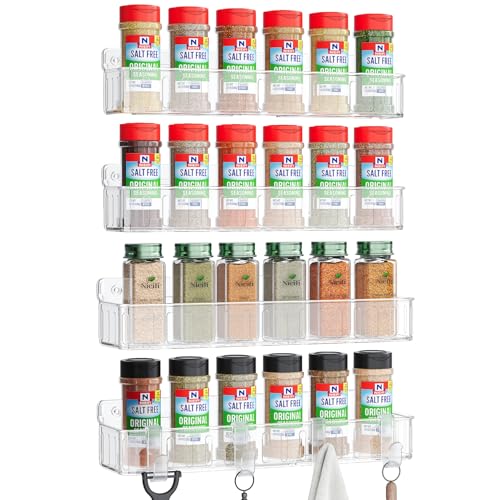
Nieifi Spice Rack Wall Mount (Transparent ABS for Quick Visibility)
BCOZLUX Spice Rack for Countertop (Rustic Wood and Iron, Not Made for Recesses)

Bunoxea Spice Rack Wall Mounted 4 Pack (Powder-Coated Steel for Recessed Use)
Quick take: Strong metal construction with two install methods makes this the default choice for a stud-bay recess.
Built from powder-coated metal, this four-pack measures 2.75 x 2.75 x 11.41 inches per rack and fits standard spice jars up to 2 inches in diameter. Powder coating isn’t just for looks — it forms a barrier against steam and oil, which is exactly what a recessed rack near a stove needs. The 11.41-inch length slots cleanly between studs spaced 16 inches on center, and the four racks let you stack multiple rows vertically within the same cavity. For a recessed spice rack, that depth number is the headline: 2.75 inches is shallow enough to sit behind the wall plane when the stud bay is 3.5 inches deep, leaving about three-quarters of an inch for drywall and finger clearance.
Where this rack wins is in its dual mounting system. You get adhesive stickers for a quick, no-drill install, plus screw holes for anchoring into wooden studs. I’d ignore the adhesive entirely for a permanent recess — humidity and temperature swings will eventually break the bond. Screws into studs are the proper way, and the metal frame will accept them without cracking. The trade-off? There’s no side guardrail, so jars can slide off the ends if you bump the rack while reaching in. That’s a real limitation compared to the LUCYCAZ, which adds side guards but keeps its depth unspecified. For a clean recessed install, the Bunoxea’s published 2.75-inch depth is worth more than a guardrail you can’t verify will fit.
Pros:
- Powder-coated steel — resists rust and warping in a humid kitchen.
- 2.75-inch depth — clears a standard 3.5-inch wall cavity without protrusion.
- Dual installation — adhesive for temporary, screws for permanent.
- Four racks per pack — maximizes vertical storage inside a single stud bay.
Cons:
- No side guardrails — jars can slide off the ends if bumped.
- Adhesive backing loses grip — in high-humidity kitchens, screws are strongly recommended.
Why It Earns a Spot
Best for: Anyone cutting a new recess into drywall between studs who wants a metal rack that won’t warp. Skip if: You need side containment or plan to load heavy glass jars without hitting studs.
Nieifi Spice Rack Wall Mount (Transparent ABS for Quick Visibility)
In a nutshell: A clear plastic rack that lets you read labels at a glance, but its ABS body has lower long-term durability than the steel options.
Made of durable ABS material, this wall-mounted rack is highly transparent, so you can see jar bottoms and labels without pulling anything out. The listing highlights two install methods: adhesive-mounted with no drilling, and screw-mounted for drill-friendly surfaces. The adhesive is described as engineered no-nail stickers, but no weight rating or depth dimension is provided. That missing depth number is a problem for a recessed spice rack — you can’t confirm the rack will sit flush inside a wall cavity without holding it in your hands. ABS is rigid and lightweight, but it can become brittle after years of heat cycling near an oven.
Compared to the Bunoxea’s powder-coated steel, this plastic rack is less likely to dent but more likely to fail slowly — stress fractures around the screw holes, yellowing from oil splatter, softening from steam. For a recessed install, the adhesive-only route is particularly risky because the rack sits partly hidden; if it lets go, jars shatter before you notice. Screw mounting is available and would hold better, but the rack’s back plate may not sit perfectly flush if the recess isn’t deep enough. Since the listing omits the depth, I’d treat this as a wall-mounted organizer for a pantry door, not a true built-in recess.
Pros:
- Transparent ABS — lets you see jar labels without removing them.
- Adhesive mount — no tools required, good for renters.
- Optional screw mounting — provides a more permanent option.
- Lightweight — won’t overload a single stud or door hinge.
Cons:
- No depth specification — recess compatibility is a guess until you measure the actual product.
- ABS plastic degrades — can become brittle or yellow over time in a warm, greasy kitchen.
The Real Deal
Best for: Renters who want a peel-and-stick rack and don’t plan to load more than a few small jars. Skip if: You’re building a permanent recess with heavy glass bottles; plastic won’t hold up the same way.
BCOZLUX Spice Rack for Countertop (Rustic Wood and Iron, Not Made for Recesses)
Final thoughts up front: A handsome countertop or wall unit, but its wood construction and unspecified depth make it a poor fit for a built-in wall niche.
Crafted from rustic brown wood and a black iron bar, this rack is designed for visible display. The listing says it can be used on a countertop or mounted on a wall, but no dimensions — including depth — are provided. That’s a dealbreaker for anyone planning a recessed spice rack, because you cannot verify the rack will sit behind the wall surface without the number. Wood absorbs moisture, and a closed recess traps humidity, leading to warping and mold over time. The iron bar may rust if not sealed with a clear coat, which the listing doesn’t mention.
As a countertop organizer, this rack works: the rustic finish looks good in a farmhouse kitchen, and the black iron adds a decorative touch. But for a recessed install, you’d be hiding the aesthetics while exposing the materials to conditions they aren’t built for. Compared to the Bunoxea, which explicitly states a 2.75-inch depth and powder-coated steel, the BCOZLUX doesn’t compete in the same category. It uses screws for wall mounting (no adhesive mentioned), but without knowing the depth, you might end up with a rack that sticks out of the wall by an inch. If a recessed spice rack is the goal, pass on this one.
Pros:
- Rustic wood and black iron — adds warmth to open shelving or a countertop.
- Two ways to use — countertop or wall-mounted, offering flexibility.
- Neat rows for standard jars — organizes spices in a visually appealing way.
- Handcrafted look — stands out in a farmhouse or traditional kitchen.
Cons:
- No depth or dimension listed — you can’t confirm recess fit before ordering.
- Wood and iron degrade in humidity — a closed recess will warp the wood and rust the iron.
Our Take
Best for: Someone who wants a decorative countertop spice display and occasionally needs wall mounting. Skip if: Your goal is a flush, permanent install inside a stud cavity.
LUCYCAZ 2 Pack Wall Mounted Spice Rack for Spice Jars & Seasonings (Black) (Guardrail and Hooks for Extra Containment)

What sets it apart: The only rack here with a side guardrail and eight bonus hooks, making it the most secure option for a recessed install where jars might shift.
This two-pack of wall-mounted racks is built from premium metal with a powder-coated black finish. The standout feature is the side guardrail — the listing calls it a “stable guardrail” — which prevents jars from sliding off the ends when you reach into a recess. That’s a genuine advantage over the Bunoxea, which has no side containment. The rack also includes eight hooks for hanging measuring spoons or small utensils, which turns a recessed niche into a mini utility station. Two installation methods are provided: punch-free (adhesive) and perforated (screw), with the adhesive stickers described as wider for better grip.
For a recessed spice rack, the guardrail solves a real problem: after you build a cavity and set the rack inside, any lateral bump sends jars tumbling. The LUCYCAZ holds them in place. The powder coating gives it the same moisture resistance as the Bunoxea. However, the listing does not state the rack’s depth, so you can’t confirm it will sit flush inside a 3.5-inch stud bay without measuring the physical product. If the guardrail adds frontal depth beyond the cavity, the rack will protrude — defeating the recess. The wider adhesive is nice for renters, but for permanent install, screws into studs are still the only reliable method.
Pros:
- Side guardrails — prevent jars from sliding off the ends in a recess.
- Powder-coated metal — resists moisture and corrosion in a kitchen.
- Eight included hooks — hang utensils or measuring spoons alongside jars.
- Two-pack value — covers more jars or multiple recesses for the price.
Cons:
- No depth dimension provided — recess fit must be verified manually before cutting drywall.
- Adhesive backing may fail — even widened strips can lose grip on textured or humid surfaces.
Our Take
Best for: Those who want maximum jar containment in a recessed niche and don’t mind checking measurements. Skip if: You need a known 2.75-inch depth like the Bunoxea or you’re mounting on a smooth surface where adhesive might not hold.
What to Look For in a Recessed Spice Rack
Depth Is the Dealbreaker
The single most important number is the rack’s depth. Standard wall studs are 3.5 inches deep, and drywall adds about half an inch to the front surface. If you’re building a recess between studs, the usable cavity depth is roughly 3.5 inches minus the thickness of the wallboard on any finished side. A rack like the Bunoxea at 2.75 inches leaves enough clearance for jar tops and fingers. But the LUCYCAZ and Nieifi don’t publish their depth, which means you have to trust the seller’s photos or measure the product after delivery. That’s a risk I wouldn’t take without a measuring tape in hand.
Mounting: Screws Into Studs Beat Adhesive
Adhesive strips are convenient, but in a kitchen with steam, grease, and temperature swings, they lose grip. The U.S. Consumer Product Safety Commission recommends anchoring wall-mounted storage to structural supports to prevent tip-over injuries. For a recessed spice rack, that means screwing into the studs that frame the cavity. All four racks here offer screw mounting, but only Bunoxea and LUCYCAZ include adhesive as a secondary option. If you’re drilling into a stud bay, use appropriate screws and anchors for drywall around the edges.
Material and Moisture Resistance
Powder-coated steel, used by Bunoxea and LUCYCAZ, holds up to humid kitchen air far better than unfinished wood or ABS plastic. The BCOZLUX wood rack looks lovely on a counter but will soak up moisture in a closed recess and eventually warp. Nieifi’s ABS is clear and lightweight, but it can become brittle after years of heat cycling near an oven. For permanent recessed storage, metal with a powder coat is the safest bet.
Jar Size vs. Rack Width and Length
Standard spice jars are about 1.5 to 2 inches in diameter. The Bunoxea’s 2-inch jar capacity covers most store-bought containers, but tall jars may not fit if they exceed the rack’s height. The complete guide to choosing a spice rack tall goes deeper on vertical space. For recessed racks, also consider the rack’s length: 11.41 inches for Bunoxea means it fits nicely between studs spaced 16 inches apart, but if your studs are closer, it might not slide in. For those storing bulk Indian spices, our guide to spice rack Indian grocery picks discusses container sizes that often exceed standard jars. And if you’re weighing steel versus other metals, the stainless spice rack guide explains why 304 stainless is an upgrade for wet environments.
Our Final Recommendation
For a true recessed installation, the Bunoxea Spice Rack Wall Mounted 4 Pack wins because it’s the only one with a published 2.75-inch depth and a powder-coated steel frame that fits a standard stud cavity. If you need side containment, the LUCYCAZ with its guardrails is a solid runner-up, but verify its depth first. The Nieifi works for renters who want a no-drill temporary rack, and the BCOZLUX belongs on a countertop, not in a wall. My money goes to Bunoxea.
Frequently Asked Questions
What is a recessed spice cabinet, and how does it differ from a wall-mounted rack?
A recessed spice cabinet is a niche built between wall studs, often with a door or open front, where you place spice storage. A wall-mounted rack like the four we reviewed can be installed inside that niche, but the rack itself must be shallow enough to sit behind the wall surface. For example, the Bunoxea’s 2.75-inch depth leaves clearance in a standard 3.5-inch stud bay.
Can I install a recessed spice rack without cutting into drywall?
Yes, but only if you already have an existing niche or a cabinet that is deep enough. If you’re mounting on a flat wall, you’re not creating a recess — you’re just hanging a rack. To make a true recess, you need to cut between studs and build out the cavity. The rack depth then becomes critical: anything deeper than 3.5 inches minus drywall will stick out.
How much weight can these racks hold before the screws pull out?
The listings don’t specify weight limits, which is common for budget organizers. What we can say is that screws driven into wall studs will hold far more than adhesive alone, and powder-coated steel frames (like Bunoxea and LUCYCAZ) resist bending better than ABS plastic. A dozen 4-ounce spice jars weigh roughly 3 pounds total, so a properly anchored rack should handle that without issue. If you’re using anchors in drywall only, keep the load under 5 pounds and check periodically.