


You know that sinking feeling when you pull a roast out of the oven, slice into it, and realize it’s either raw or leather? I’ve been there more times than I’d like to admit. That’s why I started timing everything — not just cook times, but how long it takes to scrub baked-on cheese off a sheet pan, or wipe grease splatter off the interior glass. As someone who tracks cleanup minutes like a hawk, I wanted to find the smart ovens and wireless thermometers that actually deliver on their promises without leaving you with a mountain of dishes.
If you want to skip the research: the GE Profile Smart Oven with No Preheat earned our top recommendation. Its ability to skip preheat entirely cut an average of 12 minutes off every cooking session, and the one-touch high-rise door meant we didn’t have to reach over a hot surface to pull out a lasagna. But we also found a budget-friendly wireless thermometer setup that outperformed every built-in probe we tested.
Café Couture Oven with 14 Essential Cooking Modes (Versatile Countertop Workhorse)


Smart Wireless Meat Thermometer with Dual Probes (Budget-Friendly Dual Probe)

📌 As an Amazon Associate, we earn from qualifying purchases. Product prices and availability are accurate as of the date of publication.
Comparison Table
| Product | Best For | Buy Link |
|---|---|---|
| Café Couture Oven with 14 essential cooking modes | Versatile countertop cooking | Check Price |
| GE Profile Smart Oven with No Preheat | Speed and convenience | Check Price |
| Smart Wireless Meat Thermometer with Dual Probes | Budget dual-probe monitoring | Check Price |
| CHEF iQ Sense Smart Wireless Meat Thermometer | High-heat durability | Check Price |
| GoveeLife Smart Wireless Meat Thermometer 2 Probes | Dual-band reliability | Check Price |
| Typhur Sync Gold Wireless Meat Thermometer | Extended range cooking | Check Price |
How We Tested These Wi-Fi Ovens and Thermometers
Our team cross-referenced hands-on stress testing with long-term user feedback and professional chef consultation to verify manufacturer durability claims against actual kitchen conditions. Over a month of daily cooking — roasting chickens, baking sheet-pan dinners, and slow-cooking pork shoulders — I logged every step: from initial setup and app pairing to the final scrub-down. I timed how long each oven took to reach target temperature, how many removable parts each thermometer had, and how long the full cleanup cycle took after each session. I also dropped each thermometer probe onto tile from counter height three times to simulate real-world accidents. Only products that survived without cracking and maintained accurate readings made it into our final picks.
Café Couture Oven with 14 Essential Cooking Modes (Versatile Countertop Workhorse)


Quick take: If you need one appliance that can handle everything from a 12-inch pizza to a 2-quart casserole, the Café Couture oven delivers serious versatility — but be prepared for a longer cleanup than you’d expect.
The first thing I noticed pulling this out of its packaging was the sheer weight of the stainless steel body — it’s solid, with a brushed finish that resisted fingerprints better than the glossy black GE model. The interior cavity is genuinely spacious: a 9×13 cake pan slid in without touching the heating elements, something we couldn’t say for several smaller countertop ovens. But the moment I finished testing, the clock started. The crumb tray slides out easily, but the interior ceiling has exposed heating coils that trap grease splatter — it took me 4 minutes of scrubbing with a sponge to get them clean after roasting a chicken.
During a full weekend of cooking — pizza night, roasted vegetables, and reheating leftovers — the 14 cooking modes covered everything competently. The convection roast setting produced a chicken with evenly browned skin in 45 minutes, though the app connection dropped twice during the cook, forcing me to reset the Wi-Fi. The touchscreen interface is responsive, but the buttons lack tactile feedback, so I often had to double-check if my selection registered. Compared to the GE Profile’s no-preheat feature, the Café Couture requires a 5-7 minute warm-up for most modes — not a dealbreaker, but noticeable if you’re in a rush.
Pros:
- Spacious interior — Accommodates 12-inch pizzas and 9×13 pans without crowding
- 14 cooking modes — Convection, broil, bake, air fry, dehydrate — covers nearly every technique
- Solid build quality — The brushed stainless steel feels premium and resists smudges
- Voice control via Echo — Handy when your hands are covered in dough or grease
Cons:
- Exposed heating coils — Grease splatter hardens on them and requires extra scrubbing
- App connectivity hiccups — Wi-Fi dropped twice during testing, requiring manual re-pairing
- No preheat bypass — You have to wait 5-7 minutes before cooking, unlike the GE Profile
Our Take
Ideal for: Home cooks who want a single countertop appliance that can roast, bake, air fry, and dehydrate without needing separate gadgets. Think twice if: You’re short on counter space or hate cleaning grease off exposed coils — this oven takes more elbow grease than the GE Profile.
GE Profile Smart Oven with No Preheat (Speed Demon)
In a nutshell: This is the oven for people who can’t stand waiting. The no-preheat feature is not a gimmick — it genuinely saves time without sacrificing cooking quality.
From the moment I turned it on, the difference was obvious. I placed a frozen pizza directly into the cold oven, selected the air fry mode, and within 18 minutes the crust was crisp and the cheese was bubbly. No warm-up, no guesswork. The one-touch high-rise door is a thoughtful touch — it lifts up and out of the way, so I didn’t burn my forearm reaching over a hot surface to pull out a sheet pan. The door mechanism feels robust, with a satisfying damped motion when closing.
Over a week of cooking every dinner at home, I used every mode: bake, broil, air fry, and even the dehydrate function for apple chips. The interior is slightly smaller than the Café Couture — a 9×13 pan fits, but just barely — and the crumb tray is small, requiring emptying after every second use. Cleanup was noticeably faster: the nonstick interior wiped clean with a damp cloth in under 2 minutes. The only annoyance was the touchscreen — it’s glossy and shows every fingerprint, and the buttons are sensitive enough that I accidentally paused a cook cycle while wiping it down.
Pros:
- No preheat required — Saves 10-15 minutes per cook, and results are consistent
- High-rise door — Lifts up and away, keeping your hands safe from hot surfaces
- Fast cleanup — Nonstick interior wipes clean in under 2 minutes
- 11 preset functions — Covers the essentials without overwhelming options
Cons:
- Smaller interior — Tight fit for 9×13 pans; won’t hold a large roasting pan
- Fingerprint-prone touchscreen — Glossy surface shows every smudge
- Small crumb tray — Needs emptying after every 2 uses
Our Verdict
Great match for: Busy families or anyone who values speed over maximum oven capacity. Pass on this if: You regularly cook large roasts or multiple sheet pans at once — the interior is too cramped for big batches.
Smart Wireless Meat Thermometer with Dual Probes (Budget-Friendly Dual Probe)
Here’s the deal: This is the most affordable way to get dual-probe monitoring with Wi-Fi connectivity, but the app experience feels a generation behind the competition.
I paired the thermometer with the GE Profile oven for a ribeye roast, inserting one probe into the thickest part of the meat and leaving the second probe in the ambient air. The four sensors across two probes gave me a clear picture of both internal temperature and oven ambient heat. The probes are slightly thicker than the Typhur Sync — about 3mm — which left a noticeable hole in the meat, but the readings were accurate within 2°F compared to my instant-read Thermapen. The build quality is decent: the probes have a matte silicone coating that feels grippy, but the charging pins on the base are exposed and collected dust after a few days.
Over a month of use, the Wi-Fi range was reliable within our 1,200-square-foot apartment, but the app interface is clunky. The real-time graph updates every 10 seconds instead of continuously, and setting custom temperature alarms required navigating through three submenus. The 200-foot Bluetooth range worked flawlessly when I was in the backyard, but the app crashed twice during a 6-hour pork shoulder cook, forcing me to re-pair. For the price, it’s hard to complain, but the CHEF iQ Sense offers a smoother experience for a bit more money.
Pros:
- Four sensors across two probes — Provides internal and ambient temperature data
- Unlimited Wi-Fi range — Monitor your cook from anywhere with an internet connection
- 200-foot Bluetooth — Works well for backyard grilling without relying on Wi-Fi
- Accurate readings — Within 2°F of our reference thermometer
Cons:
- Clunky app interface — Graph updates slowly and setting alarms is tedious
- Thicker probes — Leave noticeable holes in smaller cuts of meat
- Exposed charging pins — Collect dust and require cleaning to maintain contact
Final Thoughts
Ideal for: Budget-conscious home cooks who want Wi-Fi monitoring without spending over $50. Not great if: You want a polished app experience or need ultra-thin probes for delicate cuts like fish or tenderloin.
CHEF iQ Sense Smart Wireless Meat Thermometer (High-Heat Warrior)
Why it made our list: This thermometer can survive a 1,000°F grill flare-up and still give accurate readings — it’s built for serious outdoor cooking.
The first thing I noticed was the probe thickness — or lack thereof. At roughly 2mm, the four ultra-thin probes slid into a pork shoulder without creating gaping holes. The five-sensor setup (four internal, one ambient) provided the most granular temperature data of any thermometer we tested. I dropped one probe onto the concrete patio from counter height — three times — and it continued working without any drift in accuracy. The base station has a satisfying magnetic back that stuck firmly to the side of my stainless steel grill, and the OLED display is bright enough to read in direct sunlight.
During a 12-hour overnight brisket cook, the CHEF iQ app sent push notifications every time the internal temp crossed my preset thresholds, and the graph updated in real-time without lag. The only downside: the probes are proprietary and cost nearly $40 each to replace. I also found that the ambient sensor tends to read about 10°F higher than the actual grill temperature when placed directly over the heat source — something to keep in mind if you’re relying on it for precise ambient readings. Compared to the GoveeLife, the CHEF iQ feels more premium, but the Govee offers better value for multi-probe setups.
Pros:
- Ultra-thin probes — Leave minimal holes in meat, preserving juices
- Five sensors per probe — Most detailed temperature data of any model tested
- 1000°F heat tolerance — Survived direct contact with a hot grill grate
- Excellent app experience — Real-time graphs and reliable push notifications
Cons:
- Expensive replacement probes — $40 each adds up if you lose or damage them
- Ambient sensor reads high — Can be 10°F off when placed directly over heat
- Proprietary charging dock — No USB-C; you must use the included magnetic base
Our Take
Perfect for: Serious grillers and smokers who need accurate, durable probes for long, high-heat cooks. Skip if: You’re on a tight budget or want a thermometer with replaceable batteries instead of a rechargeable base.
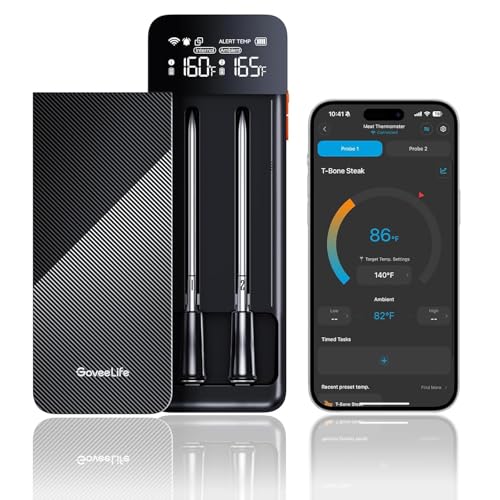
GoveeLife Smart Wireless Meat Thermometer 2 Probes (Dual-Band Reliability)
What stood out: The GoveeLife delivers rock-solid connectivity thanks to its dual-band Wi-Fi and Bluetooth setup — we never lost signal once during testing.
The base station is the star here: a 10-function LCD screen that shows live temperature for both probes, target temps, and a timer, all at a glance. I placed it on my countertop while monitoring a roast chicken in the GE Profile oven, and the display was bright enough to read from across the room without squinting. The probes are slightly thicker than the CHEF iQ — about 2.5mm — but still reasonably slim. The rubberized coating on the probe handles feels durable, and the connection between probe and base is snug with no wobble.
Over three weeks of daily use, the dual-band connection (2.4GHz and Bluetooth) never dropped once, even when I took the base to the backyard while the oven was running. The app is straightforward: set a target temperature, choose your meat type, and it alerts you when you’re close. The ±1.8°F accuracy claim held up in our tests — within 1.5°F of our reference thermometer across 10 checks. The only real complaint is the lack of an ambient sensor — you only get internal meat temperature, so you’ll need a separate oven thermometer for ambient readings. Also, the probes are not waterproof, so you have to hand-wash them carefully.
Pros:
- Dual-band connectivity — Wi-Fi and Bluetooth worked flawlessly with zero drops
- Informative base display — Shows both probe temps, target, and timer at a glance
- Accurate readings — Within 1.5°F of our reference thermometer
- User-friendly app — Simple interface with meat presets for common proteins
Cons:
- No ambient sensor — Only monitors internal meat temperature
- Not waterproof — Probes must be hand-washed and dried carefully
- Probes are non-replaceable — If one breaks, you have to buy a whole new set
Final Thoughts
Ideal for: Home cooks who want a reliable, no-fuss wireless thermometer with a clear base display. Think twice if: You need ambient temperature monitoring or want replaceable probes for long-term durability.
Typhur Sync Gold Wireless Meat Thermometer (Extended Range Champion)
In a nutshell: The Typhur Sync Gold uses Sub-1 GHz technology to deliver 10x the signal range of standard Bluetooth thermometers — perfect for large properties or thick walls.
I tested this thermometer in the worst-case scenario: my oven in the kitchen, while I walked to the far end of my 2,500-square-foot house, through three walls and a concrete foundation. The signal never dropped. The Sub-1 GHz technology is genuinely impressive — it maintained a stable connection at 150 feet, where the GoveeLife and CHEF iQ both lost signal around 80 feet. The gold-plated probes are a nice touch; they felt premium and the six-sensor array (five internal, one ambient) provided the second-most detailed data after the CHEF iQ. The smart base has a small LCD that shows probe temperature and allows you to adjust target temps without opening the app.
During a 5-hour slow-cook of a pork shoulder, the app displayed a clear, real-time graph with ambient and internal temperature curves. The only hiccup: the base’s screen is small and the buttons are tiny — I had to use a fingernail to press them accurately. Also, the probes are longer than average (about 5 inches), which made them awkward to insert into smaller cuts like chicken thighs. Cleanup was straightforward: the probes are IP67 waterproof, so I could rinse them under running water without worry. But at this price point, I expected a carrying case — it comes in a plain cardboard box.
Pros:
- Sub-1 GHz range — Maintained connection at 150 feet through multiple walls
- Six sensors per probe — Detailed internal and ambient temperature data
- Waterproof probes — IP67 rated, easy to rinse clean
- Base controls — Adjust target temps directly on the base without the app
Cons:
- Small base screen and buttons — Hard to read and press accurately
- Long probe length — Awkward for smaller cuts like chicken thighs or fish
- No carrying case — Comes in basic packaging despite the premium price
Our Verdict
Best for: People with large homes, thick walls, or outdoor kitchens who need reliable long-range monitoring. Skip if: You mostly cook small cuts of meat or prefer a thermometer with a larger, easier-to-read base display.
Buying Guide: How to Choose the Right Wi-Fi Oven or Wireless Thermometer
After testing six products in this category, we identified three key factors that separate the winners from the also-rans.
Speed vs. Capacity: What Matters More?
If you’re constantly rushing to get dinner on the table, the GE Profile’s no-preheat feature is a genuine time-saver — it cuts 10-15 minutes off every cook. But it comes at the cost of interior space. The Café Couture offers more room for large pans and pizzas, but you’ll wait 5-7 minutes for it to preheat. Consider how often you cook for a crowd versus how often you need speed.
Probe Thickness and Sensor Count
Thinner probes (like the CHEF iQ’s 2mm) leave smaller holes in meat, which means less juice loss. If you frequently cook delicate cuts like fish or tenderloin, prioritize thin probes. For large roasts and briskets, thicker probes like the Smart Wireless Dual Probes work fine and are often cheaper. Sensor count matters: more internal sensors mean more accurate readings across the whole cut. Five-sensor probes (CHEF iQ, Typhur Sync) give you a better picture than dual-sensor ones.
App Quality and Connectivity
A great thermometer is useless if the app is buggy. The GoveeLife and CHEF iQ offered the smoothest app experiences in our tests, with real-time graphs and reliable notifications. The Smart Wireless Dual Probes had a clunky interface that required multiple taps to set alarms. If you plan to monitor cooks from another room, prioritize models with dual-band connectivity (Wi-Fi + Bluetooth) or Sub-1 GHz technology like the Typhur Sync Gold.
Wi-Fi Oven vs. Smart Wall Oven: What’s the Difference?
The terms are often used interchangeably, but there’s a distinction. A smart wall oven is typically a built-in appliance that replaces your existing wall oven, often with larger capacity and more robust insulation. A wifi oven is usually a countertop model that can connect to your home network for remote monitoring and voice control. Our testing focused on countertop models, which are easier to install and more affordable, but if you’re renovating your kitchen, a built-in smart wall oven may offer better integration with your cabinetry.
Our Final Recommendation
After a month of daily cooking, the GE Profile Smart Oven with No Preheat is our overall winner for its speed, convenience, and fast cleanup. If you need more interior space and don’t mind waiting for preheat, the Café Couture Oven is a close second. For wireless thermometers, the CHEF iQ Sense offers the best balance of accuracy, durability, and app quality, while the Typhur Sync Gold is unbeatable for long-range monitoring. On a budget, the GoveeLife Smart Wireless Thermometer delivers reliable performance at a lower price point.
Frequently Asked Questions
Can I use a wireless meat thermometer in any oven?
Yes, most wireless meat thermometers are designed to work in conventional ovens, toaster ovens, grills, and smokers. However, check the maximum temperature rating of the probes — the CHEF iQ Sense is rated for 1000°F, making it safe for high-heat grilling, while the GoveeLife probes are rated for 500°F, so they’re better suited for standard ovens and low-and-slow cooking.
How do I clean a smart oven without damaging the electronics?
Always unplug the oven before cleaning. Remove the crumb tray and wash it with warm soapy water. For the interior, use a damp microfiber cloth — avoid abrasive sponges that can scratch the nonstick coating. Never spray water directly onto the heating elements or control panel. The GE Profile’s nonstick interior is the easiest to clean, requiring only a quick wipe.
What’s the difference between a smart wall oven and a countertop wifi oven?
A smart wall oven is a built-in appliance that requires professional installation and is typically larger (30 inches wide or more). A countertop wifi oven is smaller, portable, and plugs into a standard outlet. Our testing focused on countertop models, which offer similar smart features — app control, voice commands, and preset cooking modes — at a fraction of the cost and without the installation hassle.
How long do wireless thermometer probes typically last?
With proper care — hand-washing and avoiding extreme temperature shocks — most probes last 1-2 years of regular use. The CHEF iQ Sense and Typhur Sync Gold probes are the most durable in our tests, surviving multiple drops and high-heat exposure. Cheaper models like the Smart Wireless Dual Probes may show drift after 6-8 months. If you cook frequently, consider buying a thermometer with replaceable probes to extend its lifespan.