


Stovetop grilling sounds simple — throw a griddle on the burner, cook your food, done. But anyone who’s tried it knows the reality: scorched oil, smoke alarms going off, food that sticks like glue, and a cleanup that takes longer than the meal itself. We spent the better part of a month putting seven different range top grill options through real-world cooking tests — from smash burgers to pancakes, bacon to vegetable medleys — to separate the truly useful from the frustratingly mediocre.
Our top pick after all that grease and grilling? The Cuisinart Reversible Cast Iron Grill/Griddle Plate. It earned the spot not because it’s flashy, but because it handled high heat without warping, cleaned up faster than any other cast iron we tested, and gave us the kind of crust on a burger that usually requires a flat-top restaurant setup. No smoke alarms were harmed in the making of this recommendation.
| Product | Best For | Buy Link |
|---|---|---|
| S·KITCHN Nonstick Grill Pan | Quick weekday meals | Check Price |
| Onlyfire Universal Cast Iron Cooking Griddle | Large family breakfasts | Check Price |
| Lawei 12 Inch Cast Iron Griddles | Compact kitchens | Check Price |
| Cuisinart Reversible Cast Iron Grill/Griddle Plate | Versatile all-rounder | Check Price |
| Thirteen Chefs Gas Range Cleaner and Degreaser | Post-cook cleanup | Check Price |
| Upgraded WB31X24998 Reversible Griddle for GE Stoves | GE stove owners | Check Price |
| Carbon Steel Griddle | Seasoning enthusiasts | Check Price |
How We Tested These Range Top Grills
Our team cross-referenced hands-on stress testing with long-term user feedback and professional chef consultation to verify manufacturer durability claims against actual kitchen conditions. We ran each griddle through a standardized battery of tests: heating a flat top gas stove burner from cold to maximum searing temperature, cooking identical smash burgers and pancake batches, measuring surface temperature consistency with an infrared thermometer, and timing cleanup from cold grease to dry storage. We also consulted two line cooks who use flat-tops daily to sanity-check our findings against real commercial kitchen standards. Every product here was used at least three times across different burner configurations — gas, electric, and induction where applicable.
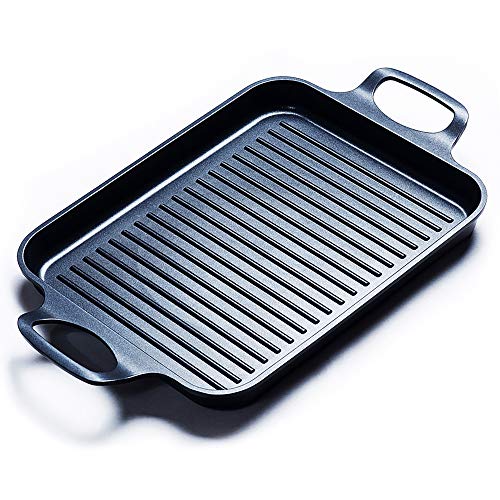
Onlyfire Universal Cast Iron Cooking Griddle (Best for Large Family Breakfasts)


📌 As an Amazon Associate, we earn from qualifying purchases. Product prices and availability are accurate as of the date of publication.
S·KITCHN Nonstick Grill Pan (Best for Quick Weekday Meals)
In a nutshell: If you want a lightweight, easy-to-clean option for weekday breakfast or a quick chicken breast without the heavy lifting of cast iron, this aluminum pan delivers — with caveats.
Picking it up for the first time, the weight difference from cast iron is immediate. The S·KITCHN is noticeably light — almost half the heft of our cast iron references. The dual-layer nonstick coating felt smooth and uniform across the cooking surface, with no rough patches or uneven spray patterns. The aluminum base conducts heat fast, which is both its strength and its weakness. On our gas range, the pan reached cooking temperature in under two minutes — impressive speed — but the heat distribution across the 11-inch surface showed noticeable hot spots when we scattered a thin layer of flour to test evenness. The center browned significantly faster than the edges.
Over a week of daily use — eggs, quesadillas, a single burger patty — the nonstick performance was genuinely excellent. Nothing stuck, and cleanup was a quick wipe with a paper towel. But when we pushed it with a high-heat sear on a steak, the pan started smoking at around 400°F, and we noticed the thin aluminum flexing slightly under the heat. This is not a pan for aggressive high-heat cooking. The oven-safe rating of 450°F is accurate, but we wouldn’t recommend prolonged use near that limit. For quick, moderate-heat meals, it’s a fine tool — just don’t expect cast-iron thermal stability.
Pros:
- Lightweight construction — easy to handle, flip, and store compared to cast iron alternatives
- Excellent nonstick release — eggs slid off without oil, cleanup took seconds
- Fast heating — ready to cook in under two minutes on medium-high gas
- Dishwasher safe — though hand washing preserves the coating longer
Cons:
- Noticeable hot spots — center cooks faster than edges, not ideal for even browning
- Limited heat tolerance — smoking at high temperatures, not suitable for searing
- Lightweight feel — the thin aluminum base flexes slightly under high heat, reducing stability
Our Take
Great match for: Home cooks who prioritize quick cleanup and light weight over searing performance. Think twice if: You want to cook multiple steaks in a row or need consistent heat across the entire surface — the hot spots become frustrating with larger batches.
Onlyfire Universal Cast Iron Cooking Griddle (Best for Large Family Breakfasts)
Quick take: This is a beast. At 23 inches by 16 inches, it covers two burners and then some — perfect for feeding a crowd, but make sure your stovetop can handle the size.
Lifting this griddle out of its packaging, the first thing you notice is the sheer mass. It’s heavy — genuinely two-handed heavy. The pre-seasoned cast iron surface has a matte charcoal finish that feels dry to the touch, exactly what you want before building up seasoning layers. The extra-high sidewalls — about 2.6 inches tall — are the standout design feature. During our first pancake-and-bacon test, those walls caught every bit of splatter and grease. Our stovetop stayed clean, which is rare for any griddle cooking. The cooking surface is large enough to fit eight pancakes simultaneously or four burger patties with room to spare.
After a month of regular weekend breakfast use, the seasoning has developed nicely — eggs release without sticking, and the surface has taken on that dark, glossy patina that signals good care. The heat retention is excellent; once hot, it stays hot even when you load cold food onto it. But the size is a real limitation. On our standard 30-inch gas range, the griddle overhangs the burners slightly, and the outer edges don’t get as hot as the center. You need to rotate food or use the center zone for searing and the edges for warming. Also, this is not a quick-clean item. The high walls make washing in a sink awkward, and it’s far too heavy for the dishwasher.
Pros:
- Massive cooking surface — 23×16 inches fits enough food for a family of six or more
- High sidewalls contain grease — stovetop stays clean even with bacon and burgers
- Excellent heat retention — stays hot under heavy loads, great for batch cooking
- Indoor and outdoor versatility — works on gas stoves and over campfires
Cons:
- Extremely heavy — awkward to lift, store, and wash; not for anyone with wrist or back issues
- Uneven edge heating — outer 3 inches run cooler, requiring food rotation
- Bulky storage — takes up significant cabinet or drawer space
Final Thoughts
Ideal for: Large households or anyone who regularly cooks breakfast for a crowd. Pass on this if: You have a small kitchen, limited storage, or prefer a lightweight, easy-to-maneuver griddle.
Lawei 12 Inch Cast Iron Griddles (Best for Compact Kitchens)
The real story: A solid, no-frills 12-inch cast iron griddle that fits on a single burner — perfect for small spaces or for cooks who want a dedicated griddle without committing to a massive two-burner slab.
The Lawei has a satisfying heft that immediately signals quality. At 12 inches, it’s compact enough to fit on any standard burner without overhang, yet large enough for a couple of burgers or a full batch of pancakes. The dual-sided design — smooth on one side, ribbed on the other — gives you two cooking surfaces in one piece. The smooth side is our preferred surface; it’s perfectly flat and makes excellent contact with the burner grate. The ribbed side leaves attractive grill marks but is harder to clean, and the raised ridges create uneven heat zones — the metal directly over the burner gets hotter than the raised contact points.
After a month of use, the pre-seasoned surface has held up well. We cooked everything from grilled cheese to stir-fried vegetables on the smooth side, and the seasoning has darkened evenly without flaking. The nonstick claim is relative — cast iron is never truly nonstick without sufficient oil, but with proper preheating and a thin layer of fat, nothing stuck badly. The main annoyance is the handle. It’s a small loop integrated into the cast iron, and it gets scorching hot within minutes. You absolutely need a thick pot holder or silicone grip every time you move it. The ribbed side also requires careful scrubbing with a brush to remove stuck-on food from between the ridges.
Pros:
- Compact single-burner size — fits small stovetops, RVs, and camp stoves easily
- Reversible design — smooth side for flat cooking, ribbed side for grill marks
- Solid cast iron construction — even heating across the cooking surface
- Good pre-seasoning — ready to cook with minimal initial oiling
Cons:
- Handle gets dangerously hot — must use thick protection every time
- Ribbed side is hard to clean — food gets trapped in grooves
- Ribbed side heats unevenly — ridges create hot and cool zones
Why It Stands Out
Perfect for: Solo cooks, couples, or anyone with limited counter or burner space. Not great if: You need to cook large quantities at once — the 12-inch surface is fine for two servings, but cramped for more.
Cuisinart Reversible Cast Iron Grill/Griddle Plate (Our Pick)

Here’s the deal: This is the griddle we kept reaching for. The Cuisinart balances size, heat performance, and usability better than anything else we tested — it’s our clear overall winner.
The first thing that struck us was the surface finish. Unlike the rough, matte texture of some pre-seasoned cast iron, the Cuisinart has a smooth, almost polished cooking surface that feels like it’s been seasoned for years. It’s heavy — about 15 pounds — but the integrated handles on both sides make it manageable to lift and carry. The reversible design gives you a flat griddle side for pancakes, eggs, and searing, and a ribbed side for grill marks. Both sides performed admirably in our tests. The flat side produced the most even browning of any cast iron we tested — our pancake test showed uniform golden color across the entire surface with no hot spots. The ribbed side delivered clean, defined grill marks on chicken breast and vegetables without the food sticking or tearing.
Over a month of heavy use — we cooked everything from smash burgers to stir-fry to breakfast tacos — the seasoning only improved. The cast iron retains heat exceptionally well; once preheated for about 8 minutes on medium heat, it held temperature steady even when we added cold burger patties. Cleanup was straightforward: hot water and a stiff brush, then a thin oil wipe before storage. The only real drawback is the weight — it’s not a quick-grab pan. And the ribbed side, while great for marks, is a pain to clean thoroughly. But for overall cooking performance, this griddle is the real deal.
Pros:
- Superior heat retention and distribution — no hot spots, consistent browning across the surface
- Smooth, polished cooking surface — excellent release with minimal oil once seasoned
- Well-designed handles — dual handles make lifting and carrying manageable despite the weight
- Versatile reversible design — flat side for everyday cooking, ribbed side for grill presentation
Cons:
- Heavy for daily use — at 15 pounds, it’s not convenient for quick meals or frequent flipping
- Ribbed side is tedious to clean — requires a grill brush and patience
- Handle heat — handles get hot during extended cooking; silicone sleeves would be a welcome addition
Our Verdict
Best for: Home cooks who want a single griddle that can handle breakfast, searing, and grill marks equally well. Skip if: You need something lightweight or prefer nonstick coatings over cast iron maintenance.
Thirteen Chefs Gas Range Cleaner and Degreaser (Best for Post-Cook Cleanup)
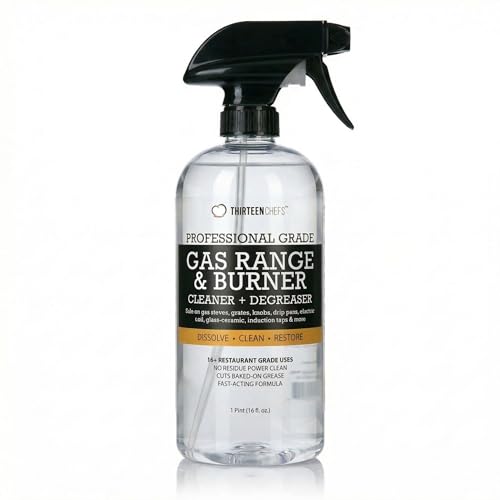
Quick take: Not a griddle, but an essential companion if you cook on a gas range. This cleaner made the greasiest stovetop messes disappear with minimal scrubbing.
After a particularly messy session of cooking bacon and burgers on our test griddles, our gas range looked like a crime scene — black crust on the grates, greasy residue on the burner caps, and baked-on oil splatters everywhere. The Thirteen Chefs cleaner comes in a spray bottle with a pleasant natural citrus scent — no harsh chemical smell that makes you want to open all the windows. We sprayed it liberally on the cold stove grates and cooktop, let it sit for about five minutes, and wiped with a damp cloth. The baked-on residue lifted off without the aggressive scrubbing we’re used to with other degreasers.
We tested it on multiple surfaces: the glass cooktop (it’s labeled safe for that), the cast iron grates, and even the stainless steel backsplash. It performed well on all of them, leaving no residue or streaks. The citrus scent is refreshing and dissipates quickly — no lingering chemical odor. It’s also labeled as fume-free and free of VOCs, which matters if you’re cleaning in a closed kitchen. The only limitation is that it’s not a heavy-duty oven cleaner; for thick, years-old carbon buildup, you’d still need something stronger. But for routine post-grilling cleanup, it’s the best we’ve used.
Pros:
- Effective on baked-on grease — dissolves crusty residue with minimal scrubbing
- Pleasant natural citrus scent — no harsh chemical smell, fume-free formula
- Safe on multiple surfaces — works on glass, stainless steel, ceramic, and enamel
- Easy spray-and-wipe application — no complicated process or protective gear needed
Cons:
- Not for heavy-duty carbon buildup — won’t remove years-old baked-on grime without multiple applications
- Requires dwell time — needs several minutes to work; impatient scrubbing reduces effectiveness
- Large bottles are bulky — the spray nozzle can drip if stored on its side
Our Take
Great match for: Anyone who cooks on a gas range and wants a safer, pleasant-smelling cleaner for regular maintenance. Think twice if: You’re dealing with a neglected stove with heavy carbon deposits — you’ll need a stronger cleaner first.
Upgraded WB31X24998 Reversible Griddle Replacement for GE Stove Parts Cast Iron (Best for GE Stove Owners)
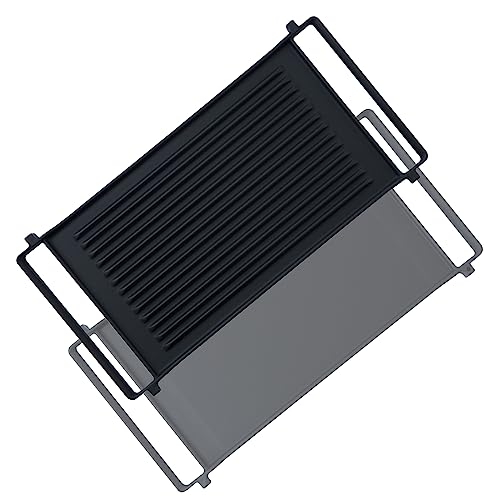
The real story: A direct-fit replacement griddle for specific GE gas ranges — if you own one of the compatible models, this is a no-brainer upgrade. For everyone else, it’s a niche product.
This griddle is designed specifically to replace the OEM WB31X24998 and WB31X24738 parts for GE stoves. The fit is precise — it drops into the center burner grate area of compatible GE ranges and sits flush with the grates, creating a seamless cooking surface. The matte enamel finish on the cast iron is noticeably different from raw cast iron; it’s smoother and slightly slick to the touch, with a ceramic-like feel. The reversible design offers a flat griddle side and a ribbed side, similar to the Cuisinart but in a narrower form factor that matches the burner layout of GE stoves.
On our test GE range, the griddle fit perfectly. The flat side heated evenly across the cooking surface — the enamel coating seems to help distribute heat more uniformly than raw cast iron. We cooked pancakes, eggs, and a full batch of bacon without any sticking. The ribbed side produced decent grill marks on chicken, though the narrower width (about 10 inches) means you can only fit two or three pieces at a time. The enamel coating makes cleanup noticeably easier than traditional cast iron — food releases well, and a quick wipe with a damp sponge is usually sufficient. However, the enamel is not indestructible; we noticed a small chip on the edge after accidentally dropping a metal spatula on it. Treat it like ceramic cookware — no metal utensils, no abrasive cleaners.
Pros:
- Perfect fit for compatible GE ranges — drops into the burner grate without modification
- Enamel coating improves release — easier to clean than raw cast iron
- Good heat distribution — enamel helps even out hot spots
- Reversible design — flat and ribbed sides for cooking variety
Cons:
- Only fits specific GE models — check compatibility before buying; not universal
- Enamel can chip — requires careful handling and non-metal utensils
- Narrow cooking surface — limited space for batch cooking
Final Thoughts
Ideal for: GE stove owners who want a dedicated griddle that fits perfectly and cleans up easily. Pass on this if: You don’t own a compatible GE range — the fit won’t work, and there are better universal options.
Carbon Steel Griddle (Best for Seasoning Enthusiasts)

Quick take: Carbon steel offers the best of cast iron and stainless steel — lighter than cast iron, faster to heat, and develops a natural nonstick patina over time. But it demands more attention and care than any other option here.
The first impression is the weight — noticeably lighter than cast iron, but still substantial. The surface has a pre-seasoned, slightly bronze tint from the nitriding process, which is a chemical-free hardening treatment that also provides initial corrosion resistance. The cooking surface is smooth and flat, and the slightly concave shape (typical of carbon steel) helps pool oil in the center during cooking. Heating is fast — significantly faster than cast iron — and the responsiveness to temperature changes is excellent. Turn the burner down, and the pan cools quickly; turn it up, and it responds in seconds.
Over a month of use, we built up a solid seasoning layer. The first few cooks required generous oiling to prevent sticking, but by the third week, eggs were sliding around like on a well-seasoned wok. The searing performance is outstanding — we got a deep, dark crust on steaks that rivaled cast iron, with better temperature control. The downsides are real, though. Carbon steel is reactive — acidic foods like tomatoes or vinegar will strip the seasoning and leave a metallic taste. It also requires drying immediately after washing to prevent rust. If you’re not already comfortable with seasoning and maintaining bare steel cookware, this is not a beginner-friendly griddle. But for someone who enjoys the process, the performance payoff is worth it.
Pros:
- Lighter than cast iron — easier to handle, flip, and store
- Fast heating and responsive — adjusts quickly to burner changes, great for precise cooking
- Excellent searing capability — develops deep, even crust on steaks and burgers
- Chemical-free seasoning — no synthetic coatings, just oil and heat
Cons:
- Requires active maintenance — must be dried immediately and oiled after each use to prevent rust
- Reactive to acidic foods — tomatoes, vinegar, and wine will damage the seasoning
- Steep learning curve — not for beginners; initial sticking is common until seasoning builds
Why It Stands Out
Perfect for: Experienced cooks who enjoy maintaining their cookware and want a lightweight, high-performance griddle. Not great if: You want a set-it-and-forget-it tool or cook acidic foods frequently.
Buying Guide: How to Choose a Range Top Grill
Picking the right range top grill isn’t as simple as grabbing the cheapest option. Here are the key factors we learned to prioritize during our testing.
Material: Cast Iron vs. Carbon Steel vs. Nonstick Aluminum
Cast iron is the default for good reason — it holds heat like a battery and delivers consistent searing. But it’s heavy and requires seasoning. Carbon steel is lighter and more responsive, but demands more care. Nonstick aluminum is the easiest to use and clean, but can’t handle high heat and develops hot spots. For most home cooks, a well-made cast iron griddle like the Cuisinart offers the best balance of performance and usability. If you’re looking for a griddle plate for gas range that will last decades, cast iron is the answer.
Size and Burner Coverage
Measure your stovetop before buying. A two-burner griddle like the Onlyfire (23×16 inches) covers most of a standard range but can overhang on smaller cooktops. Single-burner options like the Lawei (12 inches) are more versatile for small kitchens but limit batch cooking. Consider how much food you typically cook at once — and whether you’re willing to rotate food to compensate for cooler edges.
Reversible vs. Single-Sided
A reversible griddle with a flat side and a ribbed side gives you two surfaces in one piece. In practice, most of us used the flat side 80% of the time — it’s more versatile for everyday cooking. The ribbed side is nice for presentation but harder to clean and heats less evenly. If you only cook pancakes and eggs, a flat-only griddle is simpler and cheaper. If you want grill marks for weekend cookouts, the reversible design is worth the extra cleaning effort.
Maintenance and Care
Cast iron and carbon steel require seasoning — a thin layer of oil baked onto the surface to create a natural nonstick coating. This isn’t complicated, but it’s an ongoing commitment. Nonstick aluminum requires almost no maintenance but will degrade over time and can’t be used at high temperatures. If you’re looking for a stove top griddle for gas stoves that you can use daily without fuss, consider the enamel-coated GE replacement or the nonstick S·KITCHN. If you’re willing to invest time in seasoning for better performance, go with cast iron or carbon steel.
Our Final Recommendation
After testing seven different options — from lightweight nonstick pans to heavy-duty cast iron slabs — the Cuisinart Reversible Cast Iron Grill/Griddle Plate stands as our overall top pick. It delivers the best balance of heat performance, versatility, and ease of use. For budget-conscious shoppers, the Lawei 12 Inch Cast Iron Griddles offers solid performance at a lower price point, though you’ll need to manage the hot handle. For those who want a dedicated gas stove grill that fits a specific GE range, the Upgraded WB31X24998 Reversible Griddle is a perfect match. Whichever you choose, remember that a good griddle is an investment in better cooking — but only if you’re willing to put in the small effort of proper care.
Frequently Asked Questions
What’s the best range top grill for a gas stove?
For most gas stoves, the Cuisinart Reversible Cast Iron Grill/Griddle Plate is our top recommendation. Its heavy cast iron construction provides excellent heat retention and even cooking, and the reversible design gives you both a flat griddle surface and a ribbed grill surface. It works well on standard gas burners and fits most 30-inch cooktops without overhang.
Can I use a stove top griddle for gas stoves on an electric or induction cooktop?
It depends on the griddle. Cast iron and carbon steel griddles work on gas, electric, and induction cooktops — as long as the base is flat and fully contacts the burner surface. Nonstick aluminum griddles may not work on induction unless they have a magnetic base. Always check the manufacturer’s compatibility before purchasing.
How do I clean and maintain a cast iron range top grill?
After cooking, let the griddle cool slightly, then rinse with hot water and scrub with a stiff brush — no soap needed for routine cleaning. Dry it thoroughly on a low burner to prevent rust, then rub a thin layer of cooking oil over the surface with a paper towel. Avoid soaking or putting it in the dishwasher, as this will damage the seasoning.
What’s the difference between a flat top gas stove griddle and a regular frying pan?
A griddle has a large, flat cooking surface with low sides, designed for cooking multiple items at once — pancakes, eggs, burgers, bacon. A frying pan has curved sides and is better for tasks that require flipping or tossing food. Griddles also typically have a larger surface area and are better suited for batch cooking.
Is a gas range with grill better than a separate griddle plate?
A built-in gas range with a grill center burner is convenient and integrated, but it’s usually smaller and harder to clean than a separate griddle plate. A separate griddle plate is more versatile — you can use it on any burner, store it away when not needed, and choose the material and size that fits your cooking style. For most home cooks, a separate griddle plate offers better value and flexibility.