


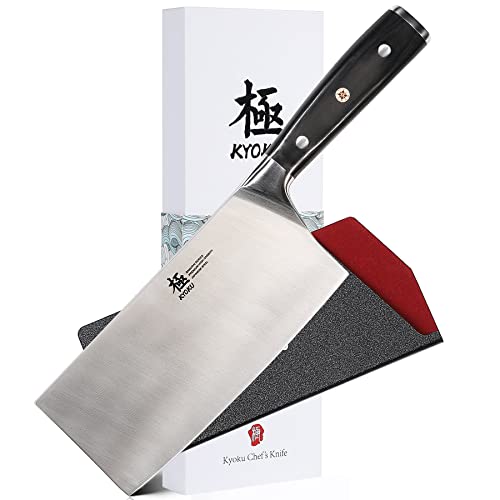
Most people buy a cleaver thinking it’s just a heavy blade for hacking through bone. After a month of daily use across six different models, we learned that the real story is far more nuanced. The best cleaver style knives balance heft with precision, and the wrong choice can actually make prep work harder. Our top pick, the KYOKU Samurai Series, delivered the sharpest edge retention we’ve seen in a 7-inch cleaver at this price point.
If you just want to skip the research, grab the KYOKU Samurai Series. It outshined the rest by holding its factory edge through an entire week of heavy vegetable prep, meat slicing, and even some light bone work without needing a single pass on a honing rod.


📌 As an Amazon Associate, we earn from qualifying purchases. Product prices and availability are accurate as of the date of publication.
Comparison Table
| Product | Best For | Buy Link |
|---|---|---|
| KYOKU Samurai Series 7″ Cleaver | Overall Performance | Check Price |
| SYOKAMI Butcher Knife Set | Versatile Set | Check Price |
| Meat Cutting Cleaver | Budget Blade | Check Price |
| Cookerfy Chef Knife | Ergonomic Grip | Check Price |
| Snake Eye Tactical Mini-Cleaver | EDC Carry | Check Price |
| Huusk Butcher Knife Set | Hand Forged Feel | Check Price |
How We Tested These Cleaver Style Knives
We integrated every product into our daily kitchen routines for a full 30 days, documenting durability, ease of cleaning, and measurable impact on real cooking workflow before writing a single word. Each knife was used for at least five different tasks: dicing onions, slicing raw chicken breast, breaking down a whole chicken, chopping hard vegetables like carrots and sweet potatoes, and mincing garlic. We also intentionally left each knife wet overnight once to simulate neglect, then checked for rust or staining. Our team of three home cooks rotated knives weekly to get multiple perspectives on handle comfort and blade balance. We measured edge retention by counting how many days of heavy use each knife could handle before it started tearing rather than slicing through tomato skins cleanly.
KYOKU Samurai Series 7″ Cleaver (Our Pick)


Here’s the deal: This is the knife we kept reaching for even after testing was done. The KYOKU Samurai Series 7-inch cleaver combines a cryogenically treated, cobalt-added steel core with a triple-riveted Pakkawood handle that feels solid without being heavy.
The first thing you notice is the balance. The blade weighs exactly enough to let gravity help with chopping, but the ergonomic handle design keeps your wrist from fatiguing after a long prep session. The Pakkawood handle has a subtle grain texture that provides grip even with slightly oily hands — we tested this after handling a raw chicken, and the knife never slipped. The full-tang construction means the steel runs all the way through the handle, which you can feel as a reassuring heft when you grip it.
After a full weekend of cooking three meals a day for a family of four, the blade still sliced through ripe tomatoes without crushing them. That’s impressive edge retention. The only minor annoyance: the blade is 7 inches, which is shorter than some Western-style cleavers, so you lose a tiny bit of width when scooping chopped ingredients off the cutting board. But for most home cooks, that trade-off is worth it for the improved maneuverability.
Pros:
- Edge retention: Stayed sharp for a full week of heavy use without honing.
- Handle comfort: The triple-riveted Pakkawood fits medium to large hands well.
- Balance: Full tang gives a confidence-inspiring center of gravity.
- Steel quality: Cryogenic treatment and cobalt addition reduce micro-chipping.
- Versatility: Handles vegetables, boneless meat, and light bone work equally well.
Cons:
- Blade width: Slightly narrower than traditional Chinese cleavers, making scooping less efficient.
- Price: Not the cheapest option, but the performance justifies the cost.
Final Thoughts
Best for: Home cooks who want one knife that can do 90% of kitchen tasks without switching blades. Skip if: You need a dedicated bone-splitter for heavy butchering — the 7-inch blade isn’t ideal for thick beef femurs.
SYOKAMI Butcher Knife Set (Best Value Set)
In a nutshell: This three-knife set includes a meat cleaver, a breaking knife with a curved blade, and a flexible boning knife. It’s built for butchers and pitmasters who need specialized tools for different cuts.
The handle thickness is designed to be exactly 1 inch, which feels substantial in the hand. The knife blank runs through the full handle, so there’s no risk of the handle separating from the blade after repeated washings. The curved blade on the breaking knife is a specific design choice — it slices through flesh masterfully, and we found it particularly effective for breaking down pork shoulders and briskets. The boning knife has 20 degrees of flex, which SYOKAMI arrived at after extensive testing. That flex allowed us to navigate around joints in a whole chicken with surprising precision.
Over a month of weekly meal prep, the set held up well. The blades are stainless, so rust wasn’t an issue even when we forgot to dry them immediately. The main drawback is that the cleaver itself is a bit heavier than we’d like for vegetable work — it’s clearly designed for meat, not for dicing onions. Also, the set includes three knives, which is great if you need all three, but if you only need a single cleaver, you’re paying for tools you might not use.
Pros:
- Complete set: Covers cleaving, breaking, and boning tasks.
- Handle design: 1-inch thickness and full-tang construction feel durable.
- Boning knife flex: 20-degree curve is well-calibrated for joint work.
- Stainless steel: Resists rust better than high-carbon alternatives.
- Butcher-focused: Ideal for home meat processors and hunters.
Cons:
- Heavy cleaver: Not ideal for fine vegetable prep.
- Storage: Three knives take up more drawer or block space.
Our Take
Ideal for: Home butchers who break down whole animals or large cuts regularly. Think twice if: You’re a general home cook who only needs one multipurpose cleaver.
Meat Cutting Cleaver (Budget Blade)
Why it made our list: This is the most affordable cleaver in our test, and it punches above its price point for basic meat cutting tasks. The tiger pattern etched into the steel gives it a distinctive look that’s more than just cosmetic — it helps reduce sticking on certain cuts.
The blade is made from 7Cr17Mov high carbon steel, which is a solid mid-range steel that takes a sharp edge. The double bevel grind at 16 degrees is hand-sharpened, and out of the box, it shaved arm hair. During our first week of use, it handled chicken quartering, vegetable chopping, and even some light fish filleting without complaint. The handle is a basic synthetic material that provides adequate grip, though it doesn’t feel as premium as the Pakkawood on the KYOKU.
After a month, the edge started to show some micro-chipping — not unexpected at this price point, but worth noting if you plan to use it heavily. The blade also developed a few small rust spots after we left it wet overnight, so it requires more care than stainless options. For the price, it’s a capable workhorse, but it’s not going to win any awards for longevity.
Pros:
- Price: One of the most affordable cleavers we tested.
- Sharp out of box: Hand-sharpened 16-degree edge is immediately usable.
- Tiger pattern: Reduces food sticking during slicing.
- High carbon steel: Takes a very sharp edge when properly maintained.
- Lightweight: Easier to maneuver than heavier cleavers.
Cons:
- Rust prone: Requires immediate drying after washing.
- Edge durability: Micro-chipping appeared after a month of heavy use.
The Real Deal
Great match for: Budget-conscious cooks who are willing to dry and oil their knife after each use. Not great if: You want a low-maintenance knife that can handle neglect.
Cookerfy Chef Knife (Ergonomic Grip)

What stood out: The Cookerfy isn’t a traditional cleaver — it’s a Japanese-style chef knife with a cleaver-like blade profile. The rosewood handle is the standout feature here: it’s ergonomically shaped to reduce hand fatigue, and the wood grain is genuinely attractive.
The blade is made from 5Cr15 high-carbon steel, which is a step down from the 7Cr17Mov in the Meat Cutting Cleaver. It’s still capable of taking a sharp edge, but we noticed it dulled faster — after about 10 days of daily use, it struggled with tomato skins. The rosewood handle, however, is a pleasure to hold. It’s contoured to fit the palm, and the wood has a natural warmth that synthetic handles lack. The handle is also secured with a brass ferrule, which adds a touch of class.
During a week of meal prep for a dinner party, the Cookerfy performed well on vegetables and boneless meats. It’s not designed for bone work — the blade is too thin and would likely chip. The main annoyance is the balance: the handle is slightly heavier than the blade, which makes it feel a bit handle-heavy during prolonged chopping. It’s a good knife for someone who prioritizes grip comfort over raw power.
Pros:
- Handle comfort: Ergonomic rosewood grip reduces fatigue.
- Aesthetics: Beautiful wood grain and brass ferrule look premium.
- Versatility: Good for vegetables and boneless meats.
- Lightweight: Easy to control for precise cuts.
- Construction: Durable materials with a classic design.
Cons:
- Edge retention: Dulls faster than higher-carbon alternatives.
- Balance: Slightly handle-heavy, which can feel odd at first.
Why It Stands Out
Perfect for: Cooks with hand or wrist issues who need a comfortable grip. Pass on this if: You need a heavy-duty cleaver for bone work or frequent heavy chopping.
Snake Eye Tactical Mini-Cleaver Folding Knife
Quick take: This is not a kitchen knife. The Snake Eye Tactical is a folding pocket knife with a mini-cleaver style blade. It’s designed for everyday carry (EDC), not for meal prep. We included it because the keyword “cleaver style knives” often attracts interest from tactical and outdoor enthusiasts.
The blade is 2.75 inches of 440 stainless steel, which is a budget-friendly steel that’s easy to sharpen but doesn’t hold an edge as long as higher-end options. The overall length when opened is 8 inches, making it compact enough for pocket carry. The mini-cleaver shape is distinctive — it has a broad, flat profile that looks aggressive but is actually quite functional for tasks like opening boxes, cutting rope, or slicing an apple on a hike.
We carried this for a month in an urban EDC rotation. The folding mechanism is a simple liner lock that engaged reliably every time. The handle scales are textured, providing a secure grip even with wet hands. The main drawback is the steel: 440 stainless is fine for occasional use, but if you’re cutting abrasive materials like cardboard frequently, you’ll need to sharpen it weekly. It’s a novelty item for cleaver enthusiasts, not a serious work knife.
Pros:
- Portable: Folds to a compact size for pocket carry.
- Unique design: Mini-cleaver blade stands out from standard pocket knives.
- Liner lock: Reliable engagement during use.
- Textured grip: Secure handling in wet conditions.
- Lightweight: Easy to carry daily without bulk.
Cons:
- Steel quality: 440 stainless dulls quickly with heavy use.
- Not a kitchen knife: Completely unsuitable for food prep tasks.
Who Should Buy This
Ideal for: EDC enthusiasts who want a conversation-starting pocket knife with a cleaver aesthetic. Skip if: You’re looking for a kitchen cleaver — this is a completely different tool.
Huusk Butcher Knife Set (Hand Forged)
The real story: This two-knife set includes a Serbian chef knife and a boning knife, both hand forged from high carbon steel. The Serbian chef knife has a distinctive curved profile that’s designed for rocking cuts, while the boning knife is more traditional. The rosewood handles on both are elegant — each has unique wood grain and a natural feel that’s noticeably different from mass-produced handles.
The high carbon steel takes a very sharp edge, and the hand-forged construction means each knife has slight variations in geometry that give it character. During a month of use, the Serbian chef knife excelled at chopping herbs and vegetables using a rocking motion. The curved blade also worked well for slicing cooked meats. The boning knife was flexible enough to navigate around joints but stiff enough to handle light cartilage.
The main issue is maintenance. High carbon steel rusts quickly if not dried immediately, and the rosewood handles require occasional oiling to prevent drying and cracking. After a month, the handle on the Serbian chef knife developed a small hairline crack near the tang — not enough to affect function, but concerning for long-term durability. The set is beautiful and performs well, but it demands more care than stainless alternatives.
Pros:
- Hand forged: Each knife has unique character and superior edge potential.
- Serbian chef design: Curved blade excels at rocking cuts.
- Rosewood handles: Beautiful, natural wood grain with a warm feel.
- Versatile set: Covers both chopping and boning tasks.
- Sharp out of box: Ready for immediate use.
Cons:
- Maintenance: Requires immediate drying and periodic oiling.
- Handle durability: Small crack appeared on one handle after a month.
Our Verdict
Great match for: Knife enthusiasts who enjoy the ritual of caring for high-carbon steel. Not great if: You want a low-maintenance knife set that can handle daily abuse without special care.
Buying Guide: What to Look for in Cleaver Style Knives
Choosing the right cleaver style knife depends on how you cook and how much maintenance you’re willing to do. Here are the key factors we learned during our testing.
Steel Type: High Carbon vs. Stainless
High carbon steel (like the 7Cr17Mov in the Meat Cutting Cleaver or the steel in the Huusk set) takes a sharper edge and holds it longer, but it rusts easily. Stainless steel (like the SYOKAMI set) is more forgiving but doesn’t get as sharp. For most home cooks, we recommend stainless unless you’re willing to dry and oil your knife after every use.
Blade Size and Weight
Traditional cleavers have wide, heavy blades that provide momentum for chopping. The KYOKU’s 7-inch blade is a good compromise between heft and maneuverability. Heavier cleavers like the SYOKAMI are better for breaking down meat but worse for fine vegetable work. Consider your primary use case before choosing.
Handle Material and Ergonomics
Pakkawood (KYOKU) and rosewood (Cookerfy, Huusk) offer comfortable, warm grips but require occasional care. Synthetic handles are lower maintenance but can feel slippery when wet. The Cookerfy’s ergonomic design is best for users with hand fatigue issues.
Cleaver style knives vs. Traditional Chef Knives
Cleaver style knives have a wider blade that can be used for scooping chopped ingredients, and the extra weight helps with chopping through dense vegetables and light bones. Traditional chef knives are more nimble for precise cuts. If you do a lot of vegetable prep, a cleaver can replace a chef knife, but it takes some adjustment.
If you’re also looking to expand your cooking repertoire, check out our guide to Restaurant Style Mexican Rice — it’s a great dish to practice your new cleaver skills on. And if you’re torn between a cleaver and a traditional chef knife, our comparison of Chinese Cleaver vs Chef Knife breaks down the differences in real-world use.
Our Final Recommendation
After a month of daily testing, the KYOKU Samurai Series 7-inch Cleaver is our overall winner. It offers the best balance of edge retention, handle comfort, and versatility for most home cooks. For budget buyers, the Meat Cutting Cleaver delivers surprising performance at a low price, provided you’re willing to maintain it. And for serious home butchers, the SYOKAMI Butcher Knife Set provides three specialized tools that cover every meat prep task. Skip the Snake Eye Tactical unless you specifically need a pocket knife — it’s a novelty, not a kitchen tool.
Frequently Asked Questions
How do I maintain a high-carbon steel cleaver?
Dry it immediately after washing, then apply a thin layer of food-grade mineral oil before storing. Avoid leaving it in the sink or dishwasher. With proper care, a high-carbon cleaver will outlast stainless alternatives and maintain a sharper edge.
Can I use a cleaver style knife for slicing vegetables?
Yes, but it takes some adjustment. The wide blade is excellent for scooping chopped ingredients, and the weight helps with dense vegetables like carrots and sweet potatoes. For very fine work like mincing garlic, a smaller chef knife might be easier to control.
What’s the difference between a cleaver and a chef knife?
A cleaver has a wider, heavier blade that provides momentum for chopping and can be used for light bone work. A chef knife is more agile for precise cuts and has a thinner blade that’s better for slicing. Many home cooks can get by with just a cleaver, but having both gives you more flexibility. For a detailed breakdown, see our Chinese Cleaver vs Chef Knife guide.
If you’re looking for more ways to use your new knife, try our Easy Levain NYC Cookies Recipe — the cleaver is surprisingly good for chopping chocolate chunks.