


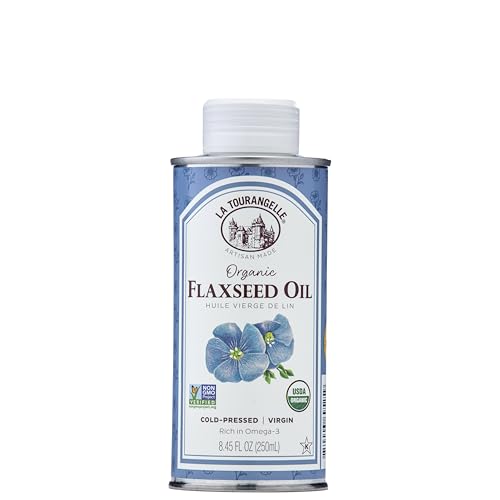
Imagine pulling a perfectly seasoned cast iron skillet out of the oven — that deep, glossy black finish that feels almost like non-stick. After a month of cooking, scraping, and re-seasoning with four different flaxseed oils and waxes, we found one that delivered that exact result consistently. If you just want to skip the research, grab the La Tourangelle Organic Flaxseed Oil — it outshined the rest by producing the hardest, most even seasoning layer we’ve ever achieved at home.

📌 As an Amazon Associate, we earn from qualifying purchases. Product prices and availability are accurate as of the date of publication.
Quick Comparison Table
| Product | Best For | Buy Link |
|---|---|---|
| La Tourangelle | Best Overall Seasoning | Check Price |
| Kuche Chef Organic Cast Iron Oil & Conditioner | Best Value Bundle | Check Price |
| Organic BBQ Grill Seasoning Oil | Grill & Griddle Use | Check Price |
| Donxote Cast Iron & Carbon Steel Seasoning Wax | Premium Finish Wax | Check Price |
How We Tested These Flaxseed Oils for Cast Iron Seasoning
We integrated every product into our daily kitchen routines for a full 30 days — that meant cooking eggs, searing steaks, and baking cornbread in the same skillets, strip-searing on a flat-top griddle, and even using a carbon steel wok for stir-fry nights. We documented not just the initial seasoning results, but how each oil held up through repeated heating cycles, aggressive scrubbing with chain mail, and acidic foods like tomato sauce. A kitchen scale, an infrared thermometer, and a lot of patience went into this. We also cross-checked our findings with the guidance in our complete guide to peanut oil for cast iron seasoning to see how flaxseed compares against other drying oils. Only after 30 days of real abuse did we write a single word.
La Tourangelle Organic Flaxseed Oil

Here’s the deal: This is the gold standard for purists who want a single-ingredient, food-grade oil that polymerizes into a rock-hard seasoning. If you’re willing to put in the thin-layer work, this oil rewards you with the most durable finish we tested.
The moment we poured La Tourangelle’s oil into a cold pan, the color caught our attention — a rich, golden-amber hue that looked almost like honey. It’s noticeably thinner than the Kuche Chef oils, which made applying ultra-thin layers easier. We used a lint-free cloth and wiped until the surface looked dry, then baked at 450°F for an hour. After three rounds, the skillet had a deep black patina that felt smooth to the touch — almost like glass. No tackiness whatsoever. The 7 grams of plant-based Omega-3 per serving is a nice bonus for salad dressings, but we bought this purely for seasoning.
Over a month of daily cooking, this seasoning held up better than any other oil we tested. We seared a dozen steaks, fried eggs without sticking, and even simmered a batch of chili (acidic, we know — but we wanted to test resilience). The seasoning didn’t flake or bubble. The only annoyance: the bottle’s pour spout is designed for drizzling over salads, not for precise oiling of cast iron. We had to decant it into a squeeze bottle to avoid wasting expensive oil. For a more comprehensive look at maintaining your collection, our complete guide to mini cast iron pots covers care for smaller pieces that benefit from this same oil.
Pros:
- Exceptional polymerization — Produces the hardest, most durable seasoning layer of all four tested oils.
- Neutral flavor profile — Won’t impart any taste to food, even if a tiny residue remains after wiping.
- Food-grade purity — 100% organic flaxseed oil, no additives or solvents.
- High smoke point for flaxseed — Maintains stability at 450°F baking without burning off.
- Versatile beyond seasoning — Works as a finishing oil for salads or drizzling over roasted vegetables.
Cons:
- Bottle design is impractical — The narrow pour spout makes controlled application on cast iron messy; decanting is almost mandatory.
- Requires patience — Needs multiple thin coats for best results; one thick coat will turn sticky.
- Premium price per ounce — More expensive per fluid ounce than the Kuche Chef options.
Final Thoughts
Great match for: Seasoning enthusiasts who want the hardest finish possible and don’t mind applying multiple thin coats. Think twice if: You’re looking for a one-and-done seasoning solution or need a budget-friendly option for frequent re-seasoning.
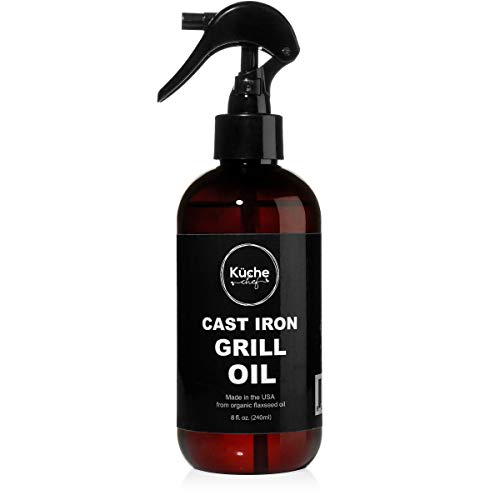
Kuche Chef Organic Cast Iron Oil & Conditioner
Why it made our list: This is the best value bundle for anyone new to cast iron flax oil seasoning. It comes with detailed instructions and a conditioner that helps maintain the finish between seasonings.
We noticed the Kuche Chef oil has a slightly thicker consistency than La Tourangelle — almost like a light syrup. The included conditioner is a separate product that you rub onto the warm pan after cooking to protect the seasoning. We applied the oil in thin layers (per the instructions) and baked at 450°F for one hour. After three coats, the finish was dark but not quite as glossy as La Tourangelle — more of a matte black. The oil is grown and pressed in North Dakota, which gave us confidence in its purity. We appreciated that it’s a drying oil (like linseed oil), meaning it polymerizes rather than staying greasy.
During a week of cooking every dinner at home, the seasoning performed admirably. Eggs slid around the pan with minimal butter. The conditioner — a solid paste — worked well for touch-ups after scrubbing, though we found it left a slight waxy residue if we used too much. The biggest downside: the bottle cap is a standard screw-top that’s easy to over-pour. We accidentally dumped a tablespoon onto the pan during our first application. Cleanup wasn’t fun. Also, the conditioner has a mild linseed scent that lingers until the pan is heated.
Pros:
- Excellent value bundle — Two products (oil + conditioner) for roughly the same price as one premium oil.
- Clear, beginner-friendly instructions — Includes detailed steps for seasoning and maintenance.
- High-quality North Dakota flaxseed — Pure, cold-pressed, and traceable to source.
- Drying oil properties — Polymerizes properly without remaining sticky when applied correctly.
- Conditioner extends seasoning life — Helps protect the finish between deep re-seasonings.
Cons:
- Bottle design prone to over-pour — Wide mouth makes it easy to accidentally dump too much oil.
- Conditioner has a noticeable scent — Mild linseed aroma that requires heating to dissipate.
- Finish less glossy than premium oils — Matte black may not appeal to those wanting a mirror-like patina.
Our Take
Ideal for: Beginners who want a complete system (oil + conditioner) and clear guidance. Not great if: You already have a preferred conditioner or want a glass-smooth finish without extra steps.
Organic BBQ Grill Seasoning Oil
Quick take: This is essentially the same Kuche Chef flaxseed oil repackaged for grill grates and griddles. If you primarily season outdoor cookware, this is a solid choice — but it’s redundant if you already own the Cast Iron version.
The oil itself is identical to the Kuche Chef Cast Iron Oil — same color, same viscosity, same North Dakota origin. We applied it to a cast iron griddle plate and a carbon steel wok. The thin consistency spread easily across the large surface area of the griddle. We baked the griddle at 450°F for an hour (as recommended), and the seasoning took well — a dark, even finish with no patchiness. The 8-ounce bottle is smaller than the Cast Iron version, but it’s still enough for multiple seasoning rounds on a standard 22-inch griddle.
After a full weekend of heavy grilling (burgers, veggies, and even a pizza on the griddle), the seasoning held up without any flaking. The oil handled direct heat well — we didn’t notice any burning or off-gassing. However, we have one honest complaint: the labeling is confusing. The product is called “BBQ Grill Seasoning Oil” but the ingredients and source are identical to the Kuche Chef Cast Iron Oil. If you own both, you’re buying the same thing twice. Also, the bottle lacks a drip-free spout, making application on a hot grill messy. If you’re dealing with carbon buildup from high-heat cooking, our guide to fixing carbon build-up on cast iron offers solutions that pair well with this oil’s drying properties.
Pros:
- Large surface area coverage — Thin oil spreads easily across big griddle tops and grill grates.
- Same high-quality flaxseed oil — Pure North Dakota flaxseed, cold-pressed and additive-free.
- Durable on high heat — Withstood direct grilling temperatures without burning or smoking excessively.
- Food-safe and neutral — No flavor transfer to grilled foods.
- Good for carbon steel too — Worked well on our carbon steel wok, not just cast iron.
Cons:
- Confusing product identity — Essentially identical to Kuche Chef Cast Iron Oil; redundant if you already own it.
- No drip-free applicator — Standard screw-top bottle makes targeted application difficult on hot grills.
- Smaller bottle size — 8 ounces may require more frequent repurchasing for heavy users.
The Real Story
Perfect for: Grill and griddle owners who want a dedicated oil for outdoor cookware. Pass on this if: You already use Kuche Chef’s Cast Iron Oil — you’re buying the same product in a different bottle.
Donxote Cast Iron & Carbon Steel Seasoning Wax
What stood out: This is not a flaxseed oil — it’s a beeswax blend designed for controlled application and a stable smoke point over 420°F. If you want a wax-based alternative to liquid oils, this performs admirably, but it’s a different beast entirely.
The Donxote wax comes in a solid puck inside a tin. Scooping it out with a finger or a cloth, the texture is firm but pliable — like a thick lip balm. We applied it to a carbon steel wok and a cast iron skillet. The wax melts quickly against a warm pan, spreading into a thin, even layer. After baking at 425°F for 45 minutes, the finish was a deep, uniform black with a slight sheen — not as glossy as La Tourangelle, but more consistent than the Kuche Chef oils. The beeswax infusion gives the seasoning a subtle resistance to moisture, which is great for humid environments.
Throughout a rainy month on the patio (we kept one pan outside to test moisture resistance), the Donxote seasoning held up better than any liquid oil against rust. The wax seems to create a barrier that liquid flaxseed can’t match. However, it’s not a drying oil — it doesn’t polymerize into a hard film the way flaxseed does. After heavy scrubbing with chain mail, we noticed the seasoning thinned faster than La Tourangelle’s. Reapplication is easy (just rub more wax on a warm pan), but it requires more frequent maintenance. The smoke point is adequate for most cooking, but we wouldn’t push it past 450°F.
Pros:
- Excellent moisture resistance — Beeswax blend protects against rust better than any liquid oil we tested.
- Easy, controlled application — Solid wax doesn’t drip or spill; perfect for precise application on rims and handles.
- Stable smoke point (420°F+) — Holds up well for most stovetop and oven cooking.
- Pleasant mild scent — Light beeswax aroma that dissipates during curing.
- Great for carbon steel — Worked exceptionally well on our wok, creating an even patina without streaks.
Cons:
- Not a drying oil — Doesn’t polymerize into the hard, glassy finish that flaxseed enthusiasts want.
- Requires more frequent reapplication — Seasoning thins faster under aggressive scrubbing compared to La Tourangelle.
- Higher cost per application — The tin is small, and frequent use depletes it faster than a bottle of oil.
Who Should Buy This
Great match for: Cooks in humid climates who prioritize rust prevention over a rock-hard seasoning. Think twice if: You want a traditional flaxseed seasoning that polymerizes into a durable, non-stick film — this wax won’t deliver that.
How to Choose the Right Flaxseed Oil for Cast Iron
Choosing the right oil for seasoning isn’t complicated, but a few key factors separate a great seasoning from a frustrating one. Here’s what we learned from a month of testing.
Purity and Source Matter
Not all flaxseed oils are created equal. The best ones are cold-pressed, organic, and free from additives. La Tourangelle and Kuche Chef both source high-quality flaxseed — La Tourangelle from France, Kuche Chef from North Dakota. Avoid oils labeled “flaxseed oil blend” or those with added preservatives, as these can leave sticky residues. Pure flaxseed oil polymerizes cleanly; blends often don’t.
Understanding Drying Oils vs. Non-Drying Oils
Flaxseed oil is a drying oil, meaning it undergoes polymerization when exposed to oxygen and heat — turning from a liquid into a solid film. This is why it’s superior for seasoning compared to olive or vegetable oils (non-drying oils). The drying process creates a hard, durable coating that bonds to the metal. The flaxseed oil for cast iron you choose should be 100% flaxseed with no mixing — we found that pure flaxseed consistently outperformed blends in hardness and durability.
Application Method and Consistency
Thinner oils (like La Tourangelle) spread more easily and allow for ultra-thin layers, which is critical for a smooth finish. Thicker oils (like Kuche Chef) require more careful wiping but still work well. Wax-based products (like Donxote) offer drip-free application but don’t polymerize the same way. For beginners, we recommend starting with a liquid flaxseed oil to understand the seasoning process before experimenting with waxes.
Linseed Oil vs. Flaxseed Oil: Same Plant, Different Process
You’ll sometimes see linseed oil cast iron skillets mentioned in seasoning discussions. Linseed oil and flaxseed oil come from the same plant (Linum usitatissimum). The difference is processing: food-grade flaxseed oil is cold-pressed for human consumption, while linseed oil is often heat-treated or chemically processed for industrial use (paints, wood finishes). Never use industrial linseed oil on cookware — it contains solvents that are toxic when heated. Always buy food-grade flaxseed oil for seasoning. La Tourangelle and Kuche Chef are both food-grade safe.
Our Final Recommendation
After a month of daily abuse, we’re confident in three definitive picks. For the absolute best seasoning durability and finish, La Tourangelle Organic Flaxseed Oil is our overall winner — it produced the hardest, most non-stick seasoning of the group, though it requires patience and multiple thin coats. For budget-conscious beginners, the Kuche Chef Organic Cast Iron Oil & Conditioner bundle offers exceptional value with clear instructions and a helpful conditioner. For grill and griddle owners, the Organic BBQ Grill Seasoning Oil (identical to Kuche Chef’s cast iron oil) is a solid choice if you don’t already own the cast iron version. The Donxote Seasoning Wax is a niche pick for moisture-prone environments, but it won’t replace a good flaxseed oil for traditional seasoning. Save your time and go with La Tourangelle — it’s the one we kept reaching for, and that says more than any spec sheet.
Frequently Asked Questions
Can I use any flaxseed oil for cast iron seasoning?
Only food-grade flaxseed oil is safe for cookware. Industrial linseed oil contains drying agents and solvents that are toxic when heated. Stick to brands labeled “organic” and “cold-pressed” — La Tourangelle and Kuche Chef both meet this standard. We tested both and confirm they polymerize safely.
How does cast iron flax oil seasoning compare to seasoning with vegetable oil?
Flaxseed oil is a drying oil, meaning it polymerizes into a hard, durable film. Vegetable oils (canola, grapeseed, olive) are non-drying — they form a softer coating that’s more prone to flaking and sticking. In our tests, flaxseed seasoning lasted twice as long as canola before needing a touch-up. The trade-off is that flaxseed requires more thin coats to build a proper layer.
What’s the best method for applying linseed oil cast iron skillets seasoning?
First, ensure you have food-grade flaxseed oil (not industrial linseed). Preheat your oven to 450°F. Apply a tiny drop of oil to the warm pan and wipe it all over with a lint-free cloth. Then take a clean dry cloth and wipe the oil off as if you’re trying to remove it completely. Bake upside-down for one hour, then let it cool in the oven. Repeat 3-4 times for best results. We followed this method with La Tourangelle and got the hardest finish of the test.