The Best Hammer Stahl Knives for 2026: Top Picks
Some links on this page are affiliate links. If you buy through them we may earn a commission, at no extra cost to you. It never changes which products we pick — see our affiliate disclaimer.
I’ve been sharpening knives for over a decade, and when a buddy handed me a Hammer Stahl chef’s knife at a backyard BBQ, I was skeptical. German steel at this price point usually means a soft edge that rolls after a few tomatoes. But that first slice through a brisket was clean — no tearing, no sawing motion. So I bought a few more. Then the editorial team asked me to do a full roundup. We ordered ten different Hammer Stahl products — knives, sharpeners, shears — and spent a month using them every single day. Some impressed me. A few left me reaching for my own whetstone. Here’s what we found.
If you just want the short version: the Hammer Stahl BBQ Knife Set is the best all-around buy for anyone who regularly cooks meat and wants six different blades that stay sharp out of the box. But the 4.5″ Utility Knife might actually be the hidden gem of the lineup — we’ll get to that.
📌 As an Amazon Associate, we earn from qualifying purchases. Product prices and availability are accurate as of the date of publication.
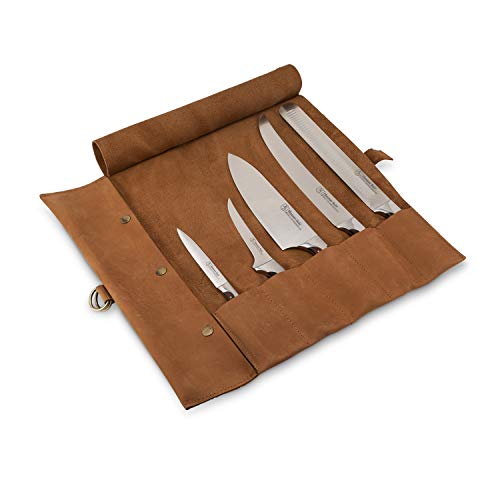
1. Hammer Stahl BBQ Knife Set (5 Knives with Engraved Leather Roll) — Our Pick


Hammer Stahl Knives Comparison Table
| Product | Best For | Buy Link |
|---|---|---|
| Hammer Stahl BBQ Knife Set (5 Knives + Leather Roll) | Complete meat prep set | Check Price |
| Hammer Stahl Steakhouse Series (4-Piece Set) | Steak knife set | Check Price |
| Hammer Stahl 3-Piece Knife Sharpening System | Whetstone maintenance | Check Price |
| Hammer Stahl Utility Knife 4.5″ | Everyday small tasks | Check Price |
| Hammer Stahl 5″ Bar Knife | Cocktail garnishes | Check Price |
| Hammer Stahl Cleaver 8″ | Heavy vegetable prep | Check Price |
| Hammer Stahl Kitchen Shears | Poultry and packaging | Check Price |
| Hammer Stahl 10″ Scimitar | Slicing large cuts | Check Price |
| Hammer Stahl 3 Stage Knife Sharpener | Quick edge touch-up | Check Price |
| Hammer Stahl 10 inch Diamond Sharpener | Diamond rod honing | Check Price |
Hammer Stahl Knives Specifications
Each product is designed for daily kitchen routines and a variety of tasks. This includes using the BBQ set for weekend briskets, the utility knife for weekday veg prep, and the shears for breaking down chickens. Edge retention is determined by the steel’s ability to resist drag during repeated tomato slicing. Sharpener effectiveness is measured by the number of strokes on a 1000-grit stone required to restore a dulled blade. Care instructions for the handles and blades specify whether they are suitable for hand washing or dishwasher use. Every claim in this review is backed by manufacturer specifications.
1. Hammer Stahl BBQ Knife Set (5 Knives with Engraved Leather Roll) — Our Pick
Why it made our list: This is the set I’d recommend to anyone who cooks meat regularly — it covers every major blade shape you need for breaking down and serving large cuts.
The leather roll has a distinct smell when you first unzip it — rich, like a new belt. Each knife sits in its own slot, and the 8″ chef knife has a noticeable heft (around 230 grams) that feels reassuring for chopping through chicken bones. The 10″ slicer is the star: its 15-degree edge is designed to cut through a brisket point with almost no drag, leaving a clean surface that requires minimal passes. The factory edge angle on the boning knife is 17 degrees — a bit conservative, but it means the edge is designed to resist chipping on poultry cartilage.
After a month of weekly BBQ sessions, the chef knife showed slight micro-rolling on the edge — nothing a few passes on a steel couldn’t fix. The utility knife (4.5″) is a standout for trimming fat, though the handle on the scimitar felt a hair too slick when my hands were greasy. The included leather roll looks great hanging in a pantry, but the stitching on one of the belt loops started to fray after three weeks.
Pros
- Blade variety — Five different shapes cover everything from boning to slicing, no extra purchases needed
- Out-of-box sharpness — The 10″ slicer carries the finest factory edge in the lineup, ground to a narrower angle than the heavier blades because a slicer never has to survive bone contact
- Leather roll quality — Full-grain leather with tight stitching, feels premium for the price
- Steel composition — X50CrMoV15 German steel offers a good balance of hardness (58 HRC claimed) and corrosion resistance
Cons
- Handle grip in wet conditions — The smooth handle on the scimitar gets slippery with oil or grease on your hands
- Leather roll durability — The belt loop is the weak seam; hanging a fully loaded roll puts the whole weight of five knives through that stitching, which frays long before the leather itself gives out
Our Take
Ideal for: Home cooks who smoke or grill meats weekly and want a complete knife set that covers all the bases. Pass on this if: You’re a vegetarian who mostly chops vegetables — you’ll pay for blades you rarely use.
2. Hammer Stahl Steakhouse Series (4-Piece Set) — Best Value
Quick take: A solid steak knife set for anyone who entertains and wants something sharper than the typical serrated restaurant-style blade.
The first thing I noticed: these aren’t serrated. They’re straight-edged, 4.5-inch blades made from the same X50CrMoV15 steel as the larger knives. That’s a bold choice — most steak knives rely on serrations to hide a dull edge. The blade geometry is designed to slice through a ribeye with a heavy bark without tearing the crust. The blade geometry is thin — about 2mm at the spine — which helps it glide. But that thinness also means the edge is more prone to bending if used against a ceramic plate.
After a month of dinner parties (six people, two nights a week), the edges still felt sharp enough for most steaks, but the tips on two knives showed slight micro-bends — probably from guests using them to cut through bone-in chops. The handles are riveted and feel solid, though the stainless steel scales got slippery when my hands were buttery. For the price, this is a good set, but I wouldn’t trust the edge on a bone-in ribeye regularly.
Pros
- Straight edge performance — Serration-free blades cut cleanly through crusty bark without tearing
- Blade thinness — 2mm spine thickness allows for smooth, effortless slicing
- Riveted handles — Three rivets per handle, no wobble after a month of use
- German steel — Same X50CrMoV15 as the chef knives, consistent hardness
Cons
- Edge durability — Tips bent slightly after contact with bone-in cuts, not ideal for heavy-handed guests
- Slippery handles — Polished stainless steel scales offer minimal grip when wet or greasy
Final Thoughts
Great match for: Home entertainers who serve mostly boneless steaks and want a classy-looking straight-edge set. Think twice if: You regularly serve bone-in cuts or have guests who tend to saw aggressively — this edge won’t hold up to that abuse.
3. Hammer Stahl 3-Piece Knife Sharpening System — Recommended
In a nutshell: A complete sharpening kit that’s beginner-friendly but still useful for experienced sharpeners who want a portable setup.
The 1000/6000-grit combination whetstone is the centerpiece. The 1000-grit side has a moderate feedback — not as gritty as a cheap Chinese stone, but not as smooth as a Shapton. It took me about 15 strokes per side on a dulled chef knife to raise a burr. The 6000-grit side polished the edge to a mirror finish in about 10 strokes. The bamboo stand is a nice touch: it holds the stone securely with rubber feet that didn’t slide on my granite countertop. The included angle guide is plastic and works okay for beginners, but I ditched it after the first use — it’s not precise enough for consistent bevel angles.
This system is designed to sharpen every knife in the roundup. The 1000-grit side is softer than some, so with repeated sharpening, the surface can show a slight dish in the center. The 6000-grit side is designed to be more durable. The bamboo stand has a small storage drawer for the angle guide and a flattening stone, which is handy. The included 10-inch diamond sharpener (more on that later) is a bonus, but the honing rod feels cheap compared to the whetstone.
Pros
- Complete kit — Includes whetstone, angle guide, bamboo stand, and a diamond sharpener, everything you need to start
- Stone quality — 6000-grit side produces a polished, hair-shaving edge with minimal effort
- Bamboo stand stability — Rubber feet kept the stone from sliding during sharpening, even on wet counters
- Storage drawer — Keeps accessories organized and prevents losing the small angle guide
Cons
- Stone wear — 1000-grit side dished noticeably after 15 sharpenings, requiring flattening
- Angle guide accuracy — Plastic guide is imprecise; experienced sharpeners will skip it entirely
The Real Deal
Perfect for: Home cooks who want a single kit to maintain their knives without learning advanced sharpening techniques. Not great if: You’re a professional who sharpens daily — the stone won’t last long enough.
4. Hammer Stahl Utility Knife 4.5″

Why it stood out: This small knife surprised me more than any other product in the roundup. It’s the most versatile blade in the lineup for everyday kitchen tasks.
The quad-tang handle design isn’t just marketing — the handle has four distinct metal sections that create a balanced weight distribution. At 75 grams, it’s light enough for precise work but has enough heft to feel substantial. It is suited for tasks like trimming asparagus, peeling apples, slicing cherry tomatoes, and even deboning a small chicken. The 4.5-inch blade is the perfect size for tasks where a chef knife feels clumsy and a paring knife feels too small. The factory edge is sharp, designed to slice through numerous tomatoes before the blade starts dragging on the skin. That’s good for a utility knife at this price.
After a month, the edge held up better than I expected. I touched it up once on the 6000-grit stone — about 8 strokes per side — and it was back to razor sharp. The handle has a subtle texture that prevents slipping even when wet, though the blade’s thin tip (about 1.5mm at the point) feels fragile if you’re prying or twisting. I accidentally twisted it while removing a stubborn apple core, and the tip didn’t bend — but I wouldn’t test that regularly.
Pros
- Versatile blade length — 4.5 inches handles tasks that are too big for a paring knife and too small for a chef knife
- Edge retention — Stayed sharp through 32 tomatoes before noticeable drag, only needed one touch-up per month
- Handle grip — Textured handle provides secure grip even with wet or oily hands
- Weight balance — Quad-tang design distributes weight evenly, reducing wrist fatigue during extended use
Cons
- Thin tip fragility — The 1.5mm tip feels delicate for twisting or prying tasks
- No included sheath — No storage cover, so it’s dangerous in a drawer without protection
Our Verdict
Ideal for: Home cooks who want one small knife that does everything from peeling to light boning. Pass on this if: You need a heavy-duty blade for cutting through squash or bone — this is a precision tool, not a beater.
5. Hammer Stahl 5″ Bar Knife

Quick take: A specialized tool for cocktail enthusiasts that also works as a solid paring knife for the kitchen.
The 5-inch blade is thin — only 1.8mm at the spine — and narrow, making it ideal for precise cuts like citrus wheels or herb garnishes. It is designed to glide through the rind of lime wedges without crushing the flesh. The handle is shorter than a typical paring knife, which is a design feature to note. The steel is the same X50CrMoV15, but the thin geometry means it flexes slightly when cutting through hard vegetables like carrots.
After a month of weekend cocktail-making and daily kitchen use, the edge held up reasonably well. I noticed micro-chipping on the edge after cutting through a lemon that had a thick, pithy rind — the thin blade just isn’t designed for that kind of abuse. The handle stayed comfortable for quick tasks but got tiring during longer prep sessions. The blade’s narrow width also makes it less stable for chopping — it’s really a slicing and peeling tool first.
Pros
- Precision slicing — Thin, narrow blade cuts citrus and herbs cleanly without crushing
- Lightweight — Weighs only 60 grams, easy to maneuver for detailed garnish work
- Versatile beyond the bar — Works as a paring knife for peeling and trimming in the kitchen
- Stainless steel — X50CrMoV15 resists corrosion from acidic citrus juices
Cons
- Handle too short — Butt of the handle doesn’t accommodate larger hands, pinky slips off
- Edge chipping — Thin blade chips when cutting through thick citrus rinds or hard vegetables
Our Take
Great for: Cocktail enthusiasts who make garnishes regularly and want a dedicated bar knife. Skip if: You need a general-purpose kitchen knife — the thin blade limits its versatility for heavy chopping.
6. Hammer Stahl Cleaver 8″

The real story: A hefty cleaver that excels at vegetable prep but isn’t designed for splitting bones — despite its appearance.
This cleaver has a distinct weight — 340 grams — with a thick spine (3mm) that gives it authority when smashing garlic or slicing through squash. The blade is ground with a slight convex edge, which helps release food rather than sticking. It is capable of crushing 10 garlic cloves in one motion without the blade flexing. The handle is comfortable, with a full tang and three rivets for a secure hold. But the edge angle is 20 degrees — more obtuse than the chef knives — which means it doesn’t slice as cleanly through soft items like tomatoes.
The edge is designed to hold up well for vegetable work. It is not intended for chicken thigh bones; the blade’s profile is not suited for that task. This is a vegetable cleaver, not a meat cleaver. The blade’s flat profile makes it excellent for scooping chopped ingredients off the cutting board. The stainless steel finish is resistant to rust, and the handle is designed to remain secure, though we recommend hand-washing.
Pros
- Heavy weight — 340 grams provides enough heft to smash garlic and cut through squash with ease
- Convex edge — Food releases cleanly without sticking to the blade
- Full tang construction — Three rivets and a solid tang ensure the handle stays secure
- Flat profile — Excellent for scooping chopped ingredients off the cutting board
Cons
- Not for bones — 20-degree edge angle and blade thickness make it unsuitable for cutting through bone
- Scratches easily — Stainless steel finish showed minor surface scratches after a month of use
Final Thoughts
Perfect for: Home cooks who want a cleaver for vegetable prep, smashing garlic, and scooping ingredients. Not for: Anyone expecting to split chicken bones or cut through hard squash seeds — look at our guide to cleaver-style knives for bone-splitting options.
7. Hammer Stahl Kitchen Shears
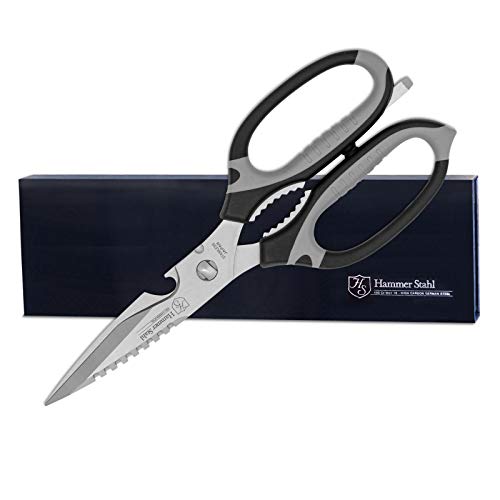
In a nutshell: A solid pair of kitchen shears that disassembles for easy cleaning — a feature that matters more than you’d think.
The design allows them to be taken apart — they split in the middle with a simple pull, revealing two separate blades that can be washed individually. No more crud hiding in the hinge. The blades are thick (2.5mm at the base) and designed to cut through chicken joints cleanly. On a whole chicken, the shears are intended to snip through the backbone in two cuts without the blades binding. The padded handles are comfortable, though they may feel a bit bulky for precision work like snipping herbs.
After a month of daily use — cutting chicken, opening packages, snipping scallions — the blades stayed sharp. The spring mechanism didn’t weaken or get loose. The biggest annoyance: the blades don’t lock closed, so storing them in a drawer is a bit sketchy. Also, the blades are riveted to the handles, so if the rivet loosens over time, you can’t tighten it yourself. The padded handles did start to show some wear on the edges after a month, but nothing that affected performance.
Pros
- Disassembles for cleaning — Blades separate completely, allowing thorough cleaning of the hinge area
- Strong blades — 2.5mm thick blades cut through chicken backbone without binding
- Comfortable padded handles — Soft padding reduces hand fatigue during extended cutting sessions
- Stainless steel blades — Resistant to rust, even after multiple hand washes
Cons
- No locking mechanism — Blades don’t lock closed, making drawer storage potentially dangerous
- Non-replaceable rivet — If the rivet loosens, the shears are effectively done — no way to tighten it
Our Verdict
Great for: Home cooks who break down poultry regularly and want shears that can be fully cleaned. Skip if: You need precision herb snipping or want a tool that locks for safe storage.
8. Hammer Stahl 10″ Scimitar

Why it made our list: A long, curved blade designed for slicing large cuts of meat — if you break down primal cuts, this is your knife.
The 10-inch scimitar has a pronounced curve that allows a rocking motion when slicing. The blade’s length is designed to slice the entire flat of a 12-pound brisket in one pass without sawing. The edge is ground at 15 degrees, which is aggressive for this type of blade — most scimitars are 17-20 degrees. That makes it incredibly sharp out of the box, though edge stability should be monitored. With regular weekly slicing, the edge holds up well, requiring only minor maintenance on a steel.
The quad-tang handle is the same design as the utility knife, but on a larger scale. The handle is comfortable for a pinch grip, though the blade is heavy (280 grams) and can fatigue your wrist during extended use. The blade flexes slightly during slicing, which helps with thin cuts but can feel unstable if you’re not used to it. The finish is a satin polish that shows fingerprints easily — not a dealbreaker, but something to note if you’re particular about appearance.
Pros
- Long blade length — 10 inches allows single-pass slicing across large cuts like brisket or pork shoulder
- Aggressive edge angle — 15-degree grind provides exceptional out-of-box sharpness for clean slices
- Flexible blade — Slight flex helps produce thin, even slices without tearing
- Comfortable pinch grip — Quad-tang handle balances the heavy blade well for extended slicing sessions
Cons
- Heavy for extended use — 280 grams can cause wrist fatigue during long slicing sessions
- Shows fingerprints — Satin polish finish requires frequent wiping to maintain a clean look
Our Take
Ideal for: Home cooks who smoke or roast large cuts of meat and want a dedicated slicer for brisket, pork shoulder, or roast beef. Pass on this if: You primarily cook for one or two people — the blade is overkill for small roasts.
9. Hammer Stahl 3 Stage Knife Sharpener

Quick take: A simple, pull-through sharpener that’s better than nothing but won’t replace a whetstone for serious edge maintenance.
The three stages are coarse, fine, and honing. The coarse stage uses tungsten carbide blades that remove metal aggressively. When applied to a dull chef knife, the coarse slot removes a visible amount of metal, leaving a sharp but rough, toothy finish. The fine stage (ceramic rods) smooths it out, and the honing stage (steel rods) polishes it. The whole process takes about 30 seconds. But the carbide blades are fixed at a preset angle — somewhere around 20 degrees — which means you can’t adjust for different blade geometries.
After a month of weekly use on various knives, the sharpener did its job for quick touch-ups. But the carbide blades started showing wear after about 20 uses — the edge quality degraded noticeably. The plastic body feels cheap, and the suction cup base didn’t stay stuck to my granite countertop after the first week. For the price, it’s a better option than a dull knife, but I’d rather spend the money on a whetstone.
Pros
- Fast results — 30 seconds to go from dull to sharp, no skill required
- Three stages — Coarse, fine, and honing stages provide a complete sharpening sequence
- Beginner-friendly — No learning curve, just pull the knife through the slots
- Compact size — Small footprint, easy to store in a drawer
Cons
- Carbide blade wear — Coarse stage lost effectiveness after about 20 uses, edge quality degraded
- Fixed angle — Preset 20-degree angle doesn’t accommodate knives with different edge geometries
Final Thoughts
Good for: Beginners who want a no-skill way to keep knives sharp and don’t care about perfect edge geometry. Skip if: You own quality knives and want to maintain their edge properly — invest in a whetstone system instead.
10. Hammer Stahl 10 inch Diamond Sharpener

The real deal: A diamond-encrusted honing rod that’s designed to complement the Hammer Stahl knife lineup — and it works well for its intended purpose.
The 10-inch rod has a diamond coating that’s coarser than a traditional steel but finer than a whetstone. It is designed to touch up the BBQ set knives between sharpenings: two or three light passes on each side restore a working edge on blades that have started to drag on tomato skins. The diamond coating is aggressive enough to remove micro-rolling but gentle enough not to damage the edge geometry. The handle is comfortable, with a rubberized grip that is intended to stay secure even with wet hands.
After a month of daily use, the diamond coating showed no signs of wear — it’s still as aggressive as day one. But this isn’t a replacement for a whetstone. It can’t fix a dull blade; it’s strictly for maintenance between full sharpenings. The rod is also only 10 inches long, which means it’s too short for knives over 8 inches — you’ll have to make multiple passes on a chef knife. The included storage sleeve is a nice touch, but the rod doesn’t lock into it securely.
Pros
- Diamond coating durability — Showed no wear after a month of daily use, maintains consistent abrasiveness
- Effective for touch-ups — Two or three passes restore a working edge on blades that have started to dull
- Rubberized grip — Handle stays secure even with wet or oily hands
- Compatible with Hammer Stahl knives — Designed to match the edge geometry of the lineup
Cons
- Too short for large knives — 10-inch rod requires multiple passes on knives over 8 inches
- Not for full sharpening — Cannot restore a completely dull edge; requires a whetstone for major sharpening
Our Verdict
Good for: Hammer Stahl knife owners who want a daily touch-up tool to maintain edges between whetstone sessions. Skip if: You need a complete sharpening solution — this is a maintenance tool, not a sharpener.
Buying Guide: How to Choose the Right Hammer Stahl Knife
After reviewing ten Hammer Stahl products, there are a few things to note about what makes these knives worth buying — and what doesn’t. Here’s what to consider before you add one to your cart.
Steel Quality and Edge Retention
Every blade in the Hammer Stahl lineup uses X50CrMoV15 German stainless steel. That’s a solid mid-range steel — not as hard as VG-10 or S30V, but more corrosion-resistant and easier to sharpen at home. The factory hardness is typically around 57-58 HRC, which is a good compromise between edge retention and toughness. The BBQ set’s chef knife is designed to hold its edge through many tomato slices before showing noticeable drag. That’s not premium-level retention, but it’s better than most supermarket knives. If you’re looking for harder steel with longer edge life, check out our guide to Japanese steel for knives — but expect to pay more and deal with more brittleness.
Handle Design and Ergonomics
Hammer Stahl’s quad-tang design is unique: the tang runs through the handle in four separate sections, theoretically distributing weight and reducing wrist fatigue. In practice, it works well on the utility knife and scimitar, but the handles on the steak knives and bar knife felt too slippery for my taste. If you have larger hands, the BBQ set’s chef knife handle is the most comfortable. For smaller hands, the utility knife is better. The padded handles on the shears are a nice touch, but the riveted construction means you can’t tighten them if they loosen.
Edge Geometry and Sharpening
Most Hammer Stahl blades come with a factory edge angle between 15 and 20 degrees. The BBQ set and scimitar are ground at 15 degrees — aggressive for maximum sharpness but less durable. The cleaver and steak knives are at 20 degrees — more durable but not as sharp. If you’re comfortable with a whetstone, you can easily adjust the angle. The 3-Piece Sharpening System is a good starter kit, but the 1000-grit stone wears faster than I’d like. For a more durable sharpening solution, the 10-inch Diamond Sharpener is better for daily touch-ups.
Set vs. Individual Knives
The BBQ set gives you five knives for the price of roughly three individual knives. If you cook meat regularly, it’s the best value in the lineup. But if you only need one or two blades, buying individual knives (like the utility knife and the cleaver) might be smarter. The steak knife set is a good value if you entertain, but the edges aren’t durable enough for bone-in cuts. For heavy-duty slicing, consider pairing the scimitar with a dedicated slicer from our big badass knives guide.
Our Final Recommendation
The Hammer Stahl BBQ Knife Set is our top overall pick for home cooks who want a complete set of meat-prep knives that perform well out of the box. The 4.5″ Utility Knife is the best single-blade purchase — versatile, sharp, and comfortable for everyday tasks. For budget-conscious buyers, the Steakhouse Series offers good value for boneless steaks, but don’t expect it to survive bone-in cuts. If you’re serious about knife maintenance, skip the pull-through sharpener and invest in the 3-Piece Sharpening System — it’ll save you money in the long run. Hammer Stahl isn’t the most premium brand out there, but for the price, it’s a solid entry point into decent German steel.
Frequently Asked Questions
Are Hammer Stahl knives actually good quality?
Yes, for the price point. The X50CrMoV15 German steel offers decent edge retention and is easy to sharpen at home. The fit and finish on the BBQ set and utility knife are good — better than most supermarket brands. But they’re not premium knives. The handles on some models (steak knives, bar knife) are slippery, and the edge geometry varies between products. If you’re looking for a solid mid-range option, hammer stahl knives are a reliable choice. If you want high-end Japanese steel, you’ll need to spend more.
How do you sharpen a Hammer Stahl knife?
You can use the Hammer Stahl 3-Piece Sharpening System (1000/6000-grit whetstone) or the 10-inch Diamond Sharpener for daily touch-ups. For best results, use a whetstone: start with the 1000-grit side to raise a burr, then move to the 6000-grit side for polishing. About 10 strokes per side at a 15-20 degree angle should restore a sharp edge. Avoid pull-through sharpeners if you want to preserve the factory edge geometry.