The Recessed Spice Rack: What Actually Matters Most
Some links on this page are affiliate links. If you buy through them we may earn a commission, at no extra cost to you. It never changes which products we pick — see our affiliate disclaimer.
You open the cabinet door and every jar is right where you left it — labels front, nothing tumbling out, the line of spices so orderly it almost feels like a built-in. That’s the end state a decent wall-mounted recessed spice rack gets you, and the difference between that and a cluttered shelf comes down to a few boring numbers: cavity depth, shelf lip angle, and whether you’re screwing into a stud or trusting an adhesive strip in a steamy kitchen.
Out of all four racks we compared, the Bunoxea Spice Rack Wall Mounted 4 Pack is the one I’d put my own money on. It’s four separate metal racks with a 2-inch jar clearance, and that modular setup covers more ground than any single-piece rack without forcing you into a custom wall cutout. Keep reading for the full breakdown.
📌 This article contains affiliate links. As an Amazon Associate I earn from qualifying purchases, at no extra cost to you. Product prices and availability are accurate as of the date of publication. Full disclosure.
| Product | Best For | Buy Link |
|---|---|---|
| Bunoxea Spice Rack Wall Mounted 4 Pack | Maximum jar count | Check Price |
| Nieifi Spice Rack Wall Mount | See-through storage | Check Price |
| BCOZLUX Spice Rack for Countertop | Rustic countertop display | Check Price |
| LUCYCAZ 2 Pack Wall Mounted Spice Rack | Guardrail stability | Check Price |
How We Chose These Recessed Spice Racks
Our shortlist came from comparing published dimensions, materials, and documented mounting features against what actually separates a good recessed spice rack from a failed one. The first thing we weighted was depth compatibility — a standard 2×4 stud bay gives roughly 3.5 inches of usable cavity space, so any rack deeper than that will protrude awkwardly from the wall. The second was the mounting mechanism: screw anchors hold indefinitely, while adhesive failures are common in moist kitchens. Material was the third filter. Solid wood and acrylic resist warping better than thin MDF or laminated particleboard, which can swell and jam the jars. Finally, we looked at interior clearance and shelf lip angle, because those determine whether standard jars sit securely or slide forward. Each product below was evaluated on those four points, and we noted where each one gives something up. Before you order, measure the exact space between your cabinet door and the shelf behind it — a rack that fits the spec sheet but not your actual cabinet is the most common return reason in this category.

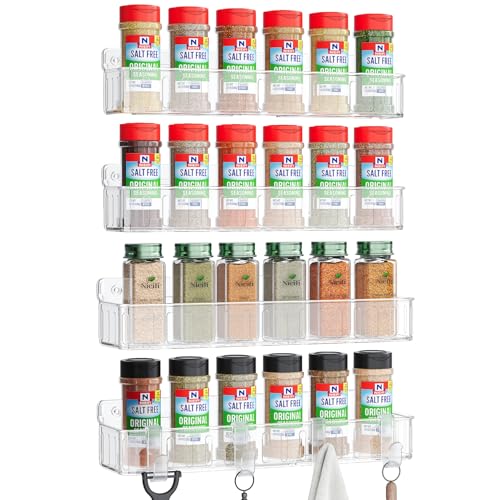

Bunoxea Spice Rack Wall Mounted 4 Pack (Our Pick)
Quick take: This is the pick for anyone who wants the most jars organized for the least wall space, and who is willing to spend ten minutes with a screwdriver.
The Bunoxea set is four individual racks made from powder-coated metal, each measuring 2.75 inches deep by 2.75 inches tall by 11.41 inches long. That depth matters because it sits inside the standard cabinet door gap without eating into the shelf space behind it. The 2-inch interior clearance is what limits jar diameter, and most standard spice jars — the 1.75-inch and 2-inch glass cylinders — slide in without forcing. Powder-coated metal is a good call for a kitchen that sees moisture from boiling pots: the coating seals the steel against rust and is far less porous than a painted wood surface, which means a turmeric spill wipes off instead of becoming a permanent yellow stain. That’s the exact failure mode I look for when I’m storing fermented pastes and raw onion powders.
Where this design wins is modularity. Four separate racks means you can stagger them vertically on a pantry wall, line them in a row inside a cabinet door, or split them between two different cabinets. That flexibility is something a single-piece recessed niche can’t match. The trade-off is that none of the four racks has a front lip or guardrail — the listing mentions jars fitting up to 2 inches, but there’s no raised edge on the front to catch a jar that gets jostled. If you’re mounting these on a door that gets slammed, you’ll want to push jars all the way back against the wall bracket. The adhesive installation option exists, but I would not use it for glass jars over 8 ounces. Screw mounting into a cabinet frame or wall stud is the only permanent way to hold this much weight. The spec sheet doesn’t list a total weight capacity, which is the number I’d want to know before loading all four racks with 16-ounce glass bottles.
Pros:
- Four separate racks — covers a full pantry wall or two cabinet doors without gaps.
- 2.75-inch depth — sits within the standard 3.5-inch cavity without protruding past the cabinet face.
- Powder-coated metal — resists moisture and wipes clean, unlike raw steel or MDF.
- Screw or adhesive mounting — gives you a permanent option and a renter-friendly fallback.
Cons:
- No front guardrail — jars can slide forward if the door is bumped hard.
- No stated weight capacity — you have to guess how much glass you can load before the anchors pull out.
- Adhesive mode is risky — kitchen humidity degrades adhesive over time, so the no-drill option is not reliable for heavy jars.
Our Verdict
Best for: Someone who wants a high jar count without cutting into a wall, and who can screw into a cabinet frame or stud. Skip if: You need a built-in front lip to prevent sliding, or you’re renting and can’t drill — the adhesive alone is a gamble with glass jars.
Nieifi Spice Rack Wall Mount (Recommended for Visibility)
In a nutshell: This one trades metal strength for total transparency, so you see every label at a glance, but you also need to trust the plastic not to warp.
The Nieifi rack is made from ABS plastic — a clear, impact-resistant polymer that lets you read a label without pulling the jar out. That see-through quality is the main reason to buy it. The listing doesn’t give exact dimensions beyond a 2-inch depth, which matters for recessed applications because anything over about 3 inches would stick out past the drywall edge. Assuming the 2-inch figure is accurate, this rack fits inside a standard cabinet door gap with room to spare. ABS is far less prone to staining than polycarbonate or acrylic — while fermented chili paste can leave a permanent orange hue on acrylic containers, ABS resists this staining and cleans up with a quick scrub. That’s a real advantage for anyone who keeps turmeric, annatto, or smoked paprika in open jars.
The construction gives up structural rigidity compared to the Bunoxea metal racks. ABS is strong for plastic, but it flexes under load, and that flex becomes a problem when you’re holding five or six full glass jars. The rack offers both adhesive and screw mounting, and again, screws are the answer for anything heavier than a few ounces. The removable design listed in the product data is a nice touch for cleaning — you can pop the whole unit off the wall bracket and run it under the sink, which is something a metal rack bolted into a stud can’t do. What’s missing is a raised front edge or dividers between jars: the clear shelves are flat, so jars sitting next to each other can rattle and shift when the door opens. For a recessed wall niche, that’s less of an issue because the wall itself acts as a backstop, but on a cabinet door, every swing is a chance for a jar to walk forward.
Pros:
- Clear ABS construction — labels stay visible without pulling jars, and the material resists turmeric and chili stains better than acrylic.
- Removable design — you can take the tray off the bracket for a real wash, not just a wipe-down.
- 2-inch depth — fits flush in a standard 2×4 stud bay without any furring out.
- Two mounting methods — screw into a wooden door for permanence, or use the adhesive for a temporary spot.
Cons:
- ABS flexes under full glass jars — the plastic isn’t as stiff as powder-coated steel, so a fully loaded rack can bow slightly.
- No front lip or dividers — jars are free to slide sideways and forward on the smooth shelves.
- Listing omits weight capacity — you don’t know how many 16-ounce bottles the adhesive can support before it fails.
Why It Earns a Spot
Great match for: A spice cabinet where you want to see everything without opening drawers, and where jars are mostly small or half-full. Not great if: You’re storing heavy glass jars of whole spices — flex plus no guardrail is a recipe for a mess.
BCOZLUX Spice Rack for Countertop (Rustic Option)
Here’s the deal: This one is more furniture than hardware, meant to sit on a counter or mount on a wall as a display piece, not to disappear inside a cabinet.
The BCOZLUX rack pairs a rustic brown wood body with black iron bars — a combination that reads as farmhouse or industrial depending on the rest of your kitchen. It’s described as a countertop rack with a wall-mount option, so the depth isn’t listed as a recess-fitting measurement. That’s a clue: this rack is not designed to hide inside a wall cavity. Its primary job is to hold spice jars out in the open where you can see them, which means it needs to look good, and on that count the material pairing works. Wood and iron are both stable in dry conditions, but a countertop near a steamy stove is a moisture trap, and raw or lightly sealed wood will absorb that humidity over time. If you’re storing anything with turmeric or smoked paprika, a spill on that wood grain is permanent — this is the exact opposite of the Nieifi ABS tray for stain resistance.
The two-way use is the main selling point. You can stand it on a counter next to the stove, where it holds jars at an angle for easy retrieval, or you can hang it on a wall as a shallow display shelf. What the listing doesn’t tell you is the mounting hardware included, the weight capacity, or whether the wood is sealed. Those are the numbers that matter for a wall install, because a wooden rack full of glass jars is a lot of static load on whatever screws or anchors you use, and if the wood swells from humidity, the screw holes loosen. Compared to the Bunoxea metal racks, this one adds visual warmth but subtracts durability in a moist kitchen. Compared to the LUCYCAZ with its guardrails and hooks, this has no secondary retention — if a jar tips forward off the shelf lip, it falls.
Pros:
- Rustic wood and iron construction — looks like a deliberate design choice, not a plastic utility item.
- Countertop or wall use — one unit can move from a shelf to a wall as your kitchen changes.
- Iron bar front — at least one side has a low rail, which is more than the flat Bunoxea shelves offer.
- No assembly required — the listing implies a ready-to-use piece, not a DIY project.
Cons:
- Wood is porous — any spilled spice oil or paste soaks in and leaves a permanent stain, unlike ABS or powder-coated metal.
- No recess depth listed — if you’re trying to fit it into a wall cavity, you’ll be guessing whether it protrudes.
- Unknown wall-mount hardware — the listing doesn’t say what anchors or screws come with it, and a heavy wood rack on drywall needs proper support.
The Real Deal
Perfect for: Someone who wants the spice rack to be part of the kitchen’s decor, sitting on an open counter or a dry pantry wall. Think twice if: You’re actually looking for a recessed fit inside a cabinet — this rack is too wide and too decorative to disappear into a stud bay.
LUCYCAZ 2 Pack Wall Mounted Spice Rack for Spice Jars & Seasonings (Black)

What sets it apart: The guardrails and hooks solve the two problems every other rack on this list ignores — jars sliding forward and nowhere to hang a measuring spoon.
The LUCYCAZ set is two black powder-coated metal racks, each with a stable guardrail along the front edge and improved wider adhesive stickers for the no-drill installation. The addition of side guards is significant: unlike the Bunoxea’s open front, these racks have a raised lip that physically stops a jar from sliding off during a door swing. The eight hooks are another practical touch — they hold measuring spoons, small scoops, or even bag clips for partially used spice pouches. The powder coating matches the Bunoxea for stain resistance, which matters if you’re storing anything with annatto or beet powder that loves to stain plastic.
Where this design gives up ground is capacity. Two racks mean fewer total jars than the Bunoxea’s four, so if you have a large spice collection, you’ll need two sets and double the wall space. The wider adhesive stickers are marketed as a benefit, and they are wider than typical, but adhesive is still adhesive — in a humid kitchen above a dishwasher or next to a boiling pot, the bond degrades and eventually fails. The rack includes screw mounting as a second option, and that’s what I’d use for any jar over 4 ounces. The listing doesn’t provide the rack’s depth or the exact jar diameter it accommodates, which are the two numbers you actually need before ordering for a recessed cabinet application. Without that, you’re guessing whether your jars will sit flush or stick out past the door frame.
Pros:
- Front guardrail and side guards — jars stay put even when the cabinet door swings open fast.
- Eight hooks included — measuring spoons and small tools hang right where you need them.
- Wider adhesive stickers — more surface area than typical peel-and-stick strips, though still not a substitute for screws.
- Powder-coated metal — resists moisture and cleans up without staining.
Cons:
- Only two racks per pack — half the storage of the Bunoxea set for roughly similar money.
- Missing depth spec — you can’t verify that the rack sits fully inside a 3.5-inch wall cavity.
- Adhesive mode still risky in moisture — the wider strip doesn’t change the fundamental chemistry of adhesive failure in humid air.
Final Thoughts
Ideal for: A small kitchen where stability beats capacity, and you want the security of a guardrail plus hooks for tools. Pass on this if: You have more than a dozen jars to store — two racks won’t cut it, and doubling up eliminates the value of this set.
What Matters When You’re Buying a Recessed Spice Rack
A recessed spice rack isn’t just a shelf you screw to a wall. The whole point is that it disappears into the structure — either inside a cabinet door gap or set into an actual wall cavity. The first thing to check is depth. A standard 2×4 stud wall gives you about 3.5 inches of cavity space between the drywall surfaces. Any rack deeper than that will protrude, which defeats the purpose. The Bunoxea at 2.75 inches fits with room to spare; the BCOZLUX doesn’t list its depth at all, which is a red flag if you’re planning a true recess.
Second, look at the mounting mechanism. Adhesive-mounted racks fail in two ways: the adhesive itself loses grip in warm, humid kitchen air, and the paint on the cabinet door or wall can peel away, taking the rack with it. Screw anchoring into a wooden cabinet frame or a wall stud is the only permanent hold for anything holding glass jars. The Consumer Product Safety Commission sets voluntary standards for wall-anchor testing on furniture, and the principle applies here: a loaded rack falling from a cabinet door is a blunt-force hazard in a busy kitchen. If the listing doesn’t mention a weight capacity, assume the adhesive mode is only safe for lightweight plastic jars.
Third, consider the shelf lip and side guards. A flat shelf with no front rail relies on the back wall to stop jars from sliding backward, but nothing stops them from sliding forward when the door swings. The LUCYCAZ’s guardrail is the standout fix here; the Bunoxea and Nieifi leave jars exposed, which means you’ll be picking turmeric off the floor one day. If you’re set on a rack without a lip, mount it low enough that a falling jar lands on a counter, not a tile floor.
Finally, think about material in terms of staining and warping. Solid wood and powder-coated metal resist warping better than thin MDF or laminated particleboard, which swells with humidity and can jam jars in place. For odor and stain transfer, clear ABS and powder-coated metal are your best bets. Wood is beautiful but porous — a spilled drop of annatto oil or fish sauce will soak into the grain and linger for years under the finish. If you’re also looking at stainless steel spice racks, note that most household stainless is 201-grade, which resists staining but not pitting in salty air. Powder-coated steel is actually more forgiving for a moist kitchen.
Matching a Rack to a Recessed Cavity
If you’re building a true recessed spice cabinet — meaning you cut into drywall and frame a niche between studs — your rack choices narrow. The Bunoxea and Nieifi both fit within the 3.5-inch stud bay depth, so they could sit inside a shallow niche flush with the surrounding wall. The LUCYCAZ’s depth is unlisted, so you’d have to measure before buying. The BCOZLUX is a countertop piece first and likely too deep for a flush wall insert. Before cutting any hole, use a stud finder to locate both stud edges and any electrical wiring or plumbing running through the bay. A drywall saw can nick a Romex cable in half a second, and a spice rack isn’t worth rewiring a wall.
Our Final Recommendation
For most kitchens, the Bunoxea Spice Rack Wall Mounted 4 Pack is the clear winner: four powder-coated metal racks, 2.75-inch depth that fits a standard wall cavity, and screw mounting that holds indefinitely. If you need an affordable set with guardrails and hooks, the LUCYCAZ 2 Pack is the best value despite half the capacity. On a budget where visibility matters more than weight capacity, the Nieifi clear ABS tray works, but keep the jars light. The BCOZLUX is a decorative piece, not a recess solution. My own money goes to Bunoxea, screwed into a stud, with a second set ordered when the collection grows.
Frequently Asked Questions
What’s the difference between a recessed spice cabinet and a wall-mounted spice rack?
A recessed spice cabinet is built into the wall cavity itself — the jars sit inside a framed niche between two studs, so the rack face is flush with the drywall. A wall-mounted rack, like all four reviewed here, attaches to the surface of a cabinet door or wall and protrudes outward. Both can hold jars, but a true recess requires cutting into drywall and reframing, which is a much bigger project than screwing a metal rack to a door.
Can I install a recessed spice rack without cutting into drywall?
Yes, if you use a surface-mounted rack inside a cabinet door gap. The gap between a cabinet door and the shelf behind it usually measures between 3 and 4 inches, and racks like the Bunoxea at 2.75 inches deep fit into that space without any demolition. What you can’t do is create a flush wall niche without cutting drywall — the cavity doesn’t exist until you open the wall.
How much weight can an adhesive-mounted spice rack hold in a kitchen?
The listing for none of these racks states a weight capacity for the adhesive mode, which should tell you something. Adhesive strips in a humid kitchen above a dishwasher or stove gradually lose bond strength, and a fully loaded rack of 12-ounce glass jars can exceed several pounds. For anything heavier than a few plastic spice bottles, use the screw mounting option. The wider adhesive on the LUCYCAZ helps, but it’s still a temporary solution.
Will these racks hold tall bottles like vanilla extract or soy sauce?
Only if the bottle’s diameter fits the rack’s interior clearance. The Bunoxea lists a 2-inch maximum jar diameter, which excludes most tall extract bottles and soy sauce cruets. Height isn’t the limiting factor for a shallow rack — depth is. A tall narrow bottle can sit upright only if its base diameter is under 2 inches, otherwise it will either not fit or tip forward. Check your tallest bottles before buying.
What should I check before cutting a recess for a spice rack in a stud wall?
Use a stud finder with an electrical detection mode to locate the edges of the two studs framing the bay you want to open. Then check for plumbing or wiring running vertically through that cavity — a wire or pipe is often stapled to the side of a stud inside the wall. Only cut between the studs, and keep the opening shallower than 3.5 inches to avoid hitting anything on the far drywall. If you’re at all unsure, use a surface-mounted rack instead; the Bunoxea or LUCYCAZ will serve the same function without opening a wall. For tall narrow jar collections, our guide to choosing a tall spice rack covers the specific height constraints that flat racks can’t handle.