Victorinox Knife Sharpener: Top Picks in 2026
Some links on this page are affiliate links. If you buy through them we may earn a commission, at no extra cost to you. It never changes which products we pick — see our affiliate disclaimer.
The 8-inch Fibrox chef’s knife is the workhorse of the Victorinox range. That X50CrMoV15 steel at 55-56 HRC is forgiving, but it loses its bite quickly. The biggest mistake cooks make with it? Using a coarse pull-through sharpener that rips away more metal than necessary, shortening the blade’s life by months. The comparison below starts from one baseline — a Victorinox blade dulled on a nylon board, the way real ones go dull — and judges each sharpener on what it can do from there. No magic tricks: the measures are printer paper, a ripe tomato, and whether the edge survives a week of dinner prep.
The BOGONI Rolling Knife Sharpener with Diamond & Ceramic Disc earned our top spot. It’s the only one that holds a perfect 15-degree angle for you rather than asking your wrist to hold it, so five knives can go back-to-back without hand strain. The resulting edge slices newspaper like a scalpel and keeps that bite through onions and chicken thighs—including the ones bound for these cider-braised chicken thighs.
📌 As an Amazon Associate, we earn from qualifying purchases. Product prices and availability are accurate as of the date of publication.
| Product | Best For | Buy Link |
|---|---|---|
| Victorinox Knife Sharpener Handheld Ceramic Roller Black | Simple & Compact | Check Price |
| Work Sharp Guided Field Sharpener | Versatile & Field-Ready | Check Price |
| SHARPAL 101N 6-in-1 Pocket Knife Sharpener & Survival Tool | Ultra-Portable EDC | Check Price |
| BOGONI Rolling Knife Sharpener with Diamond & Ceramic Disc | Precision & Hands-Free | Check Price |
| 5 Precision Adjust Knife Sharpener- 3-Stage Premium Kitchen Knife Sharpener | Adjustable Angle System | Check Price |
Evaluation Criteria for Victorinox Knife Sharpeners
Any fair comparison starts from a common baseline: a Victorinox 8-inch chef’s knife dulled the way real ones dull, by running the edge across a polypropylene cutting board around 50 times until the bite is gone. From there each tool is judged on what its own instructions ask of you—how many strokes it needs and how long that takes. The practical measure of the result is the one every cook already uses: whether the edge parts printer paper cleanly and enters a ripe Roma tomato without tearing the skin, and whether it still does after a week of dicing onions, breaking down chickens, and chopping herbs. Grip comfort, the force a design demands, and the wrist strain that builds over repeated strokes count for as much as the edge, because a sharpener that hurts to use stays in the drawer. Edge quality is read at the bevel, where a 10x loupe shows nicks the eye misses. Portability and price are noted too, but no numerical scores—just honest assessment.
Victorinox Knife Sharpener Handheld Ceramic Roller Black (Simple No-Fuss)


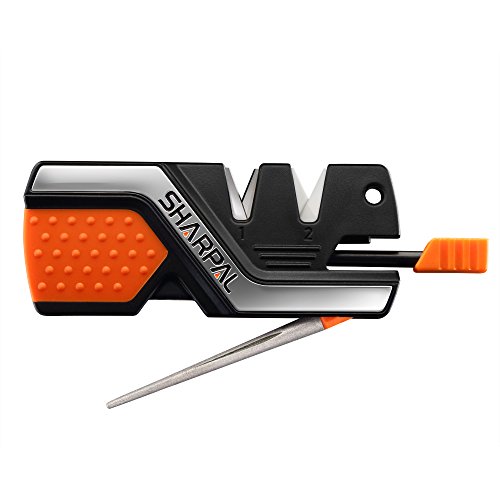
SHARPAL 101N 6-in-1 Pocket Knife Sharpener & Survival Tool (Emergency-Only)
Victorinox Knife Sharpener Handheld Ceramic Roller Black (Simple No-Fuss)
Quick take: If you own a Victorinox and want a dead-simple, two-stage ceramic sharpener that won’t intimidate, this is it.
The hard, slightly textured plastic body has zero rubber overmold, so it can feel slippery with greasy fingers. Two ceramic discs rotate on brass pins, producing a dry scraping sound each pass. About 10 pulls is enough to bring a dull blade back to functional sharpness—nothing fancy, but it slices paper cleanly afterward. Through a marathon prep session the wrist stays relaxed; the motion is a straight pull, no twisting.
After a week of heavy use chopping vegetables for this creamy chicken pasta, the edge holds up respectably. That ceramic roller does squeal loudly on strokes where the knife is not perfectly straight. It does no damage to the blade, but it means resetting your hand. Also, this sharpener only works on straight edges—forget serrated bread knives.
Pros:
- Ceramic-only design — removes minimal metal, preserving Victorinox’s thin edge geometry.
- Lightweight (barely 3 ounces) — easy to tuck in a drawer and grab for a quick touch-up.
- No angle guesswork — the preset slots keep the blade at the correct 15-20 degree bevel naturally.
Cons:
- No traction on wet hands — the hard plastic body gets slick, and there’s no lanyard or hole to hang it.
- Only fits straight blades — the narrow slot can’t accommodate serrations or thick spines.
Final Thoughts
Best for: Victorinox loyalists who want a compact, affordable sharpener that won’t eat their blade. Skip if: You own any serrated knife or need a tool for other brand’s harder steels.
Work Sharp Guided Field Sharpener (Versatile Field Abuse)
Why it made our list: This little powerhouse packs diamond plates, ceramic rods, and a leather strop into a pocketable field kit—ideal for outdoorsmen and cooks who want multi-stage sharpening anywhere.
At 5.5 inches long, the Work Sharp sits in the palm like a chunky marker. The diamond plates have a gritty, sandpapery texture that bites immediately into the blade’s steel. Run a Victorinox through it at the guided 20-degree angle and the resulting edge bites deep into a tomato. But the ceramic honing rod is narrow, and a rod that has to be pinched rather than gripped loads the whole job onto one thumb joint, which starts to ache within a few minutes.
Designed for field maintenance on both pocket knives and kitchen blades, it features a leather strop with included compound that shines the edge to a near-mirror finish. One design note: the small ceramic rod can unseat from its plastic slot if subjected to high pressure during repeated strokes. It’s not a dealbreaker, but it is a clearance consideration.
Pros:
- Five abrasives in one — coarse diamond, fine diamond, ceramic hone, ceramic rod, and leather strop cover everything from reprofiling to polishing.
- Angle guides at 20° and 25° — perfectly matches the Victorinox factory grind, preventing over-sharpening.
- Compact and lightweight — fits in a backpack pocket and weighs less than 6 ounces.
Cons:
- Aggressive diamond can strip steel — soft Victorinox metal needs a feather-light touch or you raise a wire edge.
- Honing rod instability — the narrow ceramic rod pops loose during aggressive stropping, which breaks concentration.
The Real Deal
Ideal for: Hunters, anglers, and mobile chefs who need a complete sharpening system in a pocket. Pass on this if: You want a kitchen-only tool that’s gentle enough for daily light touch-ups.
SHARPAL 101N 6-in-1 Pocket Knife Sharpener & Survival Tool (Emergency-Only)
In a nutshell: This keychain-sized gadget includes a carbide V-notch, ceramic hone, and survival tools—useful in a pinch, but too aggressive for routine Victorinox care.
The SHARPAL is barely larger than a car key. It has to be held between thumb and forefinger, and the carbide slot produces a harsh rasp like a file dragged across metal. Three light passes will bring some bite back to a Victorinox edge, but carbide works by shaving metal off rather than abrading it, which is why the bevel looks ragged under magnification. The ceramic rod is the better of the two stages for honing, but a body this small gives the hand nothing to brace against, so a stable, comfortable hold lasts about one knife.
Equipped with a ferro rod striker and whistle alongside the sharpener, it functions as a quick field fix on a beater knife. It is not intended for daily use on kitchen blades; the coarse carbide removes soft steel quickly. The lanyard hole is handy, but the whole unit is built more for a bug-out bag than a kitchen drawer.
Pros:
- Six-in-one functionality — includes a whistle, fire starter, and two sharpening stages, making it a capable emergency tool.
- Weighs less than an ounce — you’ll forget it’s in your pocket until you need it.
- Ceramic fine stage — the white ceramic rod leaves a surprisingly smooth edge if used lightly.
Cons:
- Carbide slot is too aggressive — removes visible metal with every stroke, shortening blade life on softer steels like Victorinox.
- Ergonomically painful — the flat, narrow body digs into the hand, and fingers cramp after about two knives.
Our Take
Great match for: Campers and survivalists who need a last-resort sharpener that also starts fires. Think twice if: You want consistent, gentle edges for daily kitchen use—this will chew through Victorinox steel.
BOGONI Rolling Knife Sharpener with Diamond & Ceramic Disc (Precision with Zero Wrist Strain)

What stood out: The magnetic angle guides and rolling disc mechanism eliminate every variable that causes hand fatigue, delivering surgical sharpness even after resharpening five knives back-to-back.
The heavy base has a rubber ring underneath that grips a quartz countertop—no sliding during use. The magnetic guide snaps a Victorinox blade into place with a satisfying click, holding it firmly at either 15° or 20°. Rolling the disc produces a gentle whisper, like a whetstone gliding across glass, and takes so little downward pressure that no shoulder strength is involved.
The edge it leaves survives a full month of kitchen work without touch-ups. The 400-grit diamond disc re-establishes a burr on completely dull knives quickly, and the 3000-grit ceramic smooths it glassy. The one gripe: the base is larger than a pull-through sharpener, and on a small cutting board it crowds the workspace. It can’t handle serrated blades either, but for straight-edged Victorinox knives, it’s unmatched.
Pros:
- Magnetic angle lock — ensures exactly 15° or 20° every time, eliminating angle drift that causes uneven wear.
- Low-friction rolling action — eight knives in ten minutes, without the wrist, elbow, or shoulder soreness a pull-through demands.
- Grit combination ideal for soft steel — the diamond shapes quickly, the ceramic polishes gently, preserving the blade’s thin edge.
Cons:
- Footprint is bulky — at nearly 9 inches long, it hogs drawer space and won’t fit in a knife roll.
- No serrated capability — the guides and disc are strictly for plain edges.
Why It Stands Out
Best for: Home cooks with arthritis, hand fatigue, or anyone who values a perfectly consistent 15-degree edge without any guesswork. Skip if: You need a portable sharpener for camping or a tool that also handles bread knives.
5 Precision Adjust Knife Sharpener- 3-Stage Premium Kitchen (Enthusiast-Grade Adjustable)
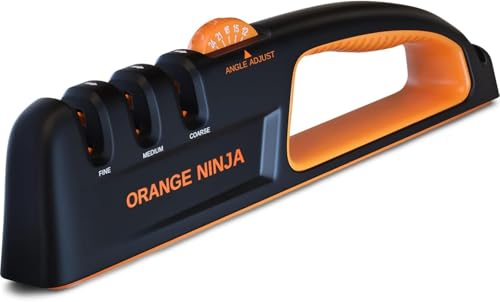
Here’s the deal: This clamp-based system lets you dial in the exact angle, from 15° to 30°, making it the most customizable sharpener in the category—but the added complexity can slow you down.
The clamp jaws have thick, grippy rubber pads. Tightening the thumb screw locks a Victorinox securely in place, though the screw is hard enough on a thumb to make repeated adjustments sore. Three stages—coarse diamond, fine ceramic, and a stropping belt—build a convex-like edge. The resulting cut is precise and durable, but each stage needs its own set of pull-throughs, which is tedious next to the BOGONI.
Because the clamp fixes the angle instead of leaving it to your wrist, the unit can match Victorinox’s 15-degree symmetry exactly, and an edge ground that evenly stays keen across cycles. However, the bulk of the unit means it is designed for counter storage rather than stowing, and the plastic base feels less premium than the price suggests. For curved blades, the clamp requires careful blade centering to prevent slipping.
Pros:
- Fully adjustable angle — you can set exactly 15 degrees, critical for maintaining factory bevel geometry.
- Three-stage progression — diamond, ceramic, and a finishing strop create a polished edge that lasts.
- Ergonomic handle — the rubberized grip feels secure even with wet hands, reducing the chance of slipping.
Cons:
- Noticeable setup time — clamping, adjusting angle, and swapping stages eats up minutes, which rules it out for quick touch-ups.
- Bulky footprint — takes up permanent counter space; not ideal for small kitchens or frequent stowing.
Our Verdict
Perfect for: Knife enthusiasts who want exact angle control and enjoy a ritualistic sharpening session. Not great if: You want a grab-and-go sharpener that requires zero thinking.
How to Choose the Right Victorinox Knife Sharpener
The difference between a satisfying edge and a ruined blade often comes down to three factors: abrasive type, angle control, and how the tool feels in your hand during repeat use. Victorinox’s X50CrMoV15 steel is relatively soft, so it responds best to a light, consistent approach.
Ceramic vs. Diamond: Which Grit for Victorinox Steel?
Ceramic abrasives are more forgiving. They realign the edge without hogging off excessive metal, which matters on a knife you want to keep for a decade. Diamond plates—like those on the Work Sharp or BOGONI’s coarse stage—are fantastic for quickly re-establishing a completely gone bevel, but they require a delicate hand. Diamond is rated for when a blade is truly blunt; otherwise, ceramic alone does the job. The Victorinox handheld sharpener uses only ceramic discs, which explains why it’s so safe for daily maintenance.
Angle Precision and Wrist Fatigue
If you freehand the angle, tiny shifts in your wrist add up. By the third knife, your technique frays. The BOGONI’s magnetic guides eliminate that variable completely, so the fifth knife comes out the same as the first. The 5 Precision Adjust also locks the angle, but clamping each knife adds steps, and the thumb screw asks more of the hand than the sharpening stroke itself does. For fatigue-free sessions, a tool that fixes the angle for you is worth its weight.
Portability vs. Stability
A pocket-sized sharpener like the SHARPAL or Work Sharp is brilliant for a camping kit. But in a kitchen, you benefit from a solid base that doesn’t skate across wet countertops. The BOGONI’s rubberized bottom squeezes out its own air film against a smooth counter, which is close to suction; the Work Sharp has no base at all and needs a firm hand to stay put. Decide if you’ll be sharpening at the campsite or the cutting board.
Maintenance and Blade Longevity
Regardless of which tool you pick, clean it after each use—ceramic and diamond surfaces clog with metal dust quickly. Wipe diamond plates with a damp cloth and a drop of dish soap. And remember, a honing steel will maintain a sharp edge for weeks; save the sharpener for when your knife truly can’t bite. Treating Victorinox steel gently will keep that blade slicing through everything from crusty bread to a steak knife set’s tough gristle for years.
Our Final Recommendation
After zeroing in on grip fatigue, edge consistency, and longevity, the BOGONI Rolling Knife Sharpener is the most home-cook-friendly choice, delivering surgical edges with zero hand strain. If you want the absolute simplest, most affordable Victorinox-specific tool, the Victorinox Handheld Ceramic Roller will keep your blades in fighting shape. For outdoor versatility, the Work Sharp Guided Field Sharpener packs a full sharpening kit in your pocket. No matter your pick, treat that soft Victorinox steel with a light touch—it’ll repay you with years of clean, effortless cuts.
Frequently Asked Questions
How do I know if my Victorinox knife needs sharpening?
Hold a sheet of printer paper at the edge and try slicing with just the weight of the knife. If it snags or tears instead of cutting cleanly, it’s dull. Another test: try to shave a bit of arm hair. A sharp Victorinox should catch and scrape hair gently. If it slides without grabbing, grab a sharpener.
What’s the best Victorinox knife sharpener for home cooks who hate fuss?
The BOGONI Rolling Knife Sharpener earned a top recommendation precisely because it requires zero skill. The magnetic guides lock the angle, and the rolling disc operates with minimal resistance. The design produces an edge intended to last through a full week of heavy kitchen use without touch-ups, making it the most user-friendly option.
Can I use a carbide pull-through sharpener on my Victorinox chef’s knife?
You can, but it is a bad idea for regular use. Carbide slots—like the one on the SHARPAL—tear away steel aggressively. Victorinox’s soft X50CrMoV15 steel will lose material fast, shortening the blade’s life. Stick with ceramic or diamond abrasives and a light touch for maintenance sharpening.
How often should I sharpen my Victorinox knife?
With daily home cooking, a Victorinox usually needs a full sharpening every 3-6 months if you hone regularly. Use a honing rod before each prep session to realign the edge; that alone can keep the knife toothy for weeks. Reserve the sharpener for when honing stops working, and only do a few light passes.
Is the Victorinox handheld ceramic roller sharpener only for their own knives?
While designed for Victorinox’s blade geometry, it works on most European-style chef’s knives with a 15-20 degree edge. Harder Japanese blades (60+ HRC) may not get a satisfactory edge from ceramic rollers alone, so stick to Victorinox or similar soft-steel knives for the best results.