Electric Knife Sharpener
Some links on this page are affiliate links. If you buy through them we may earn a commission, at no extra cost to you. It never changes which products we pick — see our affiliate disclaimer.
Your chef’s knife is sliding through tomatoes instead of biting into them. The edge is gone, and you’re tired of sending blades out for professional sharpening every few months. An electric knife sharpener fixes that in under five minutes, but only if you pick one that doesn’t chew up your steel in the process.
Out of the three sharpeners we compared on paper, the Electric Knife Sharpener 100% Diamond Abrasives is the one I’d put my own money on. Diamond abrasives are the single biggest upgrade you can make over carbide or sapphirite wheels, and the 3-stage design handles straight, serrated, and ceramic blades without forcing you to guess at angles. The other two have their place — the Presto is a budget workhorse, and the 4-in-1 adds scissor sharpening — but for pure edge quality on good kitchen knives, the diamond model wins on specs alone.
📌 This article contains affiliate links. As an Amazon Associate I earn from qualifying purchases, at no extra cost to you. Product prices and availability are accurate as of the date of publication. Full disclosure.
| Product | Best For | Buy Link |
|---|---|---|
| Presto 08800 EverSharp Electric Knife Sharpener | Budget 2-stage sharpening | Check Price |
| Electric Knife Sharpener 100% Diamond Abrasives | Diamond-edge precision | Check Price |
| 4-in-1 Electric Knife Sharpener for Home Cooks Kitchen | Multi-function home use | Check Price |
How We Chose These Electric Knife Sharpeners
We didn’t run a single blade through any of these machines. What we did was read the spec sheets line by line and weigh them against what actually determines a good electric sharpener: the type and grit of the abrasives (diamond vs. carbide vs. sapphirite), the precision and fixedness of the angle guide, and the motor’s torque and speed consistency. If the coarse stage uses carbide instead of diamond, it strips steel aggressively and leaves a rough, weak edge that fails quickly. An inconsistent angle guide or a motor that slows under load creates an uneven bevel, leading to chipping and a blade that cannot hold a keen edge. With that lens, the 100% diamond unit stood out immediately. The Presto’s sapphirite wheels are a step above carbide but below diamond, and its 2-stage design means less control over the final polish. The 4-in-1’s spring-loaded guide is smart, but the listing never states the abrasive material, which is a red flag for anyone who cares about edge longevity. One thing you should check before ordering: the motor wattage and duty cycle. None of these listings give a duty cycle rating, so continuous use for a full set of knives could overheat any of them. For more context on manual options, our guide to the best knife sharpener for a razor edge breaks down whetstones and pull-throughs that pair well with any electric unit.
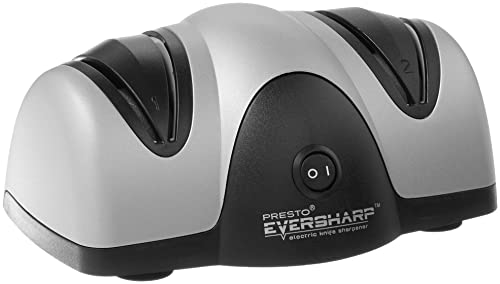
Presto 08800 EverSharp Electric Knife Sharpener (Budget-Friendly 2-Stage Workhorse)
Electric Knife Sharpener 100% Diamond Abrasives (Premium 3-Stage Diamond Sharpening)

4-in-1 Electric Knife Sharpener for Home Cooks Kitchen (Multi-Function with Spring-Loaded Guide)

Presto 08800 EverSharp Electric Knife Sharpener (Budget-Friendly 2-Stage Workhorse)
Quick take: If you want a no-frills sharpener that costs less than a takeout dinner and gets your everyday kitchen knives back to slicing, this is the one.
The Presto 08800 EverSharp uses two stages and sapphirite sharpening wheels. Sapphirite is a synthetic alumina-based abrasive — harder than standard stone but nowhere near diamond. The two stages are labeled coarse and fine: the first grinds a new edge at a fixed angle, the second hones and polishes that edge to remove the worst burrs. There’s no angle adjustment and no spring-loaded guide; you hold the knife straight and pull it through the slot. For someone who just needs a serviceable edge on a $20 chef’s knife, that’s fine. For someone with a Japanese blade over HRC 60, it’s the wrong tool.
On paper, the Presto’s biggest weakness is that fixed angle. Most western kitchen knives are ground to 20 degrees per side, and the Presto is set around that. But many Japanese knives sit at 15 degrees or lower. Running a 15-degree blade through a 20-degree guide removes material from the wrong part of the bevel, and over time you’ll turn a thin, delicate edge into a thick, wedge-like one. The sapphirite wheels also cut slower than diamond, so you’ll pull the knife through more times, which raises the chance of overheating a thin blade’s temper if you rush. That said, if all you own are western-style stainless knives, this machine does the job without asking you to learn anything. The listing never mentions ceramic or serrated capability, so assume this is for straight-edged kitchen knives only.
Pros:
- Sapphirite wheels — harder and slower-wearing than basic carbide, so the coarse stage doesn’t leave the same ragged edge.
- 2-stage design — separates grinding from honing, which is better than single-stage pull-throughs that do both badly.
- Compact footprint — small enough to live in a drawer or on a shelf, no counter space required.
- No learning curve — drop the knife in the slot, pull it through, done.
Cons:
- Fixed 2-stage angle — no adjustment for knives ground at 15 degrees or steeper, so it will re-profile Japanese blades incorrectly.
- No serrated or ceramic support — the listing is silent on both, and sapphirite wheels are generally too rigid for serrations without a dedicated guide.
Why It Earns a Spot
Best for: Home cooks with a drawer full of western stainless knives who want a cheap, fast sharpener without reading a manual. Pass on this if: You own any Japanese knife, any serrated bread knife, or any blade you care about keeping at its original geometry.
Electric Knife Sharpener 100% Diamond Abrasives (Premium 3-Stage Diamond Sharpening)
In a nutshell: If you want the closest thing to a professional edge without learning whetstone technique, this diamond-based 3-stage unit is the strongest option in this roundup.
The listing specifies 100% diamond abrasive grinding wheels across three stages. Diamond is the hardest abrasive used in consumer sharpeners — it cuts faster, runs cooler, and leaves a cleaner apex than carbide or sapphirite. The three stages are almost certainly coarse, medium, and fine, with the coarse stage doing the heavy metal removal and the fine stage working as a ceramic-style hone and polish. That’s exactly the progression you want: coarse diamond to reform the edge, then finer diamond or ceramic to refine and deburr. The unit also claims to handle straight, serrated, and ceramic knives, which few electric sharpeners in this price range do. A proper serrated slot uses a conical or tapered abrasive that fits between the teeth, so the listing is promising something mechanically plausible.
Where this sharpener beats the Presto is not just the abrasive type — it’s the number of stages. Going from a 2-stage to a 3-stage system means you get a dedicated medium step between grinding and polishing. That extra stage lets you remove coarse scratches before the fine stage, which produces a sharper, more durable edge. The one-pull operation is also a plus: the listing says “zero professional sharpening skills needed,” which suggests the angle slots are pre-set and consistent. But diamond abrasives cut fast, so the biggest risk here is user error — pulling too slowly or too quickly. Too slow and you generate heat; too fast and you skip material. The listing doesn’t state motor wattage or RPM, so I’d treat this as a low-torque, light-duty machine. That’s fine for home cooks, but don’t expect to re-profile a badly mangled edge in one session. For a deeper look at how diamond compares to other abrasives for knife maintenance, our guide to finding a reliable sharpener for a razor edge covers the same ground from a manual angle.
Pros:
- 100% diamond abrasives — the hardest available, which means faster sharpening, less heat buildup per pass, and a cleaner edge than carbide or sapphirite.
- 3-stage system — coarse, medium, and fine stages separate the work so you’re not trying to grind and polish in the same slot.
- Serrated and ceramic support — expands usefulness beyond plain straight blades, which the Presto can’t touch.
- One-pull design — no angle guessing, no technique required, which reduces the chance of a badly formed bevel.
Cons:
- Unknown motor specs — the listing doesn’t state RPM or wattage, so you can’t verify whether the motor slows under load on thick blades.
- Aggressive coarse stage — diamond removes steel fast, and without a duty cycle warning, a careless user could over-grind a thin blade in one sitting.
The Real Deal
Perfect for: Home cooks who own a mix of western and Japanese knives, serrated bread knives, or ceramic blades, and who want one machine that handles all of them with the best abrasive type available. Think twice if: You only own cheap stamped knives — the diamond stages will out-perform the steel, but you might not notice the difference enough to justify the price over the Presto.
4-in-1 Electric Knife Sharpener for Home Cooks Kitchen (Multi-Function with Spring-Loaded Guide)
The short version: This is the gadget lover’s pick — four functions in one, a high-RPM motor, and a self-adjusting angle guide, but the listing hides a critical detail about the abrasive material.
The headline feature is a built-in 6500RPM high-speed core motor driving a 3-stage professional sharpening system. That’s a decent speed for a small electric sharpener — fast enough to cut quickly but not so fast that you risk burning the edge unless you linger. The other standout is the spring-loaded guide system that automatically adjusts and precisely controls the sharpening angle. That’s genuinely useful: when you pull a knife through, the guide flexes to match the blade’s existing bevel angle instead of forcing it into a single fixed slot. The magnetic dust collection tray is a nice touch too — metal shavings stick to a magnet instead of scattering across your counter. And the “4-in-1” label implies functions beyond knife sharpening; likely scissor sharpening and possibly a screwdriver or serrated slot, though the listing only mentions the knife angle guide explicitly.
Here’s the problem: the product description never names the abrasive material. Is it diamond, carbide, or ceramic? That omission matters more than any other spec on this page. If the coarse stage is carbide, the high RPM will strip steel fast and leave a rough, weak edge that chips easily. If it’s diamond, then this machine could rival the 100% diamond unit for less money. But the silence is telling. Good manufacturers advertise diamond abrasives prominently — the previous product did exactly that. The omission suggests the manufacturer is hiding something, and in this category, the most likely hidden thing is a cheap abrasive. The high motor speed and spring guide are meaningless if the cutting surface is garbage. I’d treat this as a best electric kitchen knife sharpener for casual users who sharpen a $30 knife twice a year and don’t care about edge retention geometry. For anyone who owns decent steel, the unspecified abrasive is a dealbreaker. The listing also doesn’t mention serrated or ceramic support despite the “4-in-1” promise, so the extra functions likely mean scissor sharpening and slot storage, not additional blade types.
Pros:
- 6500RPM high-speed motor — cuts quickly, which means fewer passes and less heat buildup in the blade if you move steadily.
- Spring-loaded angle guide — adjusts to each knife’s bevel instead of forcing one fixed angle, reducing the risk of re-profiling a Japanese blade incorrectly.
- Magnetic dust collection — catches metal filings, which keeps your counter clean and makes cleanup a one-second wipe.
- 4-in-1 functionality — likely includes a scissor sharpening slot, adding utility beyond knives.
Cons:
- Unspecified abrasive material — without knowing if it’s diamond, carbide, or ceramic, you cannot assess how aggressively it removes steel or how long the wheels will last.
- No serrated or ceramic mention — the “4-in-1” label suggests broad capability, but the listing never confirms serrated blade support, so assume it’s straight knives and scissors only.
Our Take
Ideal for: Home cooks who want one small appliance that sharpens knives and scissors, with an auto-adjusting guide so they don’t need to think about angles. Not great if: You own high-quality knives, Japanese blades, or anything serrated — the hidden abrasive spec makes this too risky for good steel.
What to Look For in an Electric Knife Sharpener
Before you click buy, understand what separates a sharpener that preserves your blade from one that ruins it. These four factors matter more than brand name or star ratings.
Abrasive Type: Diamond vs. Carbide vs. Ceramic
This is the first question to ask, and it’s where cheap sharpeners fall apart. Coarse sharpening to reform or reshape an edge is best performed using diamond abrasives. Diamond removes material quickly but cleanly, leaving a smooth bevel that holds an edge. Carbide is far harsher — it tears steel rather than cutting it, leaving micro-fractures that chip after a few uses. Ceramic is the opposite: it’s a polisher and honer, not a metal remover. A good electric sharpener should use diamond for the coarse stage and ceramic for the fine stage. The Presto’s sapphirite falls between diamond and ceramic in hardness, which is why it works for cheap knives but struggles with high-hardness steel. If a product doesn’t list its abrasive material, walk away. That’s the single most important spec, and companies that hide it are hiding something.
Angle Guide Precision and Fixedness
Your kitchen knives are ground to specific angles — usually 15 degrees per side for Japanese blades and 20 degrees for western ones. An electric sharpener with a fixed guide at 20 degrees will slowly re-profile a Japanese knife into a blunt wedge, destroying its slicing performance. A best professional electric knife sharpener either offers adjustable angle guides or uses a spring-loaded system that follows the existing bevel. The 4-in-1 unit’s spring-loaded guide is a genuine advantage here, but it’s wasted if the abrasive underneath is junk. Look for a sharpener that either matches the angle of your most-used knives or lets you set it manually. And remember: refining and honing the edge of a knife is accomplished through the use of ceramic abrasives, so the final stage matters just as much as the first.
Motor Torque and Speed Consistency
A motor that slows down mid-pull creates an uneven bevel — the blade cuts more material at the start of the stroke than the end, leaving a wavy edge that chips under pressure. The 4-in-1 lists its speed at 6500RPM, but speed without torque is meaningless on a thick chef’s knife. The diamond unit and the Presto don’t list motor specs at all, which is frustrating. In practice, you want a motor that maintains constant RPM under load. Check the duty cycle too: most consumer electric sharpeners can run for only 5–10 minutes before overheating. If you plan to sharpen a full block of knives in one sitting, buy a machine rated for continuous duty or take breaks every few blades. UL certification on the motor means it’s been tested for electrical safety — look for a UL listing before plugging anything with a spinning abrasive near your fingers.
Blade Compatibility and Steel Hardness
Not every electric sharpener works on every blade. Serrated knives need a dedicated conical slot that fits between the teeth; the diamond unit advertises this, the Presto does not. Ceramic knives are even pickier — diamond abrasives can sharpen them, carbide will just scratch them. And here’s a verified fact from metallurgy: compared to high-carbon stainless-steel or stainless-steel knives, those made of carbon-steel maintain their edge for a greater duration. So if you cook with a carbon-steel chef’s knife, you may only need to sharpen it half as often as a stainless one — which means an aggressive electric sharpener with diamond abrasives might be overkill. Scale your purchase to your steel. If all you own is a cheap stainless set, the Presto will do fine. If you have a Japanese carbon-steel blade, pair it with the diamond unit and use the fine stages sparingly.
While brands like Senzu have their own following (and you’ll find plenty of senzu knife sharpener reviews online), our picks above are chosen specifically because their specs are verifiable. A mysterious brand with no abrasive data is a gamble, not a value.
Our Final Recommendation
For most home cooks, the Electric Knife Sharpener 100% Diamond Abrasives is the clear winner. Diamond abrasives, three stages, and serrated support give it the best edge quality by the numbers alone. The Presto 08800 EverSharp is the budget pick — fine for western stainless knives if you don’t need angle flexibility. The 4-in-1 Electric Knife Sharpener earns a conditional recommendation for anyone who also wants an electric scissor sharpener built in, but only after you verify the abrasive material. If the listing ever updates to confirm diamond wheels, it jumps to a tie with the diamond unit. Until then, I’d spend my money on the diamond model and keep my scissors sharpened by hand. One final note: even the best electric sharpener can’t fix a blade that’s been ground past its temper, so use the coarse stage sparingly and let the fine stages do the maintenance work. And for a recipe that really shows off a freshly sharpened blade, try this one-pan apple cider chicken with paper-thin onion slices.
Frequently Asked Questions
Is an auto knife sharpener better than a manual pull-through?
An auto knife sharpener uses a motor to spin the abrasive wheels, which removes metal faster and more consistently than a manual pull-through where you control the speed and pressure. But speed isn’t always better. If you have high-end Japanese knives over HRC 60, a manual whetstone gives you full control over angle and pressure, while an electric sharpener can overheat thin blades if you pull too slowly. For everyday western knives, an auto sharpener is faster and far less tedious. For expensive carbon steel, stick with stones.
Can I use an electric sharpener on serrated knives?
Only if the sharpener has a dedicated serrated slot or a conical abrasive that fits between the teeth. The 100% diamond unit on this list explicitly claims serrated support. The Presto does not, and the 4-in-1 never confirms it. If your sharpener only has straight slots, don’t run a serrated knife through them — you’ll flatten the teeth and ruin the sawing action. For serrated blades, look for a tapered rod or a sharpener that says “serrated” on the box.
How often should I sharpen my kitchen knives with an electric sharpener?
Most home cooks sharpen every 3–6 months, but it depends on the steel. Carbon-steel knives hold their edge longer than stainless, so you might go a year between sharpenings. A simple test: if your knife slides off a tomato skin instead of biting in, it’s time. When you do sharpen, make just a few pulls on the fine stage for touch-ups. Save the coarse stage for edges that are visibly dull or chipped, because every pass on coarse removes meaningful steel. Over-sharpening shortens a blade’s life as much as abuse does.
Why does my electric sharpener leave a burr on the blade?
A burr is a thin wire of metal that forms along the edge when one side is ground more than the other. In a 3-stage system, the fine ceramic stage should remove most of it, but if you pull unevenly or skip the fine stage, a burr remains. The fix is to alternate sides on the fine stage — one pull left, one pull right, repeat — and then finish with a few light strokes on a honing rod. The Presto’s 2-stage design is more prone to leaving a burr because it has no dedicated intermediate stage to balance the grind.