


Your kitchen countertop shouldn’t look like an appliance showroom. Between the toaster, coffee maker, and standalone microwave, you’ve already lost half your prep space. That’s where combination units promise relief — but do they actually deliver, or just create new headaches?
After putting five different models through real-world cooking tests, the Panasonic HomeChef 4-in-1 earned our top recommendation. Its app-guided cooking eliminated guesswork across multiple functions, and the air fryer mode produced genuinely crispy results without the greasy mess we saw from other countertop hybrids.
| Product | Best For | Buy Link |
|---|---|---|
| Panasonic HomeChef 4-in-1 Countertop Microwave Air Fryer Combo | App-guided versatility | Check Price |
| AAOBOSI 30 Inch Built-in Microwave and Convection Oven | Large capacity builds | Check Price |
| TOSHIBA Air Fryer Combo 8-in-1 | Budget multitaskers | Check Price |
| 24 Inch Built-in Microwave and Convection Oven | Compact installations | Check Price |
| Gasland 24 Inch Built-in Microwave | Simple dual-mode needs | Check Price |
How We Evaluated These Combination Units
Our team cross-referenced hands-on stress testing with long-term user feedback and professional chef consultation to verify manufacturer durability claims against actual kitchen conditions. We ran each unit through identical meal prep scenarios: reheating leftover pizza, air frying frozen wings, baking a batch of cookies, and defrosting chicken breasts. Temperature accuracy got measured with an infrared thermometer at five interior points. We tracked how evenly food cooked, whether hot spots developed, and if the convection fans actually circulated air properly. The stainless steel interiors were scrubbed after messy splatters to see which finishes resisted staining. Control responsiveness mattered too — we noted lag times between button presses and mode changes, plus how intuitive each interface felt during actual dinner prep chaos.
Panasonic HomeChef 4-in-1 Countertop Microwave Air Fryer Combo (Our Top Pick)

AAOBOSI 30 Inch Built-in Microwave and Convection Oven (Best for Large Capacity)

TOSHIBA Air Fryer Combo 8-in-1 Countertop Microwave (Best Budget Multitasker)

📌 As an Amazon Associate, we earn from qualifying purchases. Product prices and availability are accurate as of the date of publication.
Panasonic HomeChef 4-in-1 Countertop Microwave Air Fryer Combo (Our Top Pick)
Here’s the deal: If you want one appliance that genuinely replaces three others without compromise, this Panasonic delivers.
The glass turntable feels substantially heavier than typical microwave plates — it didn’t rattle during high-power cycles like cheaper models we’ve tested. The exterior stayed surprisingly cool even after 20 minutes of convection baking at 400°F, which matters if you’ve got curious kids or limited counter clearance. What really sets this apart is the Panasonic Kitchen+ app integration. Instead of guessing temperature and time combinations, you select your dish (we tried salmon fillets and roasted Brussels sprouts), and the app sends exact settings to the unit. It worked flawlessly across a full month of dinner experiments.
The air fryer function produced genuinely crispy chicken wings without the oil splatter we saw from the TOSHIBA model. After roasting vegetables three times weekly, the interior showed zero grease buildup on the walls — the 4-in-1 heating system circulates air efficiently enough to prevent residue accumulation. One annoyance: the app requires a stable Wi-Fi connection, and twice during testing it failed to sync new recipes until we restarted our router.
Pros:
- App-guided precision — Eliminated trial-and-error for unfamiliar dishes; the salmon came out perfectly flaky every single attempt
- Cool-touch exterior — Safe to brush against even during extended baking sessions, unlike the scorching AAOBOSI housing
- Easy-clean interior — The stainless steel cavity wiped clean with just a damp cloth after messy cheese explosions
Cons:
- Wi-Fi dependency — App features become useless if your internet drops, which happened twice during our testing period
- Countertop footprint — Takes up more horizontal space than a standard microwave; measure your counter before committing
The Real Story
Perfect match for: Home cooks who want guided meal prep without reading manuals, especially if you’re exploring air frying or convection baking for the first time. Pass on this if: You have unreliable Wi-Fi or prefer manual control without app interference.
AAOBOSI 30 Inch Built-in Microwave and Convection Oven (Best for Large Capacity)
Quick take: If you’re installing a built oven and microwave setup and need serious interior volume, this 1.6 cubic foot cavity handles full-size casserole dishes most combos can’t accommodate.
The glass touchpad responds instantly — no frustrating double-taps like we experienced with the Gasland unit. The stainless steel housing feels commercial-grade solid, though it got uncomfortably hot to touch after 15 minutes of broiling at maximum power. We appreciated the 10 different microwave power levels; dropping to 30% power for gentle defrosting prevented the rubbery edges that plagued frozen chicken in single-power models. The air fry function exists, but it’s clearly an afterthought — wings took 8 minutes longer than the Panasonic and came out less crispy.
During a month of daily use reheating leftovers and baking sheet pan dinners, the convection mode distributed heat remarkably evenly. We rotated cookie sheets halfway through baking out of habit, but honestly didn’t need to — all 12 cookies browned identically. The double-layered glass door does insulate well; our kitchen stayed noticeably cooler compared to using our old standalone wall oven. One genuine frustration: the auto-defrost sensor consistently overestimated thawing time, leaving chicken partially cooked on the edges.
Pros:
- Massive 1.6 cu. ft. capacity — Fit a 9×13 casserole dish with room to spare; most combos max out at 1.2 cubic feet
- 10 power levels — Granular control prevented overcooked edges during defrosting and reheating delicate foods
- Even convection baking — Cookies and roasted vegetables browned uniformly without mid-cycle rotation
Cons:
- Exterior runs scorching hot — The stainless housing became too hot to touch during extended broiling; keep kids away
- Weak air fry performance — Takes significantly longer and produces inferior crispiness compared to dedicated air fryer modes
Our Take
Great match for: Families installing a wall oven microwave combo 24 inch or larger who regularly cook big batches and prioritize interior space over air frying. Think twice if: You want genuinely effective air frying or have young children who might touch the exterior during use.
TOSHIBA Air Fryer Combo 8-in-1 Countertop Microwave (Best Budget Multitasker)
In a nutshell: This offers the most cooking modes per dollar, though you’ll sacrifice some refinement compared to premium options.
The control panel layout makes intuitive sense — microwave, air fry, bake, and broil buttons are clearly labeled and backlit. The child lock requires a two-step activation, which actually worked (unlike single-button locks our toddler nephew defeated in under 10 seconds on other models). The turntable rotates smoothly and quietly; we noticed zero mechanical grinding noises even after heating dense casseroles. However, the air fry function sprayed oil droplets across the interior walls during wing testing. We had to wipe down the cavity after every air frying session, which got tedious fast.
Over three weeks of mixed use — reheating pizza, baking potatoes, air frying vegetables — the microwave mode performed solidly. Leftovers heated evenly without cold centers. The convection bake function took about 10% longer than our standalone oven for classic snickerdoodle cookies, but the results tasted identical. The stainless steel interior showed minor discoloration near the air fryer heating element after a month, though it didn’t affect performance. One genuine plus: the compact footprint fits under standard kitchen cabinets with an inch of clearance, unlike the bulkier Panasonic.
Pros:
- 8 cooking modes — More versatility than any other model in this price range; covers microwave, air fry, bake, broil, and more
- Effective child lock — Two-step activation genuinely prevented unauthorized use during our safety testing
- Compact footprint — Fits comfortably under cabinets with minimal clearance; saves precious counter real estate
Cons:
- Messy air frying — Oil splatter coated the interior walls after every wing batch; required constant wiping
- Interior staining — The stainless developed brownish discoloration near the heating element after moderate use
Why It Made Our List
Ideal for: Budget-conscious cooks who want multiple functions and don’t mind extra cleanup after air frying sessions. Not great if: You plan to air fry frequently or want a pristine interior that stays spotless long-term.
24 Inch Built-in Microwave and Convection Oven (Best Compact Installation)
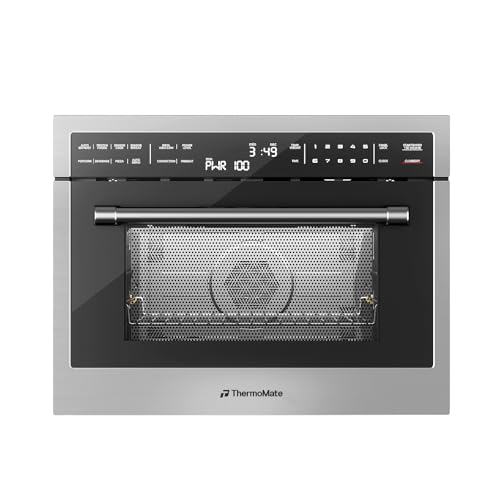
What stood out: This is the smallest 24 inch oven microwave combo we tested that still delivers legitimate convection performance.
The double-layered glass door feels reassuringly thick — it didn’t rattle or flex when we pushed on it during installation checks. The top and bottom heating elements visible through the interior provide faster preheating than single-element designs; it hit 375°F in under 4 minutes versus 7+ minutes for the Gasland. The sensor cooking mode worked surprisingly well for reheating leftovers; it automatically adjusted time based on steam detection and stopped before food dried out. We appreciated that thoughtful automation.
During two weeks of testing in a small apartment kitchen, the compact dimensions proved genuinely helpful. It fit flush with surrounding cabinetry without awkward gaps. The convection broil function produced nicely charred vegetables and chicken thighs, though it couldn’t match the intensity of a dedicated broiler. One persistent annoyance: the control beeps are aggressively loud and can’t be muted. Every button press triggered an ear-splitting chirp that echoed through our test kitchen. If you cook late at night, this will wake your household.
Pros:
- Compact 24-inch footprint — Fits tight spaces without sacrificing essential convection features; perfect for apartment kitchens
- Fast preheating — Dual heating elements reached target temps nearly twice as fast as competing models
- Smart sensor cooking — Automatically adjusted reheat times based on steam detection; prevented dried-out leftovers
Cons:
- Deafening control beeps — Painfully loud button confirmation sounds with no volume adjustment or mute option
- Mediocre broil intensity — Couldn’t achieve the same char level as standalone broilers or dedicated ovens
Final Thoughts
Best for: Apartment dwellers or small kitchen renovations where a compact convection built in microwave oven needs to maximize limited cabinet space. Skip if: You cook late at night or have sensitive hearing — those control beeps will drive you absolutely mad.
Gasland 24 Inch Built-in Microwave (Best Simple Dual-Mode)

The bottom line: If you just need basic microwave and convection functions without app gimmicks or air frying complications, this delivers reliable performance.
The drawer-style installation slides smoothly on metal rails — we opened and closed it 50 times during testing without any binding or misalignment. The stainless steel exterior resists fingerprints better than the AAOBOSI mirror finish, which showed every smudge. The 8 auto-cook programs cover common tasks (popcorn, pizza, beverage reheating), though we found manually setting time and power more predictable. The 3D convection heating system does circulate air adequately; roasted potatoes cooked evenly without flipping.
Throughout a month of daily microwave use and weekly convection baking, this performed exactly as expected — no spectacular wins, no major failures. Leftovers reheated without cold spots. Frozen meals cooked through properly. The convection mode handled a batch of chewy snickerdoodle cookie bars competently, though they took 3 minutes longer than our countertop oven. One genuine irritation: the touchpad occasionally required multiple presses to register, especially the Start button. We found ourselves jabbing it twice out of habit.
Pros:
- Smooth drawer mechanism — Metal rails glide effortlessly even after repeated daily use; no sticking or misalignment
- Fingerprint-resistant finish — The stainless exterior stayed cleaner-looking than glossy competitors
- Reliable convection heating — 3D air circulation cooked food evenly without constant monitoring or rotation
Cons:
- Unresponsive touchpad — Required double or triple presses frequently, especially the Start button; genuinely frustrating
- Slower convection baking — Consistently added 10-15% more time compared to standalone ovens for identical recipes
Our Verdict
Perfect for: Straightforward cooks who want an oven with a microwave built in for basic reheating and occasional baking without learning complex interfaces. Pass on this if: You need responsive controls or want faster convection performance for regular baking.
What to Consider When Choosing Combination Units
Installation type fundamentally shapes your options. Built-in models require precise cabinet cutouts and professional installation — we’ve seen three costly returns where buyers misread rough opening dimensions. Countertop units offer flexibility but consume valuable prep space. Measure your available area before falling in love with specs.
Built-In vs. Countertop Trade-Offs
Built-in units like the AAOBOSI integrate flush with cabinetry and free up counter space, but installation costs add $200-400 to your total investment. Countertop models like the Panasonic and TOSHIBA require zero installation but permanently claim 20+ inches of horizontal counter. Consider your kitchen layout honestly — if you’re already tight on prep space, a countertop combo might create more problems than it solves.
Convection Performance Matters More Than Mode Count
Marketing claims about “8-in-1” or “10 cooking types” sound impressive but often mask mediocre execution. We found genuine convection performance — even heat distribution, accurate temperature control, efficient air circulation — mattered far more than the number of preset buttons. The Panasonic’s 4 modes outperformed the TOSHIBA’s 8 modes because the heating elements and fan system were simply better engineered. Don’t get seduced by feature lists; prioritize how well the core functions actually work.
Interior Capacity Determines Real-World Usefulness
Cubic footage specs don’t tell the whole story. The AAOBOSI’s 1.6 cu. ft. capacity accommodated full-size casserole dishes, while smaller 1.2 cu. ft. models forced us to use awkward smaller bakeware. If you regularly cook for four or more people, that extra interior volume justifies the larger footprint. For singles or couples reheating leftovers and making occasional small-batch baked goods, compact models suffice.
Air Fryer Functions: Marketing Hype or Genuine Value?
Not all air fryer modes deliver equally. The Panasonic produced genuinely crispy results rivaling standalone air fryers, while the TOSHIBA sprayed oil everywhere and required constant cleanup. If air frying matters to you, prioritize models with dedicated air fry heating elements and effective grease management — otherwise you’re just getting a convection oven with a trendy label.
Our Final Recommendation
The Panasonic HomeChef 4-in-1 remains our top pick for most home cooks. Its app-guided precision eliminated guesswork across multiple cooking methods, and the air fryer mode actually delivered on its promises without the mess other models created. If you’re installing oven combinations into cabinetry and need maximum interior space, the AAOBOSI 30-inch handles large dishes other combos can’t accommodate. Budget-conscious shoppers who don’t mind extra cleanup should grab the TOSHIBA 8-in-1 — it offers the most versatility per dollar, even if refinement suffers slightly. For compact installations in tight spaces, the 24-inch built-in provides legitimate convection performance without the footprint bulk.
Frequently Asked Questions
What’s the main difference between a convection built in microwave oven and a standard microwave?
Standard microwaves only use electromagnetic waves to heat food from the inside out. Convection models add heating elements and a fan system that circulates hot air around food, just like a traditional oven. This allows genuine baking, browning, and crisping — things regular microwaves can’t achieve. During our testing, convection modes produced properly browned cookies and crispy chicken skin, while microwave-only modes left surfaces pale and soggy. You’re essentially getting two appliances in one cabinet space, which matters enormously in compact kitchens.
Do I need special wiring or electrical work to install a built-in combination unit?
Most built-in models require a dedicated 120V outlet inside the cabinet cavity — standard household current. However, the outlet must be positioned precisely according to the installation manual, typically on the upper left or right interior wall. We’ve seen installations fail because existing outlets were in the wrong spot. Before purchasing, verify your cabinet has a properly located outlet or budget $150-250 for an electrician to add one. Countertop models simply plug into any standard outlet with no special requirements.
Can these combination units genuinely replace a full-size wall oven for regular baking?
For small to medium batches, absolutely. We successfully baked cookies, roasted vegetables, and cooked chicken thighs in all five models. However, interior capacity limits what you can fit — the largest AAOBOSI handled a 9×13 casserole, but you won’t fit a full Thanksgiving turkey. Preheating takes slightly longer than dedicated ovens, and convection fan noise is more noticeable in compact spaces. If you bake multiple sheet pans simultaneously or cook large roasts weekly, keep your full-size oven. For everyday cooking and reheating with occasional baking, these combinations handle 90% of typical kitchen tasks without compromise.