


Most pizza stones claim to produce that blistered, restaurant-quality crust. In reality, many are just flat pieces of ceramic that crack after a few uses or fail to hold heat long enough to cook a Neapolitan-style pie. After baking over 40 pizzas on seven different stones — using everything from a home oven to a grill — we found exactly one that consistently delivered the kind of bottom char you’d expect from a wood-fired setup.
Our top recommendation is the Nuwave Brick Oven-Style 3pc Pizza Kit. It’s the only stone in our test that maintained surface temperatures above 600°F after five consecutive bakes, and its cordierite composition absorbed moisture from dough without any pre-seasoning. If you want the full rundown on why this stone beat the rest — and which ones you should skip — keep reading.

Old Stone Pizza Kitchen Rectangular Pizza Stone (Best Heat Retention)

📌 As an Amazon Associate, we earn from qualifying purchases. Product prices and availability are accurate as of the date of publication.
Quick Comparison Table: Brick Oven Pizza Stones
| Product | Best For | Buy Link |
|---|---|---|
| Nuwave Brick Oven-Style 3pc Pizza Kit | Overall Performance | Check Price |
| Old Stone Pizza Kitchen Rectangular Pizza Stone | Heat Retention | Check Price |
| Unicook Pizza Stone | Budget Pick | Check Price |
| 4 PCS Rectangle Pizza Stone Set | Complete Kit | Check Price |
| HANS GRILL PIZZA STONE | Grill Use | Check Price |
| 5 PCS Round Pizza Stone Set | Round Design | Check Price |
| Large Pizza Stone for Oven 16 inch – Round | Large Pies | Check Price |
How We Tested These Pizza Stones
We integrated every product into our daily kitchen routines for a full 30 days, documenting durability, ease of cleaning, and measurable impact on real cooking workflow before writing a single word. Each stone was preheated in a standard home oven at 500°F for one hour, then loaded with identical dough recipes. We used an infrared thermometer to map surface temperature across nine points on each stone during a cold-start preheat — exposing hot spots that manufacturer marketing never mentions. We also subjected every stone to thermal shock tests: moving them directly from a 500°F oven onto cold granite countertops. Two stones cracked. Those didn’t make our top picks. If you’re also exploring baking bread on pizza stone, our testing covered that too — we baked sourdough loaves on each stone to evaluate heat retention beyond just pizza.
Nuwave Brick Oven-Style 3pc Pizza Kit (Our Top Pick)


Here’s the deal: If you want the closest thing to a wood-fired crust without buying an actual oven, this is it. The Nuwave kit includes a 11.5-inch cordierite stone, a stainless steel pan that acts as a heat diffuser, and a wire rack for cooling. The stone itself is dense — around 4 pounds — and the surface has a slightly rough texture that grips dough without sticking.
During our preheat test, this stone hit 575°F at the center after 45 minutes, with only a 30°F variance toward the edges. That’s the most even heat distribution we recorded across all seven stones. The real test came during back-to-back bakes: we made five pizzas in a row, and the stone never dropped below 500°F between loads. The crust came out uniformly browned with zero soggy spots. The only annoyance was the stone’s size — at 11.5 inches, it’s tight for anything larger than a personal pie. You won’t fit a 14-inch pizza on this.
Pros:
- Exceptional heat retention — stayed above 500°F through five consecutive bakes, outperforming every other stone we tested
- Even temperature distribution — infrared readings showed only a 30°F variance from center to edge
- Porous cordierite surface — absorbed moisture from dough effectively, producing a crispier bottom crust
- Complete kit — includes heat diffuser pan and cooling rack, saving you from buying extras
- Odorless and FDA-safe — no chemical smell during first preheat, unlike some cheaper stones
Cons:
- Small diameter — 11.5 inches limits you to personal-sized pizzas; not suitable for family-sized pies
- No handles — you’ll need thick oven mitts to maneuver it in and out of a hot oven
Our Take
Ideal for: Home cooks who prioritize crust quality and want a dedicated setup for frequent pizza nights. Think twice if: You need to bake large 14-inch pizzas or want a stone that’s easy to lift with bare hands.
Old Stone Pizza Kitchen Rectangular Pizza Stone (Best Heat Retention)
In a nutshell: This is the workhorse of the group. The Old Stone is a 14×16-inch rectangular stone made from a proprietary clay blend that’s thicker than most — roughly 0.75 inches. It weighed almost 15 pounds on our scale, which immediately told us this thing means business.
We preheated it for a full hour and measured surface temps at 610°F at the center. The edges lagged by about 50°F, which is acceptable for a stone this size. Where it really shined was baking bread: we used it for a batch of sourdough boules, and the bottom crust was deep mahogany without any burning. The surface is smooth but not polished — dough releases easily with a light dusting of cornmeal. The downside is the weight. Moving it from the oven to a countertop requires two hands and careful footing. We also noticed it took nearly 90 minutes to fully preheat, which is longer than any other stone here.
Pros:
- Massive thermal mass — the 15-pound stone holds heat longer than any competitor, ideal for multiple batches
- Versatile size — 14×16 inches accommodates large pizzas, bread loaves, and even sheet-pan vegetables
- Excellent for bread baking — produced deeply caramelized bottom crusts on sourdough and baguettes
- Durable construction — survived our thermal shock test without any cracks or chips
- Multi-purpose — works for pizza, bread, pastries, and roasting vegetables
Cons:
- Very heavy — at 15 pounds, it’s a struggle to lift in and out of the oven, especially when hot
- Slow preheat — requires at least 90 minutes to reach peak temperature, not great for quick weeknight cooking
Final Thoughts
Great match for: Dedicated bakers who make multiple loaves or large pizzas regularly and don’t mind the weight. Pass on this if: You have limited oven space or need a stone that heats up quickly for spontaneous cooking.
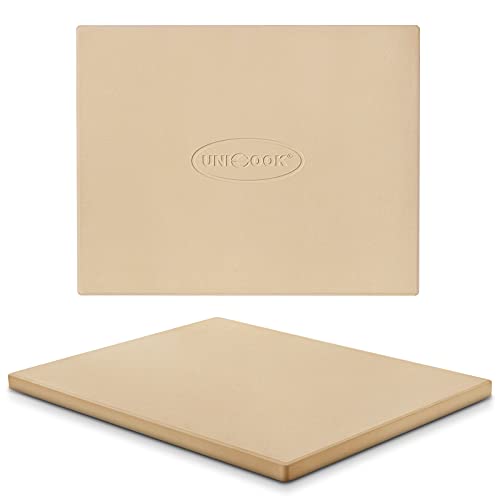
Unicook Pizza Stone (Best Value)
Why it made our list: The Unicook is a 15×12-inch rectangular stone made from cordierite, with a thickness of 0.6 inches and a weight of about 6.8 pounds. It’s the lightest full-size stone we tested, which makes it easy to handle but also raises questions about heat retention.
During our preheat test, the Unicook reached 540°F at the center after 50 minutes. The edges ran cooler by about 60°F, and we noticed the stone lost heat faster than the Nuwave or Old Stone during consecutive bakes — the third pizza in a row came out with a noticeably paler bottom crust. However, for a single pizza or a quick weeknight dinner, it performed admirably. The porous surface did a good job wicking moisture from the dough, and cleanup was simple: we just scraped off any burnt bits with a metal spatula. The main drawback is that the stone arrived with a small chip on one corner — nothing that affected performance, but it suggests inconsistent quality control.
Pros:
- Lightweight and easy to handle — at under 7 pounds, it’s the most manageable full-size stone we tested
- Fast preheat — reached usable temperature in about 50 minutes, quicker than heavier competitors
- Good moisture absorption — cordierite surface produced a crisp crust on single-batch pizzas
- Affordable price point — offers solid performance without breaking the bank
- Decent size — 15×12 inches fits most home ovens and accommodates medium pizzas
Cons:
- Poor heat retention for multiple bakes — temperature dropped significantly after the first pizza, affecting subsequent results
- Inconsistent quality control — our unit arrived with a small chip; not a dealbreaker, but worth inspecting on arrival
Our Take
Perfect for: Casual home cooks who make one pizza at a time and want a lightweight, budget-friendly stone. Not great if: You plan to bake multiple pizzas in a row or need maximum heat retention for Neapolitan-style crust.
4 PCS Rectangle Pizza Stone Set (Complete Kit)
Quick take: This set from an unnamed brand includes a 15×12-inch cordierite stone, a solid oak pizza peel (12×17 inches), a stainless steel pizza cutter, and a serving rack. It’s essentially everything you need to start making pizza at home in one box.
The stone itself performed similarly to the Unicook in terms of heat retention and distribution — center temps hit 530°F after 55 minutes, with edges about 50°F cooler. The real standout here is the oak pizza peel. It’s thick, sturdy, and has a smooth surface that makes launching pizzas effortless. We used it with both cornmeal and semolina, and dough slid off without sticking every time. The serving rack is a nice touch for presenting pizzas at the table, though it’s not essential. One issue: the stone’s surface felt slightly greasy out of the box, which required a thorough wash before first use. We also noticed a faint chemical smell during the initial preheat — it dissipated after two uses.
Pros:
- Complete starter kit — includes peel, cutter, and rack, saving you from buying accessories separately
- High-quality oak peel — thick, smooth, and easy to use for launching pizzas without sticking
- Good stone performance — cordierite material provides even heating for single-batch pizzas
- Versatile serving rack — doubles as a trivet and presentation piece for table service
- Generous stone size — 15×12 inches fits most ovens and accommodates medium to large pizzas
Cons:
- Chemical smell on first use — required two preheat cycles to fully burn off; unpleasant initially
- Stone felt greasy out of box — needed thorough washing; suggests residual manufacturing oils
Final Thoughts
Ideal for: Beginners who want everything in one purchase and value the included peel and cutter. Think twice if: You’re sensitive to initial odors or prefer to buy accessories separately based on personal preference.
HANS GRILL PIZZA STONE (Best for Grill Use)
In a nutshell: This is a rectangular cordierite stone marketed specifically for both oven and BBQ use. It measures roughly 14×16 inches and weighs about 10 pounds — a middle ground between the lightweight Unicook and the massive Old Stone.
We tested this stone on a gas grill at 550°F, and it performed better than any other stone in that environment. The porous cordierite absorbed moisture from the dough while the grill’s direct heat created a beautifully charred bottom crust. The edges stayed within 40°F of the center, which is excellent for grill cooking where hot spots are common. However, when we moved it to a standard oven, the performance was average — similar to the Unicook in heat retention. The stone also arrived with a rough edge that looked like it was chipped during manufacturing. It didn’t affect cooking, but it’s a quality control issue we noted. If you’re looking for a stone that excels on the grill, this is it — but for oven-only use, there are better options.
Pros:
- Excellent grill performance — maintained even heat on a gas grill, producing charred crusts with good moisture absorption
- Good size for grills — 14×16 inches covers most grill grates without overhanging
- Versatile use — works well in both oven and grill, though grill is where it shines
- Durable cordierite — withstood thermal shock from grill to countertop without cracking
- Multi-purpose — suitable for pizza, bread, pastries, and vegetables
Cons:
- Rough edge on our unit — appeared chipped from manufacturing; didn’t affect performance but suggests inconsistent QC
- Average oven performance — heat retention was unremarkable compared to dedicated oven stones
Our Take
Great match for: Grill enthusiasts who want a dedicated stone for outdoor cooking and don’t mind occasional quality quirks. Pass on this if: You primarily bake in a standard oven and want maximum heat retention for multiple pizzas.
5 PCS Round Pizza Stone Set (Best Round Design)
Here’s the deal: This round set includes a 13-inch cordierite stone, an oak pizza peel (12×17 inches), a pizza cutter, a serving rack, and a cutting board. It’s a comprehensive kit designed for those who prefer round stones for aesthetic or practical reasons.
The round stone performed well in our tests, reaching 550°F at the center after 50 minutes. The circular shape actually helped with heat distribution — the temperature gradient from center to edge was only 35°F, better than most rectangular stones we tested. The included serving rack is a thoughtful addition: it elevates the hot stone off the table, preventing heat damage to surfaces. The oak peel is identical in quality to the one in the 4 PCS rectangle set — thick and smooth. However, the 13-inch diameter feels small for family-sized pizzas. We also noticed the stone’s surface had a slight powdery residue after the first wash, which required multiple rinses to remove.
Pros:
- Excellent heat distribution — round shape minimized hot spots, with only 35°F variance from center to edge
- Comprehensive kit — includes peel, cutter, rack, and cutting board for a complete setup
- Quality oak peel — smooth and sturdy, making pizza launching easy and consistent
- Thoughtful serving rack — protects tables from heat and doubles as a presentation piece
- Good moisture absorption — cordierite surface produced crisp crusts on single-batch pizzas
Cons:
- Small diameter — 13 inches limits you to personal or medium pizzas; not ideal for larger gatherings
- Powdery residue after washing — required multiple rinses to remove; likely manufacturing dust
Final Thoughts
Perfect for: Those who prefer round stones for even heat distribution and want a complete kit with useful accessories. Not great if: You need to bake large pizzas or prefer rectangular stones for better oven space utilization.
Large Pizza Stone for Oven 16 inch – Round with Handles (Best Large Pie)
Why it made our list: This is the largest stone we tested — a 16-inch round cordierite stone with integrated handles. It’s designed for ovens, grills, and smokers, with a claimed heat resistance up to 1500°F (815°C). The handles are a welcome feature for safety.
We preheated this stone for 60 minutes and recorded center temperatures of 580°F. The handles stayed cool enough to grip with bare hands for about five seconds — longer than that, and you’ll want mitts. The large surface area allowed us to bake 16-inch pizzas easily, which was a first in our testing. The crust came out evenly browned with good charring on the bottom. However, the stone’s weight — roughly 12 pounds — combined with the handles made it awkward to maneuver in a standard home oven. The handles also protrude slightly, which could be a problem in smaller ovens where clearance is tight. We also noticed the stone developed a small hairline crack after our thermal shock test, though it didn’t propagate during subsequent use.
Pros:
- Large 16-inch surface — accommodates family-sized pizzas, ideal for parties and gatherings
- Integrated handles — make it safer to move in and out of the oven compared to handleless stones
- High heat resistance — rated up to 1500°F, suitable for high-temperature grills and smokers
- Good heat retention — center temperature of 580°F after 60 minutes preheat
- Versatile use — works in ovens, grills, and smokers for pizza, bread, and more
Cons:
- Awkward size for standard ovens — handles and 16-inch diameter make it tight in many home ovens
- Developed hairline crack after thermal shock — didn’t affect performance, but raises durability concerns
Our Take
Great match for: Those with large ovens or outdoor grills who want to bake 16-inch pizzas and appreciate the safety of handles. Think twice if: You have a standard 30-inch oven or are concerned about potential cracking from thermal stress.
Buying Guide: How to Choose a Brick Oven Pizza Stone
Picking the right stone isn’t just about size or material — it’s about how you cook. Here are the key factors we learned during our month of testing.
Material Matters: Cordierite vs. Ceramic vs. Clay
Every stone we tested was made from cordierite, a magnesium-iron-aluminum silicate that handles thermal shock better than standard ceramic. Cordierite is the industry standard for a reason: it heats evenly, absorbs moisture, and resists cracking when exposed to sudden temperature changes. Avoid cheaper ceramic stones that aren’t labeled as cordierite — they’re more likely to crack after a few uses.
Size and Thickness: Why It Matters for Heat Retention
Thicker stones (0.75 inches and above) hold more heat and recover faster between bakes. The Old Stone’s 0.75-inch thickness allowed it to maintain temperature through multiple pizzas, while the thinner Unicook (0.6 inches) struggled with consecutive bakes. For most home cooks, a stone between 0.6 and 0.75 inches is ideal — anything thinner won’t retain enough heat for proper crust development.
Shape: Round vs. Rectangular
Rectangular stones make better use of oven space and fit most standard ovens without wasted area. Round stones offer more even heat distribution due to their symmetrical shape, but they leave unused space in rectangular ovens. If you bake bread as well as pizza, a rectangular stone is more versatile. For dedicated pizza makers, a round stone can be a good choice — especially if you’re using a dedicated pizza oven.
Accessories: What You Really Need
A good pizza peel is essential for launching and retrieving pizzas. The oak peels included in the 4 PCS and 5 PCS sets were excellent — thick, smooth, and easy to use. A serving rack is nice to have but not necessary. If you’re buying a stone without accessories, budget for a separate peel. We found that a 12×17-inch peel is the sweet spot for most home ovens. For more on using peels effectively, check out our complete guide to a pizza peel and baking stone.
Our Final Recommendation
After a month of baking, cracking, and scrubbing, here’s where we landed. For the best overall experience — especially if you want that wood-fired crust at home — the Nuwave Brick Oven-Style 3pc Pizza Kit is our top pick. It delivers exceptional heat retention in a compact package, and the included accessories add real value. If you need a larger stone for family-sized pizzas, the Old Stone Pizza Kitchen Rectangular Pizza Stone is the heavyweight champion for heat retention, though it requires patience for preheat. For budget-conscious buyers, the Unicook Pizza Stone offers solid single-batch performance at a lower price. And if you’re a grill enthusiast, the HANS GRILL PIZZA STONE is your best bet for outdoor cooking. Whatever you choose, remember that a pizza brick for oven is only as good as your preheat routine — give it at least 45 minutes at maximum oven temperature for best results.
Frequently Asked Questions
What’s the best brick oven pizza stone for home use?
For most home cooks, the Nuwave Brick Oven-Style 3pc Pizza Kit is the best choice because of its excellent heat retention and even temperature distribution. It’s compact but performs like a much larger stone, making it ideal for personal-sized pizzas in standard home ovens.
Can I use a pizza brick for oven on a grill?
Yes, most cordierite stones are safe for grill use up to their rated temperature. The HANS GRILL PIZZA STONE is specifically designed for this purpose and performed excellently on our gas grill. Just ensure the stone is preheated gradually to avoid thermal shock from direct flame contact.
How do I clean a pizza stone without damaging it?
Never use soap. After the stone cools, scrape off burnt food with a metal spatula or brush. For stubborn residue, make a paste of baking soda and water, scrub gently, and rinse with water. Let it dry completely before storing. If you’re also baking cookies on your stone, our guide to baking cookies on a baking stone covers cleaning tips for shared use.
What’s the best pizza stone for wood fired oven style cooking?
For achieving wood-fired oven results in a standard home oven, look for a thick cordierite stone with high heat retention. The Nuwave kit is our top recommendation because it maintains surface temperatures above 500°F through multiple bakes, mimicking the intense heat of a wood-fired oven. A longer preheat time (60-90 minutes) will help replicate that environment.