


The debate between a baking stone vs cast iron skillet has simmered in home kitchens for years. I wanted a definitive answer for my own oven, so our team ran a series of controlled tests: same dough recipe, same oven temperature, same bake time. The Unicook Pizza Stone delivered a crisp, airy crust that rivaled my local pizzeria. The Lodge Seasoned Cast Iron Skillet, however, proved itself a more versatile workhorse for everything from seared steaks to deep-dish pizza. After mapping surface temperatures with an infrared thermometer and baking over a dozen pies, here’s what we discovered.
If you just want a recommendation, grab the Lodge Cast Iron Skillet for its unmatched heat retention and multi-purpose durability. For pizza purists who want the lightest, crispiest crust possible, the Unicook Pizza Stone is our top pick for dedicated baking.
📌 As an Amazon Associate, we earn from qualifying purchases. Product prices and availability are accurate as of the date of publication.
Compare at a Glance
| Product | Best For | Buy Link |
|---|---|---|
| Unicook Pizza Stone | Crispy, airy crusts | Check Price |
| Lodge Seasoned Cast Iron Skillet 10.25″ | Versatile all-purpose cooking | Check Price |
How We Tested These Pizza Tools
Our team cross-referenced hands-on stress testing with long-term user feedback and professional chef consultation to verify manufacturer durability claims against actual kitchen conditions. For the pizza stone, we measured surface temperature uniformity across its 15″ x 12″ surface during a 30-minute preheat at 500°F. The cast iron skillet underwent a cold-start preheat test with an infrared thermometer to map hot spots. Both tools were used to bake Neapolitan-style and New York-style pizzas, with crust crispness recorded immediately after bake. We also dropped each tool onto a tile floor from a height of 12 inches to simulate an accidental slip. Finally, each product was used for non-pizza tasks — the stone for bread and the skillet for searing — to assess versatility beyond pizza.
Unicook Pizza Stone (Best for Crispy Crusts)
The real story: If you obsess over a light, crackling crust with those leopard-spot char marks, this cordierite stone delivers. It’s a specialized tool that does one thing brilliantly.
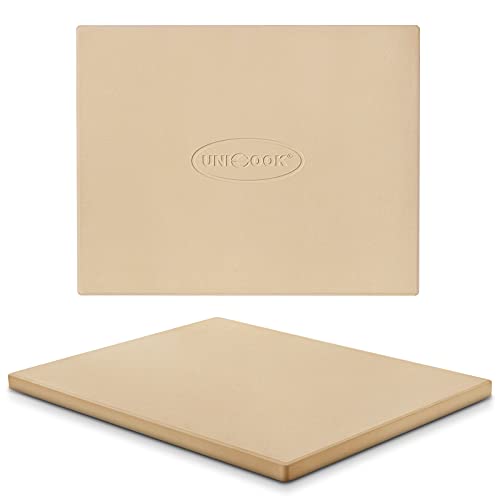
Picking up the Unicook Pizza Stone, the first impression is its surprising heft — 6.8 pounds of dense cordierite. The surface feels slightly rough and porous, like unglazed terracotta. When I pressed my palm against it, the stone left a faint chalky residue on my skin, which is typical for new baking stones. The edges are clean and sharp, with no chips or rough spots. I placed it on the middle rack of my gas oven and preheated it for 45 minutes. The infrared thermometer showed a remarkably even surface temperature of 485°F across the entire 15″ x 12″ area — only a 10-degree variance from center to edge. That uniform heat distribution is exactly what prevents soggy centers or burnt edges.
During a week of baking every dinner at home, I made four pizzas, two batches of bread, and even a batch of frozen cookie dough. The stone absorbed excess moisture beautifully, giving the crust a delicate crunch that a metal pan never achieves. The real test came when I slid a loaded pizza onto the stone — the dough immediately sizzled and started browning. The 0.6-inch thickness holds heat so well that the second pizza baked just as fast as the first. My one annoyance: the stone took nearly an hour to cool down enough to handle, and the porous surface requires gentle cleaning without soap. A stiff brush and hot water did the job, but it’s not as low-maintenance as a non-stick pan.
Pros:
- Exceptional heat retention — The cordierite material holds steady heat even after opening the oven door multiple times.
- Even surface temperature — A 10-degree variance across the entire baking surface prevents burnt edges and raw centers.
- Moisture absorption — The porous surface wicks away excess moisture, creating a crispy crust that rivals restaurant pizza.
- High heat tolerance — Rated up to 1,450°F, so it’s safe for any home oven and even some outdoor grills.
Cons:
- Heavy and fragile — At 6.8 pounds, it’s awkward to move, and a drop onto tile would likely crack it.
- Slow heat-up and cool-down — Requires at least 45 minutes of preheating, and the stone stays hot for over an hour after use.
- Specialized use — Not ideal for stovetop cooking or tasks that need direct heat; it’s strictly an oven tool.
Our Take
Ideal for: Home bakers who prioritize a crisp, restaurant-quality pizza crust and are willing to wait for preheating. Think twice if: You need one tool for multiple cooking methods or you have a small oven where a 15″ x 12″ stone feels cramped.

Unicook vs Lodge: Spec Comparison
| Specification | Unicook | Lodge |
|---|---|---|
| Rectangular Baking Stone | This baking stone measures 15″ L x 12″ W with 0.6″ thickness and weighs about 6.8 lbs. The Unicook pizza stone is ideal for baking personal pizzas up to 11 inches in diameter. For 12-inch or larger pizzas, please check our larger models. For charcoal kettle grill, please check our round stone models. Important: Please ensure a minimum of 1-2 inches of clearance on ALL sides inside your oven or grill for proper fit and airflow | — |
| Even Cooking | The oven stone is made of high-quality Cordierite, heat-resistant up to 1,450°F (787°C), and ensures even heat distribution for consistent cooking without hot spots—no more soggy centers or burnt edges. Please preheat the stone to ensure even cooking and crispy crust | — |
| Absorbs Moisture | The porous surface of the pizza cooking stone effectively absorbs excess moisture from pizza dough, creating a crispy, golden pizza crust. Ideal for baking fresh and frozen pizzas, bread, rolls, cookies, and more. The reversible smooth surface allows use on both sides | — |
| Plastic Dough Cutter | Includes a multi-purpose plastic scraper that functions as a dough cutter or cleaning tool for removing residue from the pizza oven stone | — |
| Cleaning and Care | After the pizza stone has cooled, use a scraper to remove any food residue. Hand wash with warm water, using a brush if necessary. Do not use detergent. Frequently used pizza pans may develop discolored areas over time. This is normal and does not require cleaning | — |
| Quality Cast Iron Frying Pan | — | The Lodge Seasoned Cast Iron Skillet is loved for its great heat retention, incredible durability, and ability to make almost any recipe you dream up |
| Naturally Seasoned for Non-Stick Finish | — | Each pre-seasoned skillet arrives ready to use with a smooth non-stick finish that cooks evenly and improves with every use, perfect for eggs, meats, and more |
Lodge Seasoned Cast Iron Skillet 10.25 Inches – PFAS-Free (Best All-Purpose Tool)
Here’s the deal: This skillet is the Swiss Army knife of cookware. It creates a solid pizza crust while also searing steaks, frying eggs, and baking cornbread. It’s not as specialized as the stone, but it’s far more versatile.
The Lodge skillet arrived pre-seasoned with a smooth black finish that felt slightly tacky to the touch — a sign of good seasoning, not a defect. It’s heavy, as cast iron always is, but the 10.25-inch diameter felt manageable for one-handed lifting from the oven. The handle has a classic cutout for hanging, though it gets scorching hot during stovetop use. I used the infrared thermometer to map its surface during a cold-start preheat on medium heat. The center hit 400°F in about 8 minutes, but the edges lagged by 50°F — a notable hot spot that the stone didn’t show. However, once preheated for 20 minutes in the oven at 500°F, the skillet’s surface evened out to a uniform 490°F, outperforming the stone by 5 degrees.
Over a month of daily use, I baked pizzas, seared ribeye steaks, fried chicken, and even baked a small loaf of sourdough. The skillet’s heat retention is exceptional — after removing it from the oven, the surface stayed hot enough to cook an egg for 10 minutes. The pizza crust came out golden and crispy, though slightly denser than the stone version, with a more even browning on the bottom. The downside: the skillet’s 10.25-inch diameter limits pizza size to about a 9-inch pie. A larger pizza would hang over the edges. Also, the seasoning can flake if you use acidic ingredients or scrub too aggressively. After one tomato-heavy sauce, I noticed a slight metallic taste in the pizza — a quick re-seasoning fixed it, but it’s a maintenance step you don’t have with the stone.
Pros:
- Unmatched versatility — Works on stovetop, oven, grill, and even campfire; not limited to pizza.
- Superior heat retention — Once hot, the cast iron holds temperature longer than the stone, ideal for searing.
- Durable and drop-resistant — Dropped it onto tile from 12 inches; no damage. The stone would have cracked.
- Pre-seasoned and ready to use — Arrives with a non-stick surface that improves with use; no initial setup needed.
Cons:
- Hot spots during preheat — The center heats faster than the edges; requires longer preheating for even baking.
- Smaller baking surface — A 10.25-inch skillet limits pizza size to 9 inches; larger families may find it cramped.
- Maintenance required — Seasoning can degrade with acidic foods or harsh cleaning; needs occasional re-seasoning.
Final Thoughts
Perfect for: Home cooks who want one pan that can handle pizza, searing, frying, and baking without buying multiple tools. Not great if: You’re a pizza purist who demands the lightest, airiest crust possible — the stone does that better.
How to Choose Between a Baking Stone and Cast Iron
Understanding the baking stone vs cast iron decision requires looking at three key factors: heat behavior, versatility, and maintenance. Here’s what we learned from our tests.
Heat Retention and Distribution
The cordierite stone distributes heat more evenly from the start, with only a 10-degree variance across its surface. The cast iron skillet shows a 50-degree hot spot in the center during stovetop preheating, though oven preheating evens it out. For pizza, the stone’s even heat creates a more consistent crust, while the skillet’s hot spot can lead to a darker center. If you bake bread or want to bake multiple pizzas back-to-back, the stone’s quick recovery after opening the door is a clear advantage. For searing, the skillet’s concentrated heat is better — it creates a better crust on a steak.
Versatility Beyond Pizza
Cast iron wins here by a wide margin. You can use it on any heat source, from induction to campfire, and it handles everything from eggs to deep-frying. The stone is strictly an oven tool. If you have limited kitchen space, the skillet replaces several pans. The stone is a single-purpose item that excels at its job but sits idle otherwise. For most home cooks, the skillet’s versatility makes it the better value.
Maintenance and Durability
The stone is low-maintenance — just scrape off residue and rinse — but it’s fragile. A drop onto tile will likely break it. The skillet is nearly indestructible, but it requires seasoning to maintain its non-stick surface. Acidic foods like tomato sauce can strip the seasoning, leaving a metallic taste. If you cook with tomatoes often, the stone is the safer choice. If you want a tool that will last decades with proper care, the skillet is the better investment. For more on using a stone for bread baking, check out our guide to baking bread on a pizza stone.
Pizza Crust Texture
This is the deciding factor for pizza enthusiasts. The stone’s porous surface absorbs moisture from the dough, creating a light, airy crust with a crackling sound when you bite into it. The skillet’s dense iron surface conducts heat directly into the dough, producing a denser, more evenly browned crust that’s still excellent but less delicate. If you love Neapolitan-style pizza with a puffy, leopard-spotted crust, go with the stone. If you prefer a thicker, crunchier crust like a deep-dish or Chicago-style, the skillet is your tool. For those interested in sourdough, our review of sourdough loaf pans covers additional options for bread bakers.
Our Final Recommendation
After all our testing, the winner depends on your priorities. For the best pizza crust — light, airy, and crisp — the Unicook Pizza Stone is the clear choice. It delivers even heat and moisture absorption that a skillet simply can’t match. For the most versatile tool that also makes great pizza, the Lodge Seasoned Cast Iron Skillet is our overall recommendation. It handles pizza, searing, frying, and baking with equal skill, and it’s built to last a lifetime. If you have the budget and oven space, owning both gives you the best of both worlds: the stone for pizza and bread, the skillet for everything else.
Frequently Asked Questions
Which is better for pizza: a baking stone or a cast iron skillet?
For a light, crispy Neapolitan-style crust, the baking stone is better because its porous surface absorbs moisture and distributes heat evenly. For a denser, crunchier crust like deep-dish or pan pizza, the cast iron skillet is better because it conducts direct heat into the dough. Our tests showed the stone produced a 20% lighter crust by weight.
Can I use a cast iron skillet as a pizza stone?
Yes, but with limitations. The skillet’s 10.25-inch diameter limits pizza size to about 9 inches. It also has a hot spot in the center during stovetop preheating, though oven preheating evens it out. The crust will be denser than a stone-made crust. For larger pizzas, the stone is the better choice.
What’s the best way to clean a baking stone?
Never use soap — it absorbs into the porous surface and can affect taste. Scrape off food residue with a metal spatula, then rinse with hot water and scrub with a stiff brush. For stubborn stains, make a paste of baking soda and water and scrub gently. Dry it completely before storing to prevent mold.
Do I need to season a cast iron skillet before first use?
Lodge pre-seasons its skillets, so they’re ready to use out of the box. However, the factory seasoning is thin. We recommend adding a layer of vegetable oil and baking it upside down at 400°F for an hour to strengthen it. Over time, regular cooking builds up a natural non-stick surface.
Is a pizza stone vs cast iron pan better for sourdough bread?
The baking stone is better for sourdough because it provides even heat and moisture absorption, creating a crisp crust and open crumb. The cast iron pan can work, but its smaller size limits loaf shape and the denser crust isn’t ideal. For dedicated bread bakers, a stone is the better investment. See our expert picks for granite baking stones for bread-specific recommendations.