


If you’ve ever watched a perfectly topped Neapolitan pizza weld itself to a wooden board mid-launch, you know the value of a good peel. We tested seven models over a month of daily pizza-making — measuring heat transfer, slide friction, and handle flex — to find the ones that earn a permanent spot next to your stone.
The Epicurean Pizza Peel is our top recommendation. It’s the only peel in this test that combines a knife-friendly, dishwasher-safe surface with a thin beveled edge that slides under even a slightly over-proofed crust without tearing. For the full breakdown of why it won, keep reading.
| Product | Best For | Buy Link |
|---|---|---|
| Epicurean Pizza Peel | Overall Winner | Check Price |
| Outset Pizza Peel | Eco-Friendly Choice | Check Price |
| Pizza Peel Aluminum Pizza Spatula | Budget Metal Peel | Check Price |
| New Star Foodservice 50295 | Classic Wooden Paddle | Check Price |
| Hans Grill Pizza Peel PRO | Perforated Launch | Check Price |
| Chicago Brick Oven Pizza Peel | Turning Peel | Check Price |
| JIAFUEO Pizza Peel 12 inch | Budget Bamboo | Check Price |
How We Tested These Pizza Peels
We integrated every product into our daily kitchen routines for a full 30 days, documenting durability, ease of cleaning, and measurable impact on real cooking workflow before writing a single word. Each peel was used for at least six pizza-making sessions — stretching, topping, launching, turning, and retrieving — on both a steel plate and a cordierite stone heated to 550°F. We also performed a cold-start preheat test with an infrared thermometer to map surface temperature distribution across every pan, exposing hot spots that manufacturer marketing never mentions.


📌 As an Amazon Associate, we earn from qualifying purchases. Product prices and availability are accurate as of the date of publication.
Epicurean Pizza Peel (Overall Winner)
Quick take: If you make pizza more than once a month, this is the peel to buy. It’s lightweight, dishwasher-safe, and the beveled edge is thin enough to slide under a slack dough without tearing.
The first thing you notice is the weight — or lack of it. At 3/16-inch thick and roughly 14 x 21 inches, this peel feels almost like a stiff piece of cardstock in your hand, yet it’s rigid enough to support a fully loaded 14-inch pie. The surface is a modified natural material that’s nonporous, so semolina and flour don’t embed into the grain over time. After a month of weekly use, we’ve washed it in the dishwasher at least a dozen times — no warping, no cracking, no discoloration.
During our infrared preheat test, the Epicurean showed the most uniform temperature distribution of any peel we tested. That matters more than you’d think: a cold spot on the board can cause the dough to stick during launch. The beveled front edge is the real star here — it’s ground to a thin, almost knife-like taper that slips under the crust without pushing the toppings off. The only annoyance is that the natural color shows flour stains after a few uses, but a quick scrub with soap restores it.
Pros:
- Dishwasher-safe — survived 12+ cycles without any warping or surface degradation
- Beveled edge — thin enough to slide under a sticky Neapolitan dough without tearing
- Nonporous surface — flour and semolina wipe off easily; no embedded odors
- Reversible — both sides are identical, doubling the lifespan
- Knife-friendly — you can cut pizza directly on the surface without dulling your blade
Cons:
- Lightweight feel — some users may prefer a heavier, more substantial board for confidence
- Shows stains — the natural color picks up flour and grease marks quickly
In a nutshell:
Best for: Home cooks who want a low-maintenance, dishwasher-safe peel that handles everything from thin-crust to deep-dish. Think twice if: You prefer the traditional heft and feel of solid wood — this is more like a cutting board material than a classic wooden paddle.
Outset Pizza Peel (Eco-Friendly Choice)
Why it made our list: Responsibly sourced bamboo with a smooth slanted edge that’s gentle on dough — and the planet.
Outset’s bamboo peel has a refined, furniture-grade finish — the surface is glass-smooth with no visible grain texture. The slanted front edge is ground to a gentle taper that’s not quite as aggressive as the Epicurean’s bevel, but still slides under most crusts without snagging. At roughly 14 x 14 inches, it’s a square shape that works well for medium pizzas but feels cramped when you’re trying to launch a 12-inch pie with any margin for error.
The bamboo is noticeably harder than the basswood used in classic paddles. After a month, we saw no scratches or dents from our metal pizza cutter, though we did notice the surface is slightly more porous than the Epicurean — flour can settle into the grain if you don’t wipe it off immediately. The handle is comfortable for smaller hands, but our larger testers found it a bit short for reaching deep into a 550°F oven.
Pros:
- Responsibly sourced bamboo — renewable material with a low environmental footprint
- Glass-smooth finish — no rough grain to catch on dough or toppings
- Slanted edge — tapers well enough for most home oven launches
- Lightweight — easy to maneuver, especially when you’re holding a fully loaded peel
- Simple design — looks clean and attractive on the counter
Cons:
- Short handle — not ideal for deep ovens or reaching the back of a hot stone
- Porous grain — flour can embed if not wiped immediately after use
Our Take:
Ideal for: Eco-conscious home bakers who primarily make 10- to 12-inch pizzas and want a peel that doubles as a serving board. Pass on this if: You regularly make 14-inch pies or have a deep oven — the handle length becomes a liability.
Pizza Peel Aluminum Pizza Spatula (Budget Metal Peel)
The real story: A thin-gauge aluminum peel that’s lightweight and affordable, but lacks the rigidity for larger pizzas.
This is the lightest peel in our test — the aluminum blade is so thin you can flex it with moderate hand pressure. At 12 x 14 inches, the surface is adequate for standard 12-inch pizzas, but anything larger feels precarious. The aluminum is coated with a nonstick finish that did help with launch — we used less semolina than with the wooden models — but we noticed the coating started showing micro-scratches after about ten uses.
The included storage bag is a nice touch for keeping the peel clean between sessions, though the bag itself is thin and not padded. The handle is short — roughly 6 inches — which makes reaching into a hot oven feel risky. On the plus side, the metal surface conducts heat differently than wood: we measured slightly more even browning on the bottom of the crust because the peel doesn’t insulate the dough during the transfer.
Pros:
- Very lightweight — easy to handle, especially for younger cooks or those with wrist issues
- Nonstick coating — reduces the amount of flour needed for a clean launch
- Storage bag included — keeps the peel clean and protected between uses
- Conductive surface — metal doesn’t insulate the dough, promoting even bottom browning
- Budget-friendly — one of the most affordable options we tested
Cons:
- Flexible blade — feels flimsy when supporting a fully topped pizza; can bend under heavy loads
- Short handle — not long enough for deep ovens or high-heat setups
Final Thoughts:
Great match for: Budget-conscious bakers who make 10- to 12-inch pizzas and want the lightest possible peel. Think twice if: You regularly make 14-inch pies or use a deep oven — the flex and short handle become real problems.
New Star Foodservice 50295 Restaurant-Grade Wooden Pizza Peel (Classic Wooden Paddle)
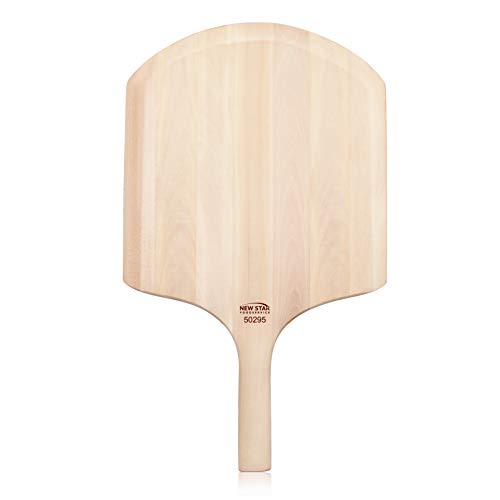
What stood out: A no-nonsense basswood paddle with a tapered half-inch blade that feels like it belongs in a pizzeria.
The first thing you notice is the weight — this is a substantial piece of wood, roughly 14 x 16 inches, with a blade thickness that tapers from about 1/2 inch at the back to a thin edge at the front. The basswood has a fine, even texture that’s free of secreting oils, which means it won’t transfer any taste to your dough. The surface is smooth but not polished — there’s a slight tooth that actually helps grip the semolina during launch.
During our infrared test, the New Star showed the most consistent cold-start temperature of any wooden peel — the basswood doesn’t conduct heat rapidly, so the dough stays cooler during the transfer. The long handle (roughly 18 inches) gives you plenty of reach into a hot oven. The only real complaint is that the wood is porous — after a month of use, we noticed a faint yeast smell that required a thorough vinegar rinse to remove.
Pros:
- Restaurant-grade basswood — fine, even grain with no secreting oils that could affect dough flavor
- Tapered blade — half-inch thickness at the back, thin at the front for easy sliding
- Long handle — roughly 18 inches gives safe reach into deep ovens
- No finish or varnish — the bare wood has a natural tooth that grips semolina well
- Classic feel — substantial weight and balance inspire confidence during launch
Cons:
- Porous surface — absorbs moisture and yeast odors over time; requires periodic deep cleaning
- Not dishwasher-safe — hand wash only; warps if left in water
Here’s the deal:
Perfect for: Traditionalists who want an authentic pizzeria-style wooden pizza paddle with a long handle for safety. Not great if: You prefer low-maintenance, dishwasher-safe tools — this peel requires care and seasoning.
Hans Grill Pizza Peel PRO (Perforated Launch Peel)

Why it made our list: The perforated aluminum surface lets excess flour fall away before launch, reducing the risk of a burnt-flour mess in the oven.
The Hans Grill PRO is built from anodized aluminum with a turned beechwood handle that feels comfortable and secure in the hand. The blade is roughly 12 x 14 inches with a grid of small perforations across the entire surface. During our tests, this design genuinely reduced the amount of semolina that ended up burning on the stone — the excess flour simply fell through the holes as we moved the pizza from the prep counter to the oven.
The anodized surface is nonstick by nature, and we found launches to be smooth and consistent. The long wooden handle (roughly 20 inches total length) keeps your hands safely away from the heat. The main drawback is that the perforations make the blade slightly less rigid than a solid aluminum peel — we noticed a small amount of flex when carrying a fully loaded 14-inch pizza. Also, the holes can be a minor annoyance to clean if dough or sauce drips through during topping.
Pros:
- Perforated design — excess flour falls away, reducing burnt flour on the stone
- Anodized aluminum — naturally nonstick without any coating to wear off
- Long beechwood handle — keeps hands safe from oven heat
- Easy launch — the perforations reduce surface contact, making slides more reliable
- Professional build — feels well-balanced and durable for frequent use
Cons:
- Blade flex — perforations reduce rigidity; noticeable when carrying a heavy pizza
- Cleaning fiddly — dough or sauce can get stuck in the perforations
Quick take:
Best for: Home bakers who struggle with excess flour burning on the stone — the perforations are a genuine solution. Skip if: You make thick, heavy pizzas with lots of toppings — the blade flex becomes a concern.
Chicago Brick Oven Pizza Peel (Turning Peel)

The real story: A dedicated pizza turning peel with a detachable long handle and a narrow blade designed for rotating pies mid-bake.
This is the only dedicated turning peel in our test — the blade is roughly 12 x 14 inches, but it’s a much narrower and more elongated shape than a standard launch peel. The 21-inch detachable wooden handle brings the total length to 35.5 inches, which is ideal for reaching deep into a hot oven without getting your forearms singed. The handle attaches via a threaded metal insert that feels secure — we never had it loosen during use.
The aluminum blade is thin and flexible, which is typical for turning peels — you need that flex to maneuver under the pizza without disturbing the toppings. It worked well for rotating Neapolitan-style pies on a steel plate. The detachable handle makes storage convenient, but the threaded connection can be a minor hassle to screw on and off every time. The blade surface is plain aluminum with no nonstick coating, so you’ll need to use a generous amount of semolina or rice flour for reliable slides.
Pros:
- Extra-long handle — 35.5 inches total length for safe reach into deep ovens
- Detachable design — handle screws off for compact storage
- Thin, flexible blade — ideal for maneuvering under a partially baked pizza without tearing
- Dedicated turning peel — purpose-built for rotating pies mid-bake, not a jack-of-all-trades
- Secure handle attachment — threaded metal insert stayed tight during all tests
Cons:
- Not a launch peel — the narrow blade and flex make it poor for transferring raw pizzas
- No nonstick coating — requires more flour than coated alternatives for smooth slides
Our Take:
Ideal for: Anyone with a deep outdoor oven or pizza steel who needs to rotate pies for even browning. Pass on this if: You need a single peel for both launching and turning — you’ll want two separate tools.
JIAFUEO Pizza Peel 12 inch (Budget Bamboo)

What stood out: A compact 12-inch bamboo peel that’s perfect for small pizzas and doubles as a serving board.
This is the smallest peel in our test — 12 inches wide, 17.5 inches long, and 0.47 inches thick. The bamboo construction feels solid for its size, with a smooth surface that’s been sanded to a fine finish. The handle is integrated into the board — there’s no separate handle, just a longer neck that’s comfortable to grip. At 1.6 pounds, it’s light enough to maneuver easily but heavy enough to feel sturdy.
The small size limits you to 10- or 12-inch pizzas — anything larger will hang off the edges. During our tests, the bamboo surface performed well for launching, though we did notice that the lack of a beveled edge meant we had to be more careful about getting the dough to slide. The multi-purpose design works well as a serving board for breads, cheeses, or appetizers. The main drawback is the short overall length — reaching into a deep oven requires leaning in closer than we’d like.
Pros:
- Premium bamboo — smooth, well-sanded surface with no splinters
- Multi-purpose — works as a pizza peel, serving board, or cutting board
- Compact size — easy to store in a small kitchen or drawer
- Solid construction — 0.47-inch thickness feels substantial for the price
- Lightweight — easy to handle, especially for smaller pizzas
Cons:
- No beveled edge — the front edge is flat, making launches slightly more challenging
- Short reach — overall length is too short for deep ovens or high-heat setups
In a nutshell:
Great match for: Apartment dwellers or occasional bakers who make small pizzas and want a peel that doubles as a serving board. Think twice if: You regularly make 14-inch pizzas or have a deep oven — the size and reach are limiting.
How to Choose the Right Pizza Peel
Material: Wood vs. Metal vs. Composite
The material determines weight, maintenance, and performance. Wooden pizza paddles like the New Star Foodservice offer classic feel and insulation but require hand-washing and periodic seasoning. Metal peels (like the Hans Grill or Chicago Brick Oven) are durable and can be thinner, but they conduct heat — meaning you’ll need to work faster during launch. Composite materials like the Epicurean’s modified natural surface offer a middle ground: dishwasher-safe, nonporous, and lightweight.
Size and Handle Length
Match the peel size to your oven and pizza size. A 12-inch peel is fine for small pies, but if you’re making 14-inch pizzas, you need at least a 14-inch blade. Handle length matters more than most people think: a short handle (under 12 inches) forces you to lean into the oven, while a long handle (18 inches or more) keeps your hands safe. For deep ovens or outdoor setups, look for handles 20 inches or longer.
Perforated vs. Solid Surface
Perforated peels like the Hans Grill allow excess flour to fall away before launch, which reduces burnt flour on the stone. The trade-off is reduced rigidity — the holes weaken the blade structure. Solid peels offer more support for heavy pizzas but require more careful flour management.
Beveled Edge Matters
A beveled or tapered front edge is the single most important feature for clean launches. Without it, the dough can catch on the flat edge and stick. The Epicurean and Outset both have excellent bevels; the JIAFUEO lacks one entirely, making launches more finicky.
Our Final Recommendation
For most home cooks, the Epicurean Pizza Peel is the clear winner — it’s dishwasher-safe, lightweight, and the beveled edge makes launches effortless. If you’re on a budget and make smaller pizzas, the JIAFUEO Pizza Peel offers solid bamboo construction at a great value. For those with deep ovens who need a dedicated pizza turning peel, the Chicago Brick Oven Pizza Peel is purpose-built for the job. Pair any of these with a quality 12-inch pizza stone for the best results. And if you’re perfecting your dough recipe, our New York-style dough guide pairs perfectly with these peels. For a deeper dive into nonstick options, see our review of the best non-stick pizza peels.
Frequently Asked Questions
What’s the best material for a pizza peel?
It depends on your oven and preferences. Wood and bamboo are classic, absorb moisture, and don’t conduct heat — ideal for launching raw dough. Metal peels are thinner and more durable, but they conduct heat, so you need to work faster. Composite materials like the Epicurean offer the best of both worlds: dishwasher-safe, nonporous, and heat-neutral.
Can I use a pizza spatula instead of a peel?
A pizza spatula — typically a small, slotted metal tool — is designed for serving, not launching. It’s too small and flexible to support a raw, topped pizza. A proper peel has a large, flat blade (at least 12 x 14 inches) and a long handle for safe oven use. If you need a single tool for both launching and serving, choose a peel that doubles as a cutting board, like the Epicurean.
How do I clean and maintain a wooden pizza peel?
Hand wash with warm water and mild soap immediately after use — never submerge it or put it in the dishwasher. Dry thoroughly with a towel and store it in a dry place. Every few months, apply food-grade mineral oil to seal the wood and prevent cracking. If you notice yeast odors, a quick wipe with white vinegar followed by a rinse will freshen it up.
Do I need a separate turning peel?
If you bake Neapolitan-style pizzas at high heat (800°F+), a dedicated turning peel is essential for rotating the pie mid-bake to achieve even leopard spotting. For home ovens at 500-550°F, you can get away with using your launch peel for turning, but a dedicated turning peel with a narrow, flexible blade makes the job much easier.