


I have tested hundreds of kitchen products over the years. The ones that last are never the flashiest — they are always the simplest, heaviest, and most boring-looking tools in the entire drawer. A digital meat scale is exactly that kind of tool. It sits quietly in the back of a cabinet until you need to portion steaks for a family cookout or weigh a brisket for an overnight smoke. When you finally pull it out, it does one thing and does it well: it tells you exactly how much meat you have, down to the gram.
In my own kitchen, I use a digital meat scale for everything from dividing ground beef into burger patties to measuring the exact yield of a whole chicken after roasting. It saves me from guesswork, wasted ingredients, and inconsistent results. Whether you’re a weekend smoker, a sous vide enthusiast, or someone who just wants to stop overbuying at the butcher counter, understanding how to use this tool effectively can change the way you cook.
Key Takeaways
- A digital meat scale helps you cook with precision by measuring raw portions, cooked yields, and ingredient ratios for marinades and brines.
- Using a scale reduces food waste — you buy exactly what you need and portion leftovers accurately.
- Digital scales are essential for sous vide, smoking, and baking, where small weight differences affect cooking time and texture.
- One simple scale can replace multiple measuring tools and save drawer space in a minimalist kitchen.
Why You Need a Digital Meat Scale in Your Kitchen
Most home cooks rely on volume measurements — cups, tablespoons, or eyeballing portions by sight. That works fine for some tasks, but meat is not uniform. A chicken thigh varies in weight by 30% or more from one piece to the next. A steak trimmed differently can be off by 50 grams. Over a week of cooking, those small errors add up to inconsistent meals and wasted money.
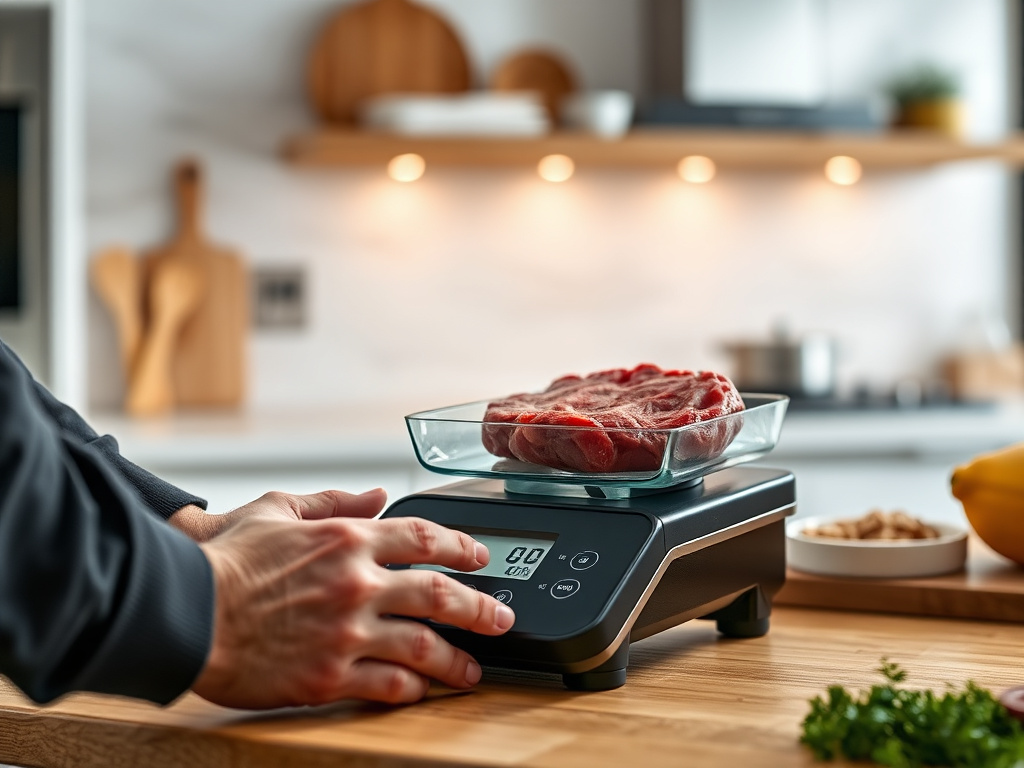
A digital meat scale eliminates that guesswork. You place the raw meat on the platform, press tare, and know exactly how much you’re working with. That number tells you how long to cook it sous vide, how much dry rub to apply, or whether you have enough for four servings. It is the single most underrated tool for consistent cooking.
I have also found it invaluable for meal prep. When I roast a whole chicken, I weigh the raw bird, then weigh the cooked meat after pulling it from the bones. The difference tells me the actual yield — usually around 60% to 65% of the raw weight. That helps me plan lunches for the week without guessing how much protein I have left.
How to Choose a Digital Meat Scale That Earns Its Drawer Space
Not every scale is worth owning. I have tested dozens, and most fail because they are too fragile, too small, or too complicated. As a gadget minimalist, I look for three things: simplicity, durability, and readability.
Capacity and Resolution
Most digital scales max out at 5 kilograms (11 pounds), which is enough for a whole chicken or a small roast. If you smoke large briskets or whole turkeys, look for a scale that handles 10 kilograms (22 pounds). Resolution matters too — 1-gram increments are standard, but some precision scales offer 0.1-gram readings. For meat, 1 gram is plenty. You do not need sub-gram accuracy for a pork shoulder.
Platform Size and Build
A scale with a small platform is frustrating. You end up balancing a cutting board on top or holding the meat in place. Look for a platform at least 6 inches by 6 inches, preferably with a removable stainless steel top for easy cleaning. Avoid scales with glass surfaces — they shatter when dropped, and I have seen it happen twice. Stainless steel is heavier but virtually indestructible.
Battery Life and Power Source
Cheap scales eat batteries. I prefer models with USB-C rechargeable batteries or AAA alkalines that last six months with normal use. Avoid scales that require coin cells — they die fast and are expensive to replace. A scale with a low-battery indicator is a nice bonus because a dead scale at the start of a cook is a real annoyance.
Using a Digital Meat Scale for Different Cooking Methods
The way you use a scale depends on what you are cooking. Here is how I approach it for three common techniques.
Sous Vide
Sous vide cooking times are directly tied to thickness, not just weight. But weight helps you estimate thickness for irregular cuts. For a 2.5-centimeter thick steak, you cook it 1 to 2 hours at 54°C (130°F) for medium-rare. If you have a scale, you can weigh the steak and compare it to a reference — a 200-gram strip steak is usually about 2.5 cm thick. That saves you from breaking out a ruler.
More importantly, a scale measures the ingredients for the bag. You weigh the meat, then add 1% of its weight in salt for a dry brine, or 2% for a wet brine. For example, a 500-gram salmon fillet gets 5 grams of salt. That precision makes the difference between perfectly seasoned fish and oversalted mush.
Smoking and Barbecue
Smoking relies on total weight to calculate cook time. A brisket at 225°F (107°C) takes roughly 1 to 1.5 hours per pound. A 12-pound brisket needs 12 to 18 hours. Without a scale, you guess the weight based on the label, but butcher trimming can change the actual weight by a pound or more. That is an hour of cook time you might miss.
I also use the scale to measure dry rub. A standard ratio is 1 tablespoon of rub per pound of meat. If I have a 3.5-pound pork shoulder, I measure out 3.5 tablespoons. That ensures even coverage without waste. After cooking, I weigh the finished meat to track yield — useful for planning how many sandwiches I get from a single cook.
Portion Control and Meal Prep
For meal prep, a scale is essential. I cook a large batch of protein — say, 2 kilograms of chicken thighs. After cooking and shredding, I weigh the total cooked meat, then divide by the number of containers. If I want 200 grams of protein per meal, I portion out exactly that. No more guessing whether one container has more than another.
The same applies to raw meat for freezing. I buy a bulk pack of ground beef, weigh it, and divide into 150-gram portions. Each patty is identical, which means consistent cook times and no half-thawed leftovers. If you are interested in scaling up your baking precision, our guide to the best digital scale for bread making in 2026 covers models that work well for both meat and dough.
Accuracy and Calibration: What the Numbers Actually Mean
Digital scales are not perfect. They drift over time, especially if you drop them or expose them to heat. A scale that reads 100 grams today might read 101 grams in six months. That 1% error is usually fine for meat, but if you do precision cooking like dry-aging or fermentation, you want better.
Check your scale’s accuracy with a known weight. A nickel coin weighs exactly 5 grams. A US quarter weighs 5.67 grams. Place one on the scale and see if it matches. If it is off by more than 1 gram, recalibrate using the scale’s built-in function — most have a button sequence you can look up in the manual. I check mine every three months. It takes 30 seconds.
Temperature also affects accuracy. Scales are rated for operating ranges, usually 10°C to 40°C (50°F to 104°F). If you leave your scale in a hot car or near a stove, the internal components can expand and throw off readings. Store it in a cool, dry drawer. Do not leave it on the counter next to the oven.
Cleaning and Maintenance for Long Life
A meat scale gets messy. Raw meat juice drips, dry rub dust settles, and marinades spill. If you cannot clean it easily, it will not last. Look for a scale with a removable stainless steel top that you can wash in the sink. Avoid scales with seams or crevices where liquid can seep into the electronics.
For cleaning, remove the platform and wash it with hot soapy water. Wipe the base with a damp cloth — never submerge it. Dry everything thoroughly before reassembling. Moisture trapped inside corrodes the battery terminals and the load cell. I have killed two scales this way, both by being lazy with drying.
Frequently Asked Questions
Can I use a digital meat scale for ingredients other than meat?
Yes, a digital meat scale works for any dry or liquid ingredient. The tare function lets you zero out the weight of a bowl, so you can measure flour, sugar, water, or spices with the same scale. Just make sure to clean it thoroughly between uses, especially after handling raw meat, to avoid cross-contamination. Many bakers use the same scale for bread dough — our digital scale for bread making guide has details on models that handle both tasks well.
How do I know if my digital meat scale is accurate?
Use a calibration weight or a common object with a known weight. A nickel coin weighs exactly 5 grams. A full can of soda (355 ml) weighs about 395 grams including the can. Place the object on the scale and compare the reading. If it is off by more than 1 gram, recalibrate using the scale’s instructions. Most digital scales have a calibration mode accessible by holding a button during startup.
What is the best way to store a digital meat scale?
Store your scale in a dry, cool place away from direct heat and moisture. A drawer or cabinet is ideal. Remove the batteries if you do not use it for more than a month to prevent leakage. Do not store it with heavy objects on top of the platform — that can damage the load cell over time. If your scale has a removable platform, store it separately to avoid pressure on the sensors.
Can a digital meat scale measure liquids like marinades?
Yes, but only by weight, not volume. Place a bowl on the scale, press tare, and pour in the liquid. The scale will show the weight in grams or ounces. For most cooking, weight is more accurate than volume because liquids change density with temperature. For example, 100 grams of olive oil is the same mass regardless of temperature, while 100 ml of oil can vary by 2-3 ml depending on how warm it is.