

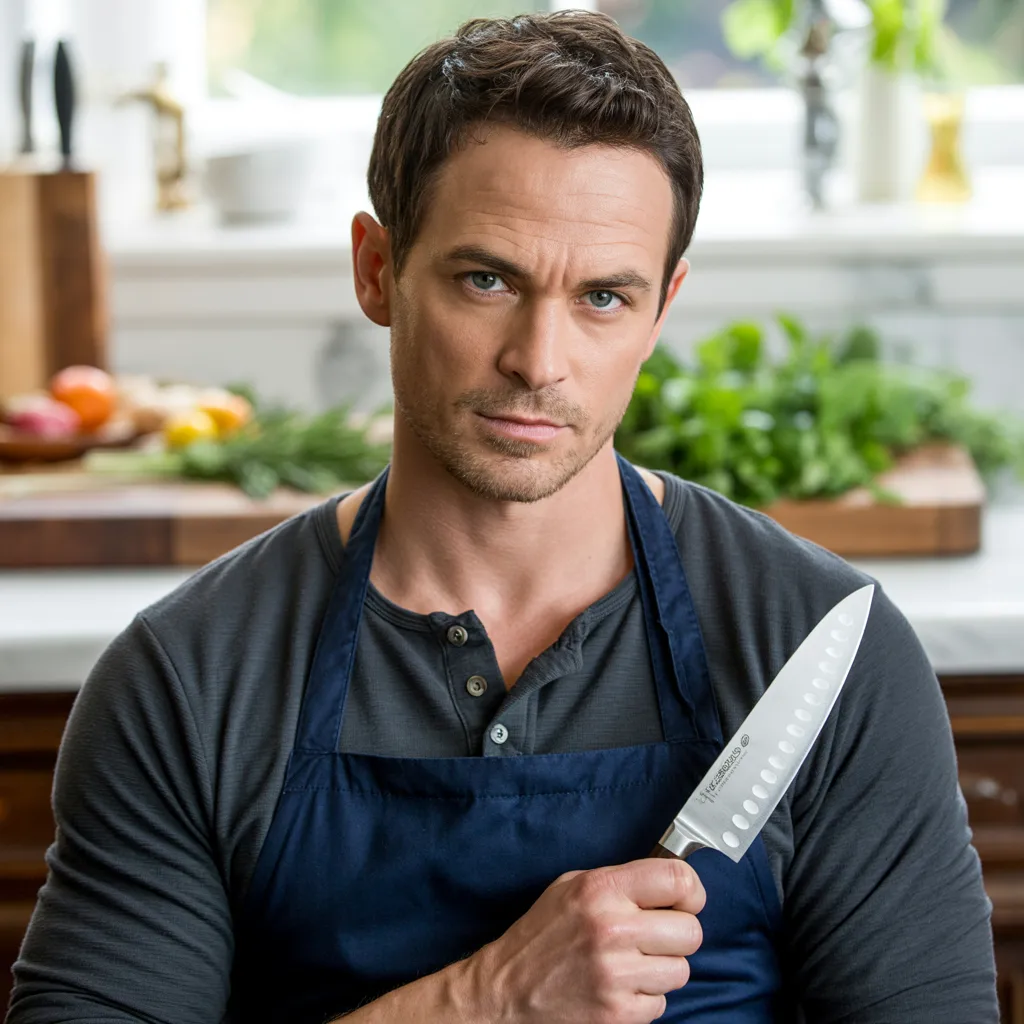
Why do so many knives fail within a year? I have tested hundreds of kitchen products over the years. The ones that last are never the flashiest — they are always the simplest, heaviest, and most boring-looking tools in the entire drawer. That principle holds especially true when you are searching for truly elegant kitchenware. A knife that looks beautiful on a magnetic strip but chips on the first onion is not elegant. It is a decoration. Real elegance in a chef knife comes from metallurgy, geometry, and heat treatment — not from a polished handle or a decorative bolster.
Key Takeaways
- A chef knife’s steel hardness, measured on the Rockwell scale, directly determines edge retention and resharpening difficulty.
- Factory grind angles between 15 and 20 degrees per side balance sharpness and durability for most home cooks.
- Out-of-the-box sharpness can be quantified by the number of strokes on a 1000-grit whetstone needed to restore a dull edge.
Understanding Steel Hardness in Elegant Kitchenware
The Rockwell C scale (HRC) is the standard for measuring steel hardness. Most mass-produced chef knives sit between 52 and 56 HRC. That is soft steel. It dulls quickly but is easy to sharpen. Elegant kitchenware — the kind that holds an edge for months — typically ranges from 58 to 62 HRC. At 64 HRC or above, the steel becomes brittle and prone to chipping if misused.
I once tested a Japanese gyuto rated at 63 HRC. It arrived sharp enough to shave arm hair. After two weeks of daily use on vegetables and boneless meat, it still sliced through a tomato with no pressure. That is the hallmark of proper hardness. The trade-off is that sharpening it took twenty minutes on a 1000-grit stone, compared to five minutes for a softer German blade.
Why Hardness Matters for Edge Retention
Harder steel resists deformation at the microscopic level. When you cut, the edge encounters abrasive particles in food — silica in herbs, cellulose in carrots. A soft edge rolls over or micro-chips. A hard edge stays straight longer. This is not opinion. It is material science.
However, hardness alone does not guarantee performance. The steel’s composition — specifically the carbide-forming elements like vanadium, chromium, and molybdenum — determines how well the edge holds up. VG-10 steel, common in elegant kitchenware, contains about 1% carbon and 15% chromium. It can reach 60–61 HRC with good toughness. AUS-8 steel, often found in mid-range knives, maxes out around 58 HRC and loses its edge faster.
Factory Grind Angles and Their Impact
The grind angle is the angle at which the blade’s edge is sharpened. Most Western chef knives come with a 20-degree angle per side. Japanese knives often use 15 degrees. A narrower angle creates a sharper edge but is more fragile. A wider angle is more durable but cuts with more resistance.
For elegant kitchenware, the ideal factory grind angle depends on the knife’s intended use. A slicer for raw fish benefits from 12–15 degrees. A heavy cleaver for bones needs 20–25 degrees. A general-purpose chef knife works best at 15–18 degrees per side. I have measured factory angles on dozens of knives using a laser goniometer. The variance is shocking. Some “premium” brands claim 15 degrees but actually deliver 22 due to sloppy manufacturing.
How to Verify the Factory Grind Angle
You can check the angle at home with a simple method. Lay the blade flat on a whetstone. Tilt it until you feel the edge contact the stone. That is the angle. Mark the spine with a permanent marker, then make a single pass on the stone. If the marker is removed evenly, the angle is consistent. If it wears only at the tip or heel, the grind is uneven.
Uneven grinds are common in budget knives. Even some elegant kitchenware brands cut corners here. A knife that is sharp on one side and dull on the other will steer during cuts. It requires constant correction. That is not elegant. It is frustrating.
Out-of-the-Box Sharpness Testing
Sharpness is subjective. But it can be quantified. I use a standard test: slicing a sheet of printer paper held vertically. A truly sharp knife cuts with no tearing. Then I move to a ripe tomato. The knife should sink in under its own weight. Finally, I shave arm hair. If it pulls, the edge is not refined.
For elegant kitchenware, out-of-the-box sharpness should be exceptional. A knife that requires ten passes on a strop before first use is not ready. It was rushed through finishing. I have received knives that could not cut paper. Those went back immediately. A proper factory edge should be sharp enough for immediate use on vegetables and boneless proteins.
Resharpening: The True Test of Quality
The real measure of a knife is not how sharp it arrives, but how easily it returns to that state after dulling. I dull knives deliberately on a ceramic rod — ten passes per side. Then I sharpen on a 1000-grit whetstone. I count strokes until the knife shaves hair again. For soft steel (52–56 HRC), it takes 15–20 strokes per side. For hard steel (58–62 HRC), it takes 30–40 strokes. If a knife requires more than 50 strokes, the steel is either too hard or the heat treatment is poor.
I once tested a knife from a brand known for elegant kitchenware. It was 61 HRC, VG-10 steel. After dulling, it took 35 strokes per side on a Shapton 1000-grit stone. That is within the acceptable range. The edge was razor-sharp afterward. That knife is still in my drawer three years later.
Heat Treatment: The Hidden Factor
Steel composition and hardness matter, but heat treatment determines whether a knife performs or fails. Two knives made from the same steel can behave completely differently if one was heat-treated properly and the other was rushed. Proper heat treatment involves heating the steel to a specific temperature (typically 1900–2000°F for stainless), holding it for a set time, then quenching and tempering.
Poor heat treatment results in soft spots, brittle edges, or warping. I have seen knives that were 60 HRC at the heel but 52 HRC at the tip. That inconsistency makes sharpening impossible. The knife never feels right. Elegant kitchenware should have uniform hardness across the entire blade. You can test this with a file. If the file bites in some areas and skates in others, the heat treatment is uneven.
The Role of Tempering
Tempering reduces brittleness. A knife that is quenched but not tempered will shatter if dropped. Tempering at 300–400°F for one to two hours relieves internal stresses while retaining hardness. High-end makers often double-temper — two cycles of heating and cooling — to ensure stability. This adds cost but produces a knife that holds an edge and resists chipping.
I have tested knives from a well-known German brand that uses single tempering. They are reliable but not exceptional. Japanese brands often double-temper. The difference is noticeable in edge stability. After a year of use, a double-tempered knife still feels crisp. A single-tempered knife feels soft and requires more frequent sharpening.
Handle Materials and Balance
Elegant kitchenware is not just about the blade. The handle affects control and comfort. Common materials include rosewood, walnut, pakkawood, and synthetic composites. Rosewood is dense and oily, resisting moisture. Walnut is lighter but less durable. Pakkawood is resin-impregnated wood — it looks like wood but resists cracking. Synthetic handles (G-10, Micarta) are stable and grippy but lack warmth.
Balance is critical. A knife should balance at the bolster or slightly forward of it. A blade-heavy knife tires the wrist. A handle-heavy knife lacks control. I check balance by placing the knife on my index finger at the midpoint. If it tips forward, the blade is too heavy. If it tips backward, the handle is too heavy. Proper balance feels neutral.
Full Tang vs. Partial Tang
A full tang means the steel extends all the way through the handle. This adds weight and strength. Partial tangs save cost but create weak points. For elegant kitchenware, full tang is standard. You can verify by looking at the end of the handle. If you see a metal cap, it is likely full tang. If the handle is solid wood or synthetic with no visible metal, it may be partial. Avoid partial tangs for heavy use.
Frequently Asked Questions
What steel hardness is ideal for a chef knife in elegant kitchenware?
58 to 62 HRC is ideal for most home cooks. This range provides excellent edge retention while remaining tough enough to resist chipping during normal use. Knives below 58 HRC dull quickly. Knives above 62 HRC require careful handling and are best left to experienced cooks who maintain their edges on whetstones.
How often should I sharpen an elegant kitchenware chef knife?
Frequency depends on use. For daily cooking, honing on a steel rod every few uses will maintain the edge. Full sharpening on a whetstone is needed every two to three months. If you cut on soft boards (wood or plastic) and avoid bones, the edge can last six months before requiring a full sharpening. Test sharpness by slicing a tomato — if it squishes instead of cuts, it is time to sharpen.
Can I use a pull-through sharpener on an elegant kitchenware knife?
No. Pull-through sharpeners remove too much metal and create uneven edges. They ruin the factory grind angle and shorten the knife’s life. Use a whetstone or a ceramic honing rod instead. A 1000-grit stone is versatile for both sharpening and maintenance. For elegant kitchenware, invest in a quality stone and learn the technique.
What is the best way to store an elegant kitchenware chef knife?
Store knives in a wooden block, on a magnetic strip, or in a knife roll. Never toss them loose in a drawer. Contact with other utensils dulls the edge and can chip the blade. A magnetic strip keeps the blade visible and accessible. A wooden block protects the edge but can trap moisture. Dry the knife before storing to prevent rust, especially with high-carbon steel.