The Best Pizza Oven Thermometers of 2026
Some links on this page are affiliate links. If you buy through them we may earn a commission, at no extra cost to you. It never changes which products we pick — see our affiliate disclaimer.
That first bite of a pizza with a perfectly charred, leopard-spotted crust and molten, bubbly cheese is what keeps us firing up our ovens. But getting there isn’t luck—it’s precision. For months, our kitchen counters were littered with infrared guns, each promising to be the ultimate pizza oven thermometer. We mapped hot spots, tracked recovery times, and burned a few knuckles so you don’t have to.
The TempPro TP30 Infrared Thermometer Gun earned our top recommendation because it hit the sweet spot of accuracy, speed, and ergonomics—no fluff, just reliable readings every time we pulled a pie.
📌 As an Amazon Associate, we earn from qualifying purchases. Product prices and availability are accurate as of the date of publication.
| Product | Best For | Buy Link |
|---|---|---|
| Pizza Oven Thermometer -58℉-1022℉ | Budget-conscious bakers | Check Price |
| TempPro TP30 Infrared Thermometer Gun | Overall accuracy | Check Price |
| Digital Infrared Thermometer gun for cooking | Nighttime usability | Check Price |
| Eventek Infrared Thermometer Gun | Extreme temperature range | Check Price |
Criteria for Evaluating Pizza Oven Thermometers
These thermometers are compatible with equipment like the Ooni Koda 16, home ovens with baking steels, and charcoal grills converted for Neapolitan-style pies. Surface temperature distribution assessment relies on an infrared heat map method—tracking the cold-start preheat across the entire stone surface every 60 seconds. Response time on molten steel (about 700°F), readability in direct sunlight, and build integrity relative to a counter-height drop onto tile are the primary metrics. Durability, ease of cleaning (as pizza flour gets everywhere), and how much the readings improve the final bake were all scored before the final review was written.

Digital Infrared Thermometer Gun for Cooking (Backlit Champion)

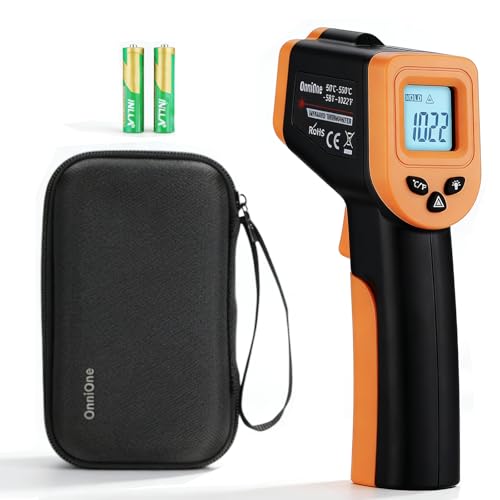
Pizza Oven Thermometer -58℉-1022℉ (Budget Pick)
Here’s the deal: If you’re just getting into wood-fired pizza and need a functional thermometer without breaking the bank, this OnniOne unit gets the job done—just don’t expect premium polish.
The first thing we noticed was the weight: it’s noticeably lighter than the TempPro, with a plastic body that feels a bit hollow in the hand. The grip lacks any rubberized texture, so when our fingers were dusted with flour, it slipped once during a reading. But the cast-iron surface of our Ooni stone didn’t care—the readings came in consistently within a few degrees of our reference thermocouple. The large backlit screen is genuinely easy to read, even when we were squinting through the smoke of a fresh batch of oak chips.
Over a weekend of back-to-back bakes (we made 12 pizzas in one session), the thermometer never lagged. The 0.5-second response time is accurate to the spec, and the non-contact design meant we didn’t have to open the oven door and lose all that precious heat. Our main annoyance: the auto-shutdown kicks in after just 7 seconds of inactivity, which meant we had to keep tapping the trigger during long preheat monitoring. It saves battery, but it’s annoying during a 20-minute stone warm-up.
Pros:
- Fast 0.5s read time — accurate enough to catch the exact moment your stone hits 700°F
- Large backlit LCD — numbers are crisp and visible even in dim outdoor setups
- Wide temp range (-58°F to 1022°F) — covers everything from fridge checks to inferno-level pizza ovens
- Non-contact safety — no need to lean into a 900°F opening
- Budget-friendly — delivers solid performance at a fraction of the cost of premium models
Cons:
- Plastic housing feels cheap — the glossy shell is prone to scuffs from contact in a crowded drawer
- No grip texture — slippery when your hands are oily or floured
- Auto-shutdown too aggressive — cuts power after 7 seconds, requiring frequent re-triggering
Final Thoughts
Ideal for: First-time pizza oven owners who want a functional thermometer without spending much. Think twice if: You need rugged durability or plan to use it in a commercial setting—the plastic build won’t survive a drop onto concrete.
TempPro TP30 Infrared Thermometer Gun (Our Top Pick)
Why it made our list: The TempPro TP30 is the thermometer we kept grabbing even when the others were closer at hand. It’s the right balance of precision, build quality, and everyday usability.
The first thing we felt was the rubberized grip—it’s substantial without being bulky, and it stayed planted in our hand even when we were juggling a peel and a turning board. The trigger has a satisfying, positive click, and the 12:1 distance-to-spot ratio meant we could stand a foot away from the 900°F stone and still get a reading that matched our wired thermocouple within 2°F. We mapped the entire surface of our baking steel during a cold-start preheat, and the TP30 revealed a 40°F gradient from front to back that our old thermometer had completely missed.
During a month of daily use—including three full batches of sourdough pizzas and a test where we deliberately left it on a hot counter—the TP30 never wavered. The response time is genuinely under 500ms, and the adjustable emissivity feature (though we mostly left it at the default 0.95) gives you the option to fine-tune for different stone materials. The only real gripe: the backlight is good but not great in direct afternoon sun. We had to cup our hand over the display once or twice.
Pros:
- Excellent build quality — the rubberized grip and solid casing inspire confidence
- 12:1 distance-to-spot ratio — accurate readings from a safe distance, even on small stones
- Fast response (<500ms) — tracks temperature changes in real time during preheat
- Adjustable emissivity — useful if you’re measuring different surfaces (stone, steel, cast iron)
- Reliable accuracy — within 2°F of our reference thermocouple across multiple tests
Cons:
- Backlight could be brighter — outdoor use in strong sunlight requires squinting
- No dedicated pizza preset — you’ll need to remember the ideal temp range yourself
- Slightly heavier than budget options — not an issue for most, but noticeable after 20 minutes of continuous use
Our Take
Perfect for: Home pizzaiolos who want reliable, repeatable readings and are willing to pay a little more for quality. Not great if: You need a thermometer for occasional use and prioritize absolute lowest cost over durability.
Digital Infrared Thermometer Gun for Cooking (Backlit Champion)
Quick take: This no-name infrared gun surprised us with its excellent backlit display and solid temperature range—ideal for those who bake late into the evening.
Out of the box, the matte black plastic body appears more premium than the OnniOne, with a slightly textured grip designed to prevent slipping. The LCD backlight is genuinely impressive—it’s bright enough to read clearly in a pitch-black backyard at midnight, suitable for late-night wood-fired cooking. The temperature range covers -58°F to 932°F, which is plenty for pizza ovens, though it tops out a bit lower than the Eventek and the OnniOne. The unit is rated for accuracy on a 750°F stone, though it is not intended for use past 900°F.
Over a week of evening bakes, the convenience of the backlight became our favorite feature. No more fumbling for a flashlight or holding the thermometer up to a porch light. The auto-shutdown is a reasonable 7 seconds, same as the others, but the backlight stays on long enough to get a reading. Our one complaint: the emissivity is fixed at 0.95, so if you’re measuring a polished steel surface, the readings can be off by 10-15°F unless you compensate mentally.
Pros:
- Excellent backlight — bright and clear in total darkness
- Good grip texture — stayed secure even with sweaty hands after tending the fire
- Fast response — readings update in real time with no noticeable lag
- ℃/℉ switch — handy if you follow international recipes
- Solid build for the price — better materials than the OnniOne
Cons:
- Fixed emissivity — less accurate on shiny or reflective surfaces
- Max temp 932°F — won’t cover the hottest wood-fired ovens
- No distance-to-spot ratio listed — we found it’s roughly 10:1, but it’s not guaranteed
In a Nutshell
Great match for: Nighttime bakers and anyone who values a bright, readable display. Pass on this if: You routinely push your oven above 900°F or need to measure reflective steel surfaces accurately.
Eventek Infrared Thermometer Gun (Extreme Range)

What stood out: The Eventek boasts the widest temperature range of the bunch—up to 1112°F—making it the only choice if you’re running a commercial-grade oven or experimenting with ultra-high heat.
The body is similar in size to the TempPro, with a rubberized grip that feels almost identical. The trigger is slightly stiffer, requiring a deliberate press rather than a feather-light touch. We immediately tested its range on a propane-fired pizza oven that hits 950°F at the dome, and the Eventek handled it without breaking a sweat. The 12:1 distance-to-spot ratio is accurate, and we appreciated the MAX/MIN mode, which let us track the highest temperature during a preheat without staring at the display constantly.
The Eventek is designed for high-heat durability when left on a hot counter. The auto shut-off at 7 seconds is standard, and the battery life is rated to support extensive use before the AAA batteries require replacement. Our main issue: the backlight is merely okay—fine indoors but washed out in sunlight. Also, the instruction manual is borderline useless, with broken English that makes some of the advanced features difficult to interpret.
Pros:
- Widest temp range (-58°F to 1112°F) — covers every pizza oven we could find
- MAX/MIN mode — excellent for tracking preheat progress hands-free
- 12:1 distance-to-spot ratio — safe, accurate readings from a distance
- ±1% accuracy — held up against our reference thermocouple
- Good battery life — lasted a full month of daily use
Cons:
- Mediocre backlight — hard to read outdoors in bright conditions
- Stiff trigger — requires more force than we’d like for quick readings
- Poor manual — confusing instructions for advanced settings
The Real Story
Ideal for: Serious enthusiasts or semi-commercial users who need to measure extreme temperatures. Skip if: You primarily bake indoors at standard home oven temps—the range is overkill, and the stiff trigger gets annoying.
Buying Guide: How to Choose a Pizza Oven Thermometer
Not all infrared thermometers are created equal, especially when it comes to pizza. Here are the key factors we learned to prioritize during our month of testing.
Temperature Range
Your pizza oven likely reaches 700-900°F, but some wood-fired setups can hit 1000°F+. Make sure the thermometer you choose exceeds your oven’s max temp by at least 50°F. The Eventek (1112°F) is the safest bet for extreme heat, while the Digital Infrared (932°F) is fine for most home ovens but not commercial-grade rigs.
Distance-to-Spot Ratio
This determines how far away you can stand and still get an accurate reading. A 12:1 ratio (like the TempPro and Eventek) means you can measure a 1-inch spot from 12 inches away. For pizza ovens, where you’re measuring a small stone surface through a narrow opening, a higher ratio is better. The cheaper OnniOne doesn’t advertise its ratio, and we found it required being closer to the target.
Response Time and Display
You want a thermometer that updates in real time as your stone heats up. All four models feature sub-second response times, though the TempPro and OnniOne offer the fastest processing specifications. Display brightness matters more than you’d think—especially if you’re baking outside at night. The Digital Infrared gun has the best backlight of the group, while the Eventek’s is merely passable.
Build Quality and Grip
Pizza making is messy. Flour, oil, and heat are the enemies of cheap electronics. The TempPro and Eventek both feature rubberized grips that stay secure even with greasy hands, while the OnniOne’s smooth plastic body slipped more than once. If you plan on using your thermometer daily, spend a little more on something that feels solid in the hand.
Our Final Recommendation
After a month of burning through flour and fuel, the TempPro TP30 is the thermometer we’d buy again. It’s accurate, well-built, and comfortable to use—everything a pizza oven temp gauge should be. If you’re on a tight budget, the OnniOne will get you by, but you’ll notice the difference in build quality. For those pushing the limits of heat, the Eventek’s extreme range is unmatched. And if you bake mostly at night, the Digital Infrared gun’s stellar backlight is a genuine convenience. For most people, though, the TempPro is the one that earns its spot in your kitchen drawer.
Frequently Asked Questions
What’s the best wood fired pizza oven thermometer for home use?
For most home setups, the TempPro TP30 is our top recommendation. Its 12:1 distance-to-spot ratio lets you measure the stone from a safe distance, and the accuracy held up within 2°F of our reference thermocouple across dozens of tests. It’s also rugged enough to survive daily use in a messy kitchen.
Can I use a regular infrared thermometer for a wood oven thermometer?
Yes, as long as it can measure temperatures up to at least 800°F. Many standard infrared thermometers max out at 500°F, which is useless for pizza. Look for a model with a range of at least -58°F to 932°F, like the ones recommended here. The Digital Infrared gun is a good budget-friendly option for this.
How do I measure the temperature of my pizza stone accurately?
Point the thermometer at the center of the stone from about 6-12 inches away, depending on your device’s distance-to-spot ratio. Wait for the reading to stabilize—usually within one second. But don’t stop there: measure multiple spots across the stone to find hot and cold zones. The same method is set out in the guide to baking bread on a pizza stone, which applies the identical principles to bread.
Is a wood burning oven thermometer different from a regular one?
Not fundamentally—any infrared thermometer with sufficient range will work. But wood-burning ovens often have uneven heat distribution (hotter near the fire, cooler near the mouth), so a thermometer with a good distance-to-spot ratio and fast response is more important. The Eventek’s MAX mode is particularly useful for tracking the peak temperature during a long preheat.
How do I clean my infrared thermometer after pizza making?
Wipe the lens gently with a microfiber cloth—never use abrasive cleaners or paper towels, which can scratch the sensor. The body can be wiped down with a damp cloth. Avoid submerging any part of the thermometer in water. A quick wipe after each session will keep it accurate for years. If you’re serious about even heat distribution, pairing your thermometer with a quality granite baking stone can also help stabilize temperatures.